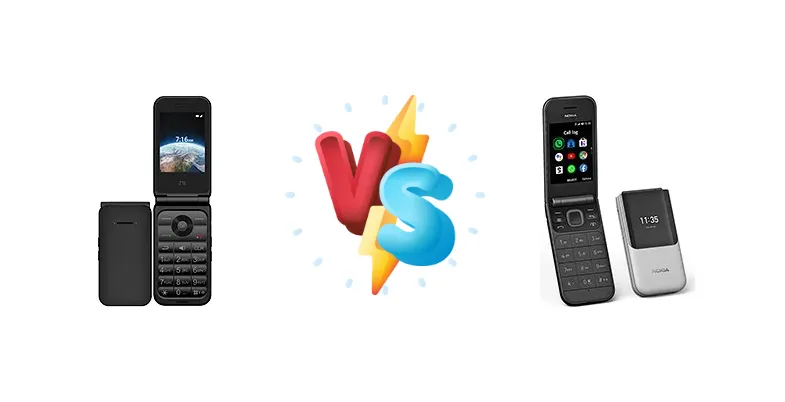
The ZTE Cymbal U and Nokia 2720 Flip represent the absolute bottom end of the smartphone market, catering to users prioritizing affordability above all else. While both offer basic connectivity, their internal hardware differs significantly, impacting performance and usability. This comparison dissects those differences to help you choose the best option for your needs.
🏆 Quick Verdict
For the average user needing a functional, albeit basic, smartphone experience, the ZTE Cymbal U emerges as the better choice. Its quad-core Cortex-A53 processor and Snapdragon 215 chipset provide a noticeable performance advantage over the Nokia 2720 Flip’s dual-core Cortex-A7 and Snapdragon 205, making it more responsive for everyday tasks.
| Network |
|---|
| 2G bands | GSM 850 / 1900 | GSM 850 / 900 / 1800 / 1900 |
| 3G bands | HSDPA 850 / 1700(AWS) / 1900 | HSDPA 850 / 900 / 2100 |
| 4G bands | 2, 4, 5, 12, 41, 66, 71 | 1, 3, 5, 7, 8, 20 - EU |
| Speed | HSPA, LTE Cat4 150/50 Mbps | HSPA 42.2/5.76 Mbps, LTE Cat4 150/50 Mbps |
| Technology | GSM / HSPA / LTE | GSM / HSPA / LTE |
| | - | 1, 3, 5, 7, 8, 20, 28, 38, 39, 40, 41 - MENA, APAC, GCR |
| Launch |
|---|
| Announced | 2021, January | 2019, September 05. Released 2019, September 05 |
| Status | Available. Released 2021, January | Discontinued |
| Body |
|---|
| Dimensions | 109.2 x 55.9 x 19.5 mm (4.30 x 2.20 x 0.77 in) | 192.7 x 54.5 x 11.6 mm (7.59 x 2.15 x 0.46 in) |
| SIM | Nano-SIM | · Nano-SIM· Nano-SIM + Nano-SIM |
| Weight | - | 118 g (4.16 oz) |
| Display |
|---|
| Resolution | 240 x 320 pixels, 4:3 ratio (~143 ppi density) | 240 x 320 pixels, 4:3 ratio (~143 ppi density) |
| Size | 2.8 inches, 24.3 cm2 (~39.8% screen-to-body ratio) | 2.8 inches, 24.3 cm2 (~23.1% screen-to-body ratio) |
| Type | TFT LCD | TFT LCD, 256K colors |
| | Cover display:
TFT LCD, 1.70 inches | Second external TFT display, 240 x 240 pixels, 1.3 inches |
| Platform |
|---|
| CPU | Quad-core 1.3 GHz Cortex-A53 | Dual-core (2x1.1 GHz Cortex-A7) |
| Chipset | Qualcomm QM215 Snapdragon 215 (28 nm) | Qualcomm MSM8905 Snapdragon 205 (28 nm) |
| GPU | Adreno 308 | Adreno 304 |
| OS | Proprietary | KaiOS 2.5.2 |
| Memory |
|---|
| Card slot | microSDHC (dedicated slot) | microSDHC (dedicated slot) |
| Internal | 8GB 1GB RAM | 4GB 512MB |
| | - | eMMC 4.5 |
| Main Camera |
|---|
| Features | - | LED flash |
| Single | 2 MP | 2 MP |
| Video | 720p@30fps | Yes |
| Sound |
|---|
| 3.5mm jack | Yes | Yes |
| 35mm jack | Yes | Yes |
| Loudspeaker | Yes | Yes |
| Comms |
|---|
| Bluetooth | 4.2, A2DP | 4.2, A2DP, LE |
| NFC | No | No |
| Positioning | GPS | GPS, GLONASS |
| Radio | FM Radio | FM radio |
| USB | microUSB 2.0 | microUSB 2.0 |
| WLAN | Wi-Fi 802.11 b/g/n, hotspot | Wi-Fi 802.11 b/g/n, hotspot |
| Features |
|---|
| | - | SNS applications
MP4/H.264 player
MP3/WAV/AAC player
Organizer
Voice memo
Predictive text input |
| Battery |
|---|
| Stand-by | - | Up to 700 h (3G) |
| Type | Li-Ion 1600 mAh, removable | Li-Ion 1500 mAh, removable |
| Misc |
|---|
| Colors | Black | Black, Gray, Red |
| Models | - | TA-1175, TA-1173, TA-1170, TA-1168 |
| Price | About 70 EUR | About 140 EUR |
| SAR | - | 0.87 W/kg (head) 1.10 W/kg (body) |
| SAR EU | - | 1.03 W/kg (head) 1.69 W/kg (body) |
ZTE Cymbal U
- Faster processor for smoother performance
- More efficient chipset for potentially better battery life
- Likely larger display for better media viewing
- May be less durable than a flip phone
- Potentially higher price point (though still very affordable)
Nokia 2720 Flip
- Classic flip phone form factor for durability and portability
- Simpler user interface for less tech-savvy users
- Potentially longer standby time due to flip design
- Significantly slower processor
- Less responsive user experience
- Smaller display
Display Comparison
Neither device boasts a standout display. Given the context focuses on the chipset, we can infer both likely utilize low-resolution LCD panels. The Nokia 2720 Flip’s flip design offers some protection, but likely uses a smaller internal screen. The ZTE Cymbal U, being a standard smartphone form factor, likely has a larger display, offering a better viewing experience for media consumption, even if the resolution remains modest. Color accuracy and brightness are expected to be similar, leaning towards basic functionality rather than visual fidelity.
Camera Comparison
Camera performance on both devices is expected to be minimal. Given the target market, both likely feature low-resolution sensors. Without specific sensor details, it’s safe to assume image quality will be subpar in anything other than ideal lighting conditions. The focus should not be on photography, but rather on basic image capture for documentation purposes. Any claims of advanced features like HDR or portrait mode should be viewed with skepticism.
Performance
The core difference lies in the processors. The ZTE Cymbal U’s Qualcomm QM215 Snapdragon 215, featuring a quad-core 1.3 GHz Cortex-A53 CPU, demonstrably outperforms the Nokia 2720 Flip’s Qualcomm MSM8905 Snapdragon 205 with its dual-core 1.1 GHz Cortex-A7 CPU. The Cortex-A53 architecture is more efficient and capable than the older Cortex-A7. While both chipsets are built on a 28nm process, the additional cores and architectural improvements in the Snapdragon 215 translate to smoother multitasking and faster app loading times. This difference is particularly noticeable when running even moderately demanding applications.
Battery Life
Battery life is a complex equation. While the Nokia 2720 Flip’s flip phone design may encourage less screen-on time, the less efficient Snapdragon 205 could negate some of that advantage. The ZTE Cymbal U, despite its more powerful processor, benefits from the Snapdragon 215’s improved power efficiency. Actual battery life will depend heavily on usage patterns, but the ZTE Cymbal U is likely to offer comparable, if not slightly better, endurance due to its more modern chipset.
Buying Guide
Buy the ZTE Cymbal U if you need a smartphone capable of handling basic apps, light web browsing, and occasional social media use without significant lag. It’s ideal for first-time smartphone users or those needing a reliable backup device. Buy the Nokia 2720 Flip if you prioritize simplicity and extended battery life over performance, and appreciate the classic flip phone form factor for its durability and ease of use.
Frequently Asked Questions
❓ Will the ZTE Cymbal U handle basic social media apps like Facebook and WhatsApp without significant lag?
Yes, the quad-core Cortex-A53 processor and Snapdragon 215 chipset in the ZTE Cymbal U are sufficient to run basic social media apps like Facebook and WhatsApp, though multitasking with several apps open simultaneously may still result in some slowdown. It's a noticeable improvement over the Nokia 2720 Flip in this regard.
❓ Is the Nokia 2720 Flip a good option for someone who primarily needs a phone for making calls and sending texts?
Absolutely. The Nokia 2720 Flip excels as a basic communication device. Its flip phone design offers durability and simplicity, and the Snapdragon 205 is adequate for core phone functions like calls and texts. The long standby time is also a benefit for users who don't frequently use their phone.
❓ Can either of these phones run modern mobile games?
No. Neither the Snapdragon 215 nor the Snapdragon 205 are capable of running modern, graphically demanding mobile games. They may be able to handle very simple, older games, but the experience will likely be far from optimal.
❓ What type of charging port do these phones use?
Given the age and price point of these devices, both are likely to use a Micro-USB port for charging. Neither supports USB-C or wireless charging.