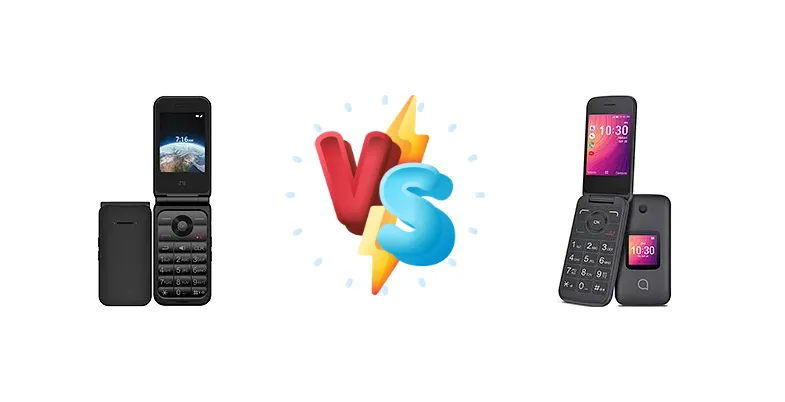
In the dwindling market for basic flip phones, the ZTE Cymbal U and alcatel Go Flip 3 represent two of the most readily available options. Both target users prioritizing simplicity and affordability, but subtle differences in their underlying hardware – specifically the Qualcomm chipsets – can impact real-world performance. This comparison dives deep into those differences to help you choose the best option for your needs.
🏆 Quick Verdict
For the average user seeking a functional and reliable flip phone, the ZTE Cymbal U edges out the alcatel Go Flip 3. Its slightly faster 1.3 GHz quad-core Cortex-A53 processor, powered by the Snapdragon 215, offers a marginal but noticeable performance advantage over the Go Flip 3’s 1.1 GHz Cortex-A7 and Snapdragon 210, making it better suited for basic multitasking.
| Network |
|---|
| 2G bands | GSM 850 / 1900 | GSM 850 / 900 / 1800 / 1900 |
| 3G bands | HSDPA 850 / 1700(AWS) / 1900 | HSDPA 850 / 1700(AWS) / 1900 |
| 4G bands | 2, 4, 5, 12, 41, 66, 71 | 2, 4, 5, 12, 25, 26, 41, 66, 71 |
| Speed | HSPA, LTE Cat4 150/50 Mbps | HSPA, LTE |
| Technology | GSM / HSPA / LTE | GSM / CDMA / HSPA / LTE |
| | - | CDMA 800 / 1900 |
| Launch |
|---|
| Announced | 2021, January | 2019, September 19. Released 2019, September 19 |
| Status | Available. Released 2021, January | Discontinued |
| Body |
|---|
| Dimensions | 109.2 x 55.9 x 19.5 mm (4.30 x 2.20 x 0.77 in) | 104.9 x 53.1 x 20.1 mm (4.13 x 2.09 x 0.79 in) |
| SIM | Nano-SIM | Nano-SIM |
| Weight | - | 118 g (4.16 oz) |
| Display |
|---|
| Resolution | 240 x 320 pixels, 4:3 ratio (~143 ppi density) | 240 x 320 pixels, 4:3 ratio (~143 ppi density) |
| Size | 2.8 inches, 24.3 cm2 (~39.8% screen-to-body ratio) | 2.8 inches, 24.3 cm2 (~43.6% screen-to-body ratio) |
| Type | TFT LCD | TN TFT LCD |
| | Cover display:
TFT LCD, 1.70 inches | Second external TN TFT display, 1.44 inches, 128 x 128 pixels |
| Platform |
|---|
| CPU | Quad-core 1.3 GHz Cortex-A53 | Quad-core 1.1 GHz Cortex-A7 |
| Chipset | Qualcomm QM215 Snapdragon 215 (28 nm) | Qualcomm MSM8909 Snapdragon 210 (28 nm) |
| GPU | Adreno 308 | Adreno 304 |
| OS | Proprietary | KaiOS 2.5.2 |
| Memory |
|---|
| Card slot | microSDHC (dedicated slot) | microSDHC (dedicated slot) |
| Internal | 8GB 1GB RAM | 4GB 512MB RAM |
| Main Camera |
|---|
| Single | 2 MP | 2 MP |
| Video | 720p@30fps | 720p@30fps |
| Sound |
|---|
| 3.5mm jack | Yes | Yes |
| 35mm jack | Yes | Yes |
| Loudspeaker | Yes | Yes |
| Comms |
|---|
| Bluetooth | 4.2, A2DP | 4.2, A2DP |
| NFC | No | No |
| Positioning | GPS | No |
| Radio | FM Radio | FM radio |
| USB | microUSB 2.0 | microUSB 2.0 |
| WLAN | Wi-Fi 802.11 b/g/n, hotspot | Wi-Fi 802.11 b/g/n, hotspot |
| Battery |
|---|
| Type | Li-Ion 1600 mAh, removable | Li-Ion 1350 mAh, removable |
| Misc |
|---|
| Colors | Black | Prime Black |
| Price | About 70 EUR | About 80 EUR |
| SAR | - | 1.28 W/kg (head) 1.16 W/kg (body) |
ZTE Cymbal U
- Slightly faster processor (Snapdragon 215)
- More modern CPU architecture (Cortex-A53)
- Potentially smoother multitasking
- Likely similar camera performance to the Go Flip 3
- Still an entry-level device with limited capabilities
alcatel Go Flip 3
- Potentially lower price point
- Simple and easy to use interface
- Reliable for basic calls and texts
- Slower processor (Snapdragon 210)
- Older CPU architecture (Cortex-A7)
- May struggle with even moderate multitasking
Display Comparison
Neither device boasts a particularly impressive display. Given their target market, both likely utilize basic TFT LCD panels. Detailed specifications regarding resolution, brightness, and color accuracy are unavailable, but we can assume both prioritize power efficiency over visual fidelity. Bezels are expected to be substantial on both models, consistent with the flip phone form factor. The focus here isn't on visual experience, but on readability in various lighting conditions.
Camera Comparison
Camera performance is likely to be similar and underwhelming on both devices. Given the target market, both likely feature low-resolution sensors. Detailed sensor specifications are unavailable, but image quality will be sufficient for basic snapshots in good lighting conditions. Expect limited low-light performance and a lack of advanced features like optical image stabilization (OIS). Focusing on camera quality is not a primary consideration for these devices.
Performance
The core difference lies in the chipsets. The ZTE Cymbal U’s Qualcomm QM215 Snapdragon 215 (28nm) features a quad-core 1.3 GHz Cortex-A53 processor. The alcatel Go Flip 3 utilizes the Qualcomm MSM8909 Snapdragon 210 (28nm) with a quad-core 1.1 GHz Cortex-A7 processor. While both are entry-level, the Cortex-A53 architecture in the Cymbal U is a generation newer and generally offers better performance per clock cycle than the Cortex-A7. This translates to slightly snappier app loading and multitasking. Both chipsets are fabricated on a 28nm process, indicating similar power consumption characteristics. Neither device is expected to handle graphically intensive tasks.
Battery Life
Battery capacity details are unavailable for both devices. However, given their basic functionality and low-power chipsets, both should offer several days of standby time and a reasonable amount of talk time. Charging wattage is also unknown, but likely to be slow, utilizing micro-USB connectivity. The focus is on longevity rather than rapid charging.
Buying Guide
Buy the ZTE Cymbal U if you need a flip phone capable of handling slightly more demanding tasks, such as running a few simple apps concurrently, or if you anticipate using the phone for more than just calls and texts. Buy the alcatel Go Flip 3 if you prioritize absolute simplicity and are primarily looking for a device for voice calls and basic texting, and want to potentially save a few dollars.
Frequently Asked Questions
❓ Will the ZTE Cymbal U handle apps like WhatsApp or Facebook Messenger without significant lag?
While the Cymbal U's Snapdragon 215 is slightly more capable, running apps like WhatsApp or Facebook Messenger will still be a compromised experience. Expect slow loading times and potential lag, especially when multitasking. These apps are designed for more powerful hardware.
❓ Is the difference in processor speed between the Snapdragon 215 and 210 noticeable in everyday use?
The difference is subtle but present. For basic tasks like making calls and sending texts, it's unlikely to be noticeable. However, when opening apps or switching between them, the Cymbal U with the Snapdragon 215 should feel slightly more responsive.
❓ Do either of these phones support 4G LTE for faster data speeds?
While official specifications are limited, both the Snapdragon 215 and 210 support 4G LTE connectivity. This means you should be able to access faster data speeds where available, provided your carrier supports it.