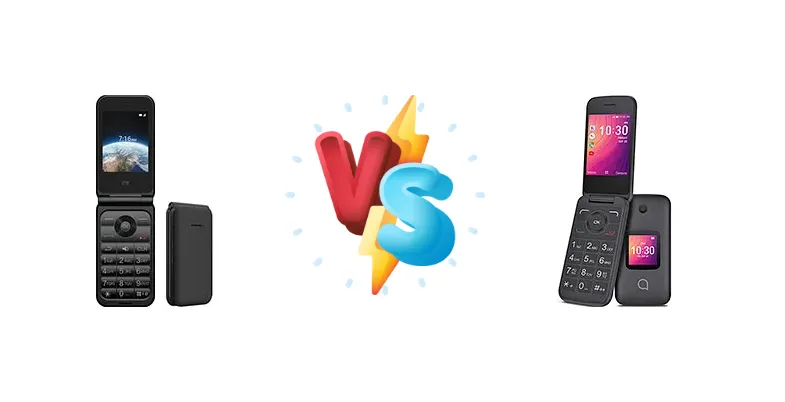
The ZTE Cymbal 2 and Alcatel Go Flip 3 represent a resurgence in basic flip phones, catering to users seeking simplicity, affordability, and long battery life. While both devices fulfill this need, they differ significantly in their underlying hardware, specifically their Qualcomm chipsets. This comparison dissects those differences to determine which phone delivers the best experience for everyday tasks.
🏆 Quick Verdict
For the average user prioritizing responsiveness in basic functions like calls and texting, the ZTE Cymbal 2 emerges as the slightly better choice. Its Qualcomm Snapdragon 215, featuring Cortex-A53 cores, offers a modest performance advantage over the Alcatel Go Flip 3’s Snapdragon 210 and Cortex-A7, translating to smoother operation.
| Network |
|---|
| 2G bands | GSM 850 / 1900 | GSM 850 / 900 / 1800 / 1900 |
| 3G bands | HSDPA 850 / 1900 | HSDPA 850 / 1700(AWS) / 1900 |
| 4G bands | 2, 4, 5, 7, 12, 13, 66 | 2, 4, 5, 12, 25, 26, 41, 66, 71 |
| Speed | HSPA, LTE | HSPA, LTE |
| Technology | GSM / HSPA / LTE | GSM / CDMA / HSPA / LTE |
| | - | CDMA 800 / 1900 |
| Launch |
|---|
| Announced | 2020, January. Released 2020, January | 2019, September 19. Released 2019, September 19 |
| Status | Discontinued | Discontinued |
| Body |
|---|
| Dimensions | 109 x 56 x 19.5 mm (4.29 x 2.20 x 0.77 in) | 104.9 x 53.1 x 20.1 mm (4.13 x 2.09 x 0.79 in) |
| SIM | Nano-SIM | Nano-SIM |
| Weight | 135 g (4.76 oz) | 118 g (4.16 oz) |
| Display |
|---|
| Resolution | 240 x 320 pixels, 4:3 ratio (~143 ppi density) | 240 x 320 pixels, 4:3 ratio (~143 ppi density) |
| Size | 2.8 inches, 24.3 cm2 (~39.8% screen-to-body ratio) | 2.8 inches, 24.3 cm2 (~43.6% screen-to-body ratio) |
| Type | TFT LCD | TN TFT LCD |
| | Cover display:
TFT LCD, 1.77 inches | Second external TN TFT display, 1.44 inches, 128 x 128 pixels |
| Platform |
|---|
| CPU | Quad-core 1.3 GHz Cortex-A53 | Quad-core 1.1 GHz Cortex-A7 |
| Chipset | Qualcomm QM215 Snapdragon 215 (28 nm) | Qualcomm MSM8909 Snapdragon 210 (28 nm) |
| GPU | Adreno 308 | Adreno 304 |
| OS | Linux 3.18.71 | KaiOS 2.5.2 |
| Memory |
|---|
| Card slot | microSDHC (dedicated slot) | microSDHC (dedicated slot) |
| Internal | 8GB 1GB RAM | 4GB 512MB RAM |
| Main Camera |
|---|
| Single | 2 MP | 2 MP |
| Video | 720p@30fps | 720p@30fps |
| Sound |
|---|
| 3.5mm jack | Yes | Yes |
| 35mm jack | Yes | Yes |
| Loudspeaker | Yes | Yes |
| Comms |
|---|
| Bluetooth | 4.2, A2DP | 4.2, A2DP |
| NFC | No | No |
| Positioning | No | No |
| Radio | No | FM radio |
| USB | microUSB 2.0 | microUSB 2.0 |
| WLAN | Wi-Fi 802.11 b/g/n, hotspot | Wi-Fi 802.11 b/g/n, hotspot |
| Features |
|---|
| Sensors | Accelerometer, proximity | - |
| Battery |
|---|
| Type | Li-Ion 1600 mAh, removable | Li-Ion 1350 mAh, removable |
| Misc |
|---|
| Colors | Black | Prime Black |
| Price | About 60 EUR | About 80 EUR |
| SAR | - | 1.28 W/kg (head) 1.16 W/kg (body) |
ZTE Cymbal 2
- Slightly faster processor (Snapdragon 215)
- More modern CPU architecture (Cortex-A53)
- Potentially smoother multitasking
- May be slightly more expensive
- Still limited performance for demanding apps
alcatel Go Flip 3
- Likely lower price point
- Simple and easy to use
- Excellent standby time
- Slower processor (Snapdragon 210)
- Older CPU architecture (Cortex-A7)
- May exhibit more lag with multiple apps
Display Comparison
Both the ZTE Cymbal 2 and Alcatel Go Flip 3 feature relatively small internal displays, likely utilizing TFT LCD technology given their price points. Specific resolution and brightness data are unavailable, but the focus isn't on media consumption. Bezels are expected to be substantial on both models, typical of this form factor. Color accuracy is unlikely to be a priority, with both displays geared towards functional readability rather than vibrant visuals.
Camera Comparison
Camera performance is not a key selling point for either device. Both likely feature basic cameras suitable for simple snapshots. Detailed sensor information is unavailable, but given the target market, image quality will be limited, especially in low-light conditions. Focusing on megapixel counts would be misleading; the image processing capabilities of the chipsets will be the primary limiting factor.
Performance
The core difference lies in the chipsets. The ZTE Cymbal 2’s Qualcomm QM215 Snapdragon 215, built on a 28nm process, utilizes four Cortex-A53 cores clocked at 1.3 GHz. This architecture, while still entry-level, is a generation newer and generally more efficient than the Alcatel Go Flip 3’s Qualcomm MSM8909 Snapdragon 210, featuring four Cortex-A7 cores at 1.1 GHz. The Cortex-A53 offers improved performance per clock cycle compared to the A7. While both are 28nm, the A53’s architecture allows for slightly better multitasking and app loading times. Neither chipset is designed for demanding applications; however, the Cymbal 2 will likely exhibit less lag when switching between the phone, contacts, and messaging apps.
Battery Life
Battery life is a significant advantage of flip phones in general. While specific mAh ratings are unavailable, both the ZTE Cymbal 2 and Alcatel Go Flip 3 are expected to offer several days of standby time and a full day of talk time. Charging wattage is likely low on both devices, meaning 0-100% charge times will be measured in hours rather than minutes. The slightly more efficient Snapdragon 215 in the Cymbal 2 *may* contribute to marginally longer battery life, but the difference will likely be minimal in real-world usage.
Buying Guide
Buy the ZTE Cymbal 2 if you need a flip phone that feels a little more responsive for navigating menus and handling occasional light app usage. Its newer chipset provides a small but noticeable edge. Buy the Alcatel Go Flip 3 if you prioritize absolute simplicity and are primarily focused on making and receiving calls, as the performance difference will be minimal for those core functions, and it may be available at a lower price point.
Frequently Asked Questions
❓ Will the ZTE Cymbal 2 handle basic apps like WhatsApp or Facebook?
The ZTE Cymbal 2 can *run* these apps, but performance will be limited. Expect slow loading times and potential lag. These apps are not optimized for such low-powered chipsets, so the experience won't be comparable to a smartphone. It's best suited for calls, texts, and simple contacts management.
❓ Is the difference in processor speed between the Snapdragon 215 and 210 noticeable in everyday use?
The difference is subtle but present. The Snapdragon 215 in the Cymbal 2 offers a slight performance boost, resulting in quicker app launches and smoother menu navigation. However, for core functions like making calls and sending texts, the difference will be minimal. The benefit is most apparent when multitasking or using slightly more demanding features.
❓ Which phone is better for someone who is not tech-savvy?
Both phones are designed for simplicity, but the Alcatel Go Flip 3's slightly less powerful processor might translate to a more straightforward experience for those unfamiliar with smartphones. Fewer features and less processing power mean fewer opportunities for confusion.