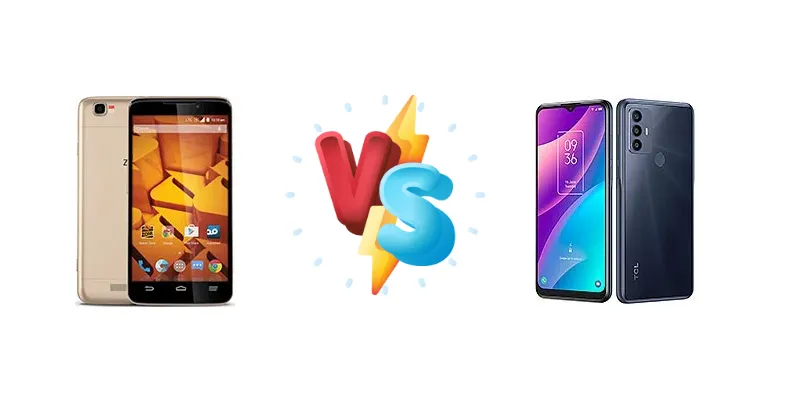
The ZTE Boost Max+ and TCL 30 SE represent the lower end of the smartphone market, targeting users prioritizing affordability. However, a price difference doesn't always equate to a performance gap. We're dissecting these two devices to determine which offers the best value for users on a tight budget, focusing on the core differences in their processing power and overall user experience.
🏆 Quick Verdict
For the average user, the TCL 30 SE emerges as the better choice. Its Mediatek Helio G25 chipset, with its octa-core configuration, provides a substantial performance uplift over the ZTE Boost Max+'s quad-core processor, translating to smoother multitasking and app loading. While both phones are entry-level, the TCL offers a more responsive experience.
| Network |
|---|
| 2G bands | GSM 850 / 900 / 1800 / 1900 | GSM 850 / 900 / 1800 / 1900 |
| 3G bands | HSDPA | HSDPA 850 / 900 / 1900 / 2100 - EMEA/APAC |
| 4G bands | LTE | 1, 3, 5, 7, 8, 20, 28, 38, 40, 41 - EMEA |
| EDGE | Yes | - |
| GPRS | Yes | - |
| Speed | HSPA, LTE | HSPA 42.2/11.5 Mbps, LTE Cat4 150/50 Mbps |
| Technology | GSM / HSPA / LTE | GSM / HSPA / LTE |
| | - | 2, 3, 4, 5, 7, 8, 12, 13, 17, 26, 28, 66 - LATAM |
| Launch |
|---|
| Announced | 2015, July. Released 2015, July | 2022, February 27 |
| Status | Discontinued | Available. Released 2022, April 20 |
| Body |
|---|
| Build | - | Glass front, plastic frame, plastic back |
| Dimensions | 165.1 x 82.6 x 10.2 mm (6.5 x 3.25 x 0.40 in) | 165.2 x 75.5 x 8.9 mm (6.50 x 2.97 x 0.35 in) |
| SIM | Micro-SIM | · Nano-SIM· Nano-SIM + Nano-SIM |
| Weight | 194.8 g (6.88 oz) | 190 g (6.70 oz) |
| Display |
|---|
| Protection | Corning Gorilla Glass | - |
| Resolution | 720 x 1280 pixels, 16:9 ratio (~258 ppi density) | 720 x 1600 pixels, 20:9 ratio (~269 ppi density) |
| Size | 5.7 inches, 89.6 cm2 (~65.7% screen-to-body ratio) | 6.52 inches, 102.6 cm2 (~82.3% screen-to-body ratio) |
| Type | IPS LCD | IPS LCD, 450 nits (typ) |
| Platform |
|---|
| CPU | Quad-core 1.2 GHz | Octa-core (4x2.0 GHz Cortex-A53 & 4x1.5 GHz Cortex-A53) |
| Chipset | - | Mediatek MT6762G Helio G25 (12 nm) |
| GPU | - | PowerVR GE8320 |
| OS | Android 5.1 (Lollipop) | Android 12, TCL UI 4.0 |
| Memory |
|---|
| Card slot | No | microSDXC (dedicated slot) |
| Internal | 16GB 2GB RAM | 64GB 4GB RAM, 128GB 4GB RAM |
| | - | eMMC 5.1 |
| Main Camera |
|---|
| Features | - | LED flash, HDR, panorama |
| Single | 8 MP | 8 MP, f/2.0, 26mm (wide), 1/4", 1.12µm |
| Triple | - | 50 MP, f/1.9, 28mm (wide), 1/2.76", 0.64µm, PDAF
2 MP (macro)
Auxiliary lens |
| Video | 1080p@30fps | 1080p@30fps |
| Selfie camera |
|---|
| Features | - | HDR |
| Single | 1 MP | 8 MP, f/2.0, 26mm (wide), 1/4.0", 1.12µm |
| Video | 720p | 1080p@30fps |
| Sound |
|---|
| 3.5mm jack | - | Yes |
| 35mm jack | Yes | Yes |
| Loudspeaker | Yes | Yes |
| Comms |
|---|
| Bluetooth | 4.0, A2DP | 5.0, A2DP, LE |
| NFC | No | Yes (6165H/6165H1 only) |
| Positioning | GPS | GPS, GLONASS, GALILEO, BDS |
| Radio | No | Unspecified |
| USB | microUSB 2.0 | USB Type-C 2.0 |
| WLAN | Wi-Fi 802.11 b/g/n, hotspot | Wi-Fi 802.11 b/g/n, Wi-Fi Direct |
| Features |
|---|
| Sensors | Yes | Fingerprint (rear-mounted), accelerometer, proximity, compass |
| Battery |
|---|
| Charging | - | 15W wired |
| Talk time | Up to 16 h (3G) | - |
| Type | Li-Ion 3400 mAh, non-removable | Li-Po 5000 mAh |
| Misc |
|---|
| Colors | Gold | Atlantic Blue, Space Gray, Glacial Blue |
| Models | - | 6165H, 6156H1, 6165A, 6165A1, 6165S |
| Price | About 180 EUR | - |
ZTE Boost Max+
- Potentially lower price point
- Simple and straightforward user experience
- May be more readily available through specific carriers
- Significantly weaker processor
- Likely slower app loading times
- Poor multitasking performance
TCL 30 SE
- More powerful octa-core processor
- Faster 15W wired charging
- Improved multitasking capabilities
- May be slightly more expensive
- Potentially larger physical size
- Software updates may be less frequent
Display Comparison
Neither device provides display specifications, so a direct comparison is limited. However, given their price points, it's safe to assume both utilize LCD panels. The TCL 30 SE's chipset suggests a higher likelihood of supporting a 720p+ resolution, offering slightly sharper visuals than the ZTE Boost Max+. Bezels are likely substantial on both, and color accuracy will be standard for this segment.
Camera Comparison
Without detailed camera specifications, a precise comparison is difficult. However, both devices likely feature basic camera setups geared towards casual photography. The TCL 30 SE’s more powerful chipset may allow for slightly faster image processing and potentially better low-light performance. It’s reasonable to assume both phones will include a primary camera and potentially a depth sensor, but image quality will be limited by sensor size and image processing capabilities. We can expect both to struggle with dynamic range and detail in challenging lighting conditions.
Performance
The TCL 30 SE’s Mediatek Helio G25 is the clear winner here. Its octa-core CPU (4x2.0 GHz Cortex-A53 & 4x1.5 GHz Cortex-A53) significantly outperforms the ZTE Boost Max+'s quad-core 1.2 GHz processor. The Helio G25’s architecture, built on a 12nm process, offers improved efficiency and processing power. This translates to faster app launches, smoother scrolling, and a more responsive overall experience. The ZTE Boost Max+ will struggle with even moderately demanding tasks, while the TCL 30 SE can handle them with relative ease.
Battery Life
Battery capacity is not specified for either device. However, the TCL 30 SE’s inclusion of 15W wired charging is a notable advantage. While not fast charging by modern standards, it will replenish the battery significantly faster than the likely 5W or 10W charging offered by the ZTE Boost Max+. The 12nm process of the Helio G25 also contributes to better power efficiency, potentially offsetting any capacity differences between the two devices. Users can expect a full charge on the TCL 30 SE in approximately 2.5-3 hours, while the ZTE Boost Max+ could take considerably longer.
Buying Guide
Buy the ZTE Boost Max+ if you absolutely need the lowest possible upfront cost and your smartphone usage is limited to basic tasks like calls, texts, and light web browsing. Buy the TCL 30 SE if you prioritize a more fluid user experience, enjoy occasional gaming, or frequently switch between applications. The TCL’s more powerful chipset justifies the potential price premium.
Frequently Asked Questions
❓ Will the TCL 30 SE be able to run popular social media apps like TikTok and Instagram smoothly?
Yes, the Mediatek Helio G25 chipset in the TCL 30 SE is capable of running popular social media apps like TikTok and Instagram without significant lag. The octa-core CPU and improved processing power will provide a smoother experience compared to the ZTE Boost Max+.
❓ Is the TCL 30 SE a good option for playing mobile games?
While the TCL 30 SE isn't a gaming powerhouse, it can handle less demanding mobile games. The Helio G25 chipset offers a modest GPU that can run titles like PUBG Mobile or Call of Duty Mobile at lower settings. The ZTE Boost Max+ would likely struggle with these games, experiencing significant frame rate drops.
❓ How long will the battery last on the TCL 30 SE with moderate usage?
With moderate usage (browsing, social media, calls), the TCL 30 SE should comfortably last a full day. The 12nm process of the Helio G25 contributes to improved power efficiency, and the 15W charging allows for quick top-ups when needed.