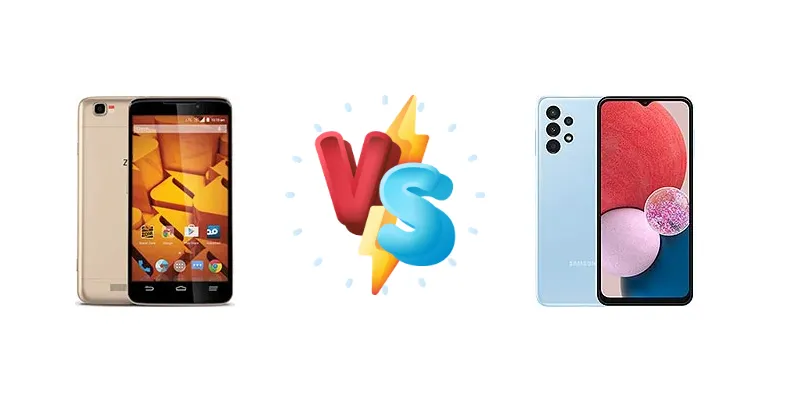
The sub-$150 smartphone market is fiercely competitive. The ZTE Boost Max+ and Samsung Galaxy A13 (SM-A137) both aim to deliver essential smartphone functionality at an accessible price. However, they take drastically different approaches to achieving this, with the A13 leveraging a more modern chipset architecture while the Boost Max+ opts for a simpler, lower-power design. This comparison will dissect the key differences to determine which device offers the best value.
🏆 Quick Verdict
For most users, the Samsung Galaxy A13 is the superior choice. Its Mediatek Helio G80 chipset provides a significantly more responsive experience for everyday tasks and light gaming, offsetting the Boost Max+'s potential battery life advantage. The A13’s 15W charging also offers a more convenient top-up experience.
| Network |
|---|
| 2G bands | GSM 850 / 900 / 1800 / 1900 | GSM 850 / 900 / 1800 / 1900 |
| 3G bands | HSDPA | HSDPA 850 / 900 / 2100 |
| 4G bands | LTE | 1, 3, 5, 7, 8, 20, 28, 38, 40, 41 |
| EDGE | Yes | - |
| GPRS | Yes | - |
| Speed | HSPA, LTE | HSPA, LTE |
| Technology | GSM / HSPA / LTE | GSM / HSPA / LTE |
| Launch |
|---|
| Announced | 2015, July. Released 2015, July | 2022, June |
| Status | Discontinued | Available. Released 2022, July |
| Body |
|---|
| Build | - | Glass front (Gorilla Glass 5), plastic frame, plastic back |
| Dimensions | 165.1 x 82.6 x 10.2 mm (6.5 x 3.25 x 0.40 in) | 165.1 x 76.4 x 8.8 mm (6.5 x 3.01 x 0.35 in) |
| SIM | Micro-SIM | · Nano-SIM· Nano-SIM + Nano-SIM |
| Weight | 194.8 g (6.88 oz) | 195 g (6.88 oz) |
| Display |
|---|
| Protection | Corning Gorilla Glass | Corning Gorilla Glass 5 |
| Resolution | 720 x 1280 pixels, 16:9 ratio (~258 ppi density) | 1080 x 2408 pixels, 20:9 ratio (~400 ppi density) |
| Size | 5.7 inches, 89.6 cm2 (~65.7% screen-to-body ratio) | 6.6 inches, 104.9 cm2 (~83.2% screen-to-body ratio) |
| Type | IPS LCD | PLS LCD |
| Platform |
|---|
| CPU | Quad-core 1.2 GHz | Octa-core (2x2.0 GHz Cortex-A75 & 6x1.8 GHz Cortex-A55) |
| Chipset | - | Mediatek MT6769V/CU Helio G80 (12 nm) |
| GPU | - | Mali-G52 MC2 |
| OS | Android 5.1 (Lollipop) | Android 12, upgradable to Android 14, One UI 6.1 |
| Memory |
|---|
| Card slot | No | microSDXC (dedicated slot) |
| Internal | 16GB 2GB RAM | 32GB 3GB RAM, 32GB 4GB RAM, 64GB 4GB RAM, 128GB 4GB RAM |
| | - | eMMC 5.1 |
| Main Camera |
|---|
| Features | - | LED flash, panorama, HDR |
| Quad | - | 50 MP, f/1.8, (wide), PDAF
5 MP, f/2.2, 123˚ (ultrawide), 1/5.0", 1.12µm
2 MP (macro)
Auxiliary lens |
| Single | 8 MP | 8 MP, f/2.2, (wide) |
| Video | 1080p@30fps | 1080p@30fps |
| Selfie camera |
|---|
| Single | 1 MP | 8 MP, f/2.2, (wide) |
| Video | 720p | 1080p@30fps |
| Sound |
|---|
| 3.5mm jack | - | Yes |
| 35mm jack | Yes | Yes |
| Loudspeaker | Yes | Yes |
| Comms |
|---|
| Bluetooth | 4.0, A2DP | 5.2, A2DP, LE |
| NFC | No | Yes |
| Positioning | GPS | GPS, GLONASS, GALILEO, BDS |
| Radio | No | No |
| USB | microUSB 2.0 | USB Type-C 2.0, OTG |
| WLAN | Wi-Fi 802.11 b/g/n, hotspot | Wi-Fi 802.11 a/b/g/n/ac, dual-band, Wi-Fi Direct |
| Features |
|---|
| Sensors | Yes | Fingerprint (side-mounted), accelerometer, compass |
| | - | Virtual proximity sensing |
| Battery |
|---|
| Charging | - | 15W wired |
| Talk time | Up to 16 h (3G) | - |
| Type | Li-Ion 3400 mAh, non-removable | Li-Po 5000 mAh |
| Misc |
|---|
| Colors | Gold | Black, White, Blue |
| Models | - | SM-A137F, SM-A137F/DSN, SM-A137F/DS |
| Price | About 180 EUR | About 180 EUR |
| SAR EU | - | 0.35 W/kg (head) 1.22 W/kg (body) |
ZTE Boost Max+
- Potentially longer battery life due to lower power CPU
- Likely more affordable upfront cost
- Simple and reliable operation
- Significantly slower performance
- Outdated processor architecture
- Likely lower quality display and camera
Samsung Galaxy A13 (SM-A137)
- Much faster and more responsive performance
- More versatile camera system
- Faster 15W wired charging
- May have slightly shorter battery life
- Potentially higher upfront cost
- Standard LCD panel
Display Comparison
The context data lacks display specifications for the ZTE Boost Max+. However, given its market positioning, it likely features a lower-resolution LCD panel with standard 60Hz refresh rate. The Samsung Galaxy A13, while also utilizing an LCD, benefits from a larger screen size and potentially better color calibration typical of Samsung displays. The A13’s panel is likely to have a standard PWM dimming rate, which may be a concern for users sensitive to flicker, but this is typical for this price bracket. The Boost Max+’s display is likely to be a cost-optimized component, prioritizing affordability over visual fidelity.
Camera Comparison
Without detailed camera specifications for the ZTE Boost Max+, a direct comparison is limited. However, it’s reasonable to assume it features a basic camera setup focused on functionality rather than image quality. The Samsung Galaxy A13, while not a camera powerhouse, offers a more versatile camera system. While the inclusion of a 2MP macro lens is largely marketing fluff, the main sensor is likely to be of higher resolution and quality than the Boost Max+'s, resulting in better photos in good lighting conditions. The A13’s image processing algorithms, while not flagship-level, are likely more refined than those found on the Boost Max+.
Performance
The performance gap between these two devices is substantial. The ZTE Boost Max+'s quad-core 1.2 GHz CPU is significantly outmatched by the Samsung Galaxy A13’s Mediatek Helio G80. The Helio G80’s octa-core configuration, featuring two 2.0 GHz Cortex-A75 performance cores and six 1.8 GHz Cortex-A55 efficiency cores, provides a much more responsive experience for multitasking and demanding applications. The Helio G80’s 12nm process node also contributes to better power efficiency at higher loads compared to the likely larger process node of the Boost Max+'s CPU. This translates to smoother app launches, faster web browsing, and a more enjoyable gaming experience on the A13.
Battery Life
The ZTE Boost Max+ may offer slightly longer battery life due to its less power-hungry processor. However, the Samsung Galaxy A13’s 15W wired charging provides a significant convenience advantage. While neither phone boasts exceptional battery capacity (specifics are missing for the Boost Max+), the A13’s faster charging allows for quicker top-ups, reducing downtime. The Helio G80’s power efficiency, despite being a more powerful chip, mitigates the battery life difference, making the convenience of 15W charging a key differentiator.
Buying Guide
Buy the ZTE Boost Max+ if your primary need is a basic, reliable phone for calls, texts, and minimal app usage, and you prioritize potentially longer battery life over performance. Buy the Samsung Galaxy A13 (SM-A137) if you want a smoother, more capable smartphone experience for social media, streaming, and casual gaming, and value a more modern chipset and faster charging.
Frequently Asked Questions
❓ Does the Mediatek Helio G80 in the Samsung Galaxy A13 get hot during extended gaming sessions?
The Helio G80 is a relatively efficient chipset. While it will generate heat during prolonged gaming, it’s unlikely to experience significant thermal throttling in most mobile games. The A13’s plastic build also helps dissipate heat, preventing uncomfortable temperatures.
❓ Is the 2MP macro camera on the Samsung Galaxy A13 worth using?
Generally, 2MP macro cameras on budget phones offer limited utility. Image quality is often poor, and the fixed focus distance makes it difficult to capture truly detailed macro shots. It’s best to rely on the main camera for most photography.
❓ Can the Samsung Galaxy A13 handle popular games like PUBG Mobile or Call of Duty Mobile?
The Samsung Galaxy A13 can run PUBG Mobile and Call of Duty Mobile, but you’ll likely need to lower the graphics settings to medium or low to achieve a smooth frame rate. The Helio G80 is capable of handling these games, but it’s not a high-end gaming chipset.
❓ What type of charging port does the ZTE Boost Max+ use?
Without specific details, it's highly probable the ZTE Boost Max+ uses a Micro-USB port, given its budget positioning. The Samsung Galaxy A13 uses USB-C, offering faster data transfer and more universal compatibility.