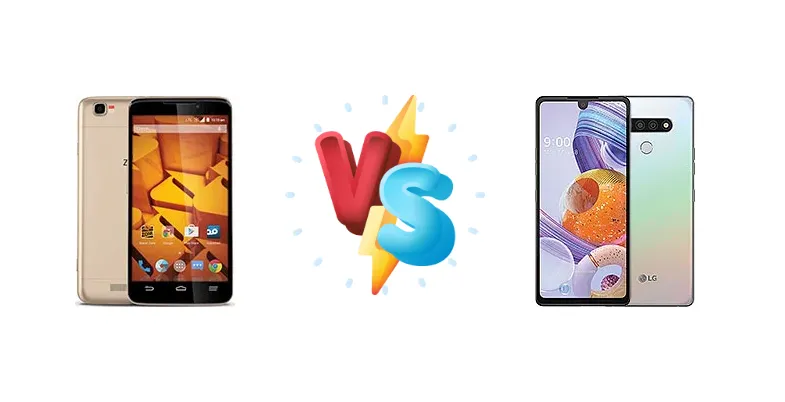
The ZTE Boost Max+ and LG Stylo 6 represent two distinct approaches to the ultra-budget smartphone market. The Boost Max+ prioritizes affordability, while the Stylo 6 attempts to offer a more robust feature set, headlined by its Mediatek Helio P35 chipset. This comparison dissects their key differences to help you determine which device delivers the best value.
🏆 Quick Verdict
For the average user prioritizing basic functionality and cost savings, the ZTE Boost Max+ offers a compelling package. However, the LG Stylo 6’s octa-core processor and more modern chipset architecture provide a noticeable performance advantage for multitasking and moderately demanding applications, justifying the price premium for those who need it.
| Network |
|---|
| 2G bands | GSM 850 / 900 / 1800 / 1900 | GSM 850 / 900 / 1800 / 1900 |
| 3G bands | HSDPA | HSDPA 850 / 900 / 1900 / 2100 |
| 4G bands | LTE | LTE |
| EDGE | Yes | - |
| GPRS | Yes | - |
| Speed | HSPA, LTE | HSPA 42.2/5.76 Mbps, LTE (2CA) Cat6 300/50 Mbps |
| Technology | GSM / HSPA / LTE | GSM / HSPA / LTE |
| Launch |
|---|
| Announced | 2015, July. Released 2015, July | 2020, May 20. Released 2020, May 20 |
| Status | Discontinued | Discontinued |
| Body |
|---|
| Dimensions | 165.1 x 82.6 x 10.2 mm (6.5 x 3.25 x 0.40 in) | 171.2 x 77.7 x 8.6 mm (6.74 x 3.06 x 0.34 in) |
| SIM | Micro-SIM | Nano-SIM |
| Weight | 194.8 g (6.88 oz) | 219 g (7.72 oz) |
| | - | Stylus |
| Display |
|---|
| Protection | Corning Gorilla Glass | - |
| Resolution | 720 x 1280 pixels, 16:9 ratio (~258 ppi density) | 1080 x 2460 pixels (~395 ppi density) |
| Size | 5.7 inches, 89.6 cm2 (~65.7% screen-to-body ratio) | 6.8 inches, 109.8 cm2 (~82.5% screen-to-body ratio) |
| Type | IPS LCD | IPS LCD |
| Platform |
|---|
| CPU | Quad-core 1.2 GHz | Octa-core (4x2.3 GHz Cortex-A53 & 4x1.8 GHz Cortex-A53) |
| Chipset | - | Mediatek MT6765 Helio P35 (12 nm) |
| GPU | - | PowerVR GE8320 |
| OS | Android 5.1 (Lollipop) | Android 10 |
| Memory |
|---|
| Card slot | No | microSDXC (dedicated slot) |
| Internal | 16GB 2GB RAM | 64GB 3GB RAM |
| | - | eMMC 5.1 |
| Main Camera |
|---|
| Features | - | LED flash, panorama, HDR |
| Single | 8 MP | - |
| Triple | - | 13 MP, (wide), PDAF
5 MP, 120˚, (ultrawide)
Auxiliary lens |
| Video | 1080p@30fps | 1080p@30fps |
| Selfie camera |
|---|
| Single | 1 MP | 13 MP, 1/3.1", 1.12µm |
| Video | 720p | 1080p@30fps |
| Sound |
|---|
| 3.5mm jack | - | Yes |
| 35mm jack | Yes | Yes |
| Loudspeaker | Yes | Yes |
| Comms |
|---|
| Bluetooth | 4.0, A2DP | 5.0, A2DP, LE |
| NFC | No | No |
| Positioning | GPS | GPS |
| Radio | No | No |
| USB | microUSB 2.0 | USB Type-C 2.0 |
| WLAN | Wi-Fi 802.11 b/g/n, hotspot | Wi-Fi 802.11 b/g/n, Wi-Fi Direct |
| Features |
|---|
| Sensors | Yes | Fingerprint (rear-mounted), accelerometer, proximity |
| Battery |
|---|
| Talk time | Up to 16 h (3G) | - |
| Type | Li-Ion 3400 mAh, non-removable | Li-Po 4000 mAh |
| Misc |
|---|
| Colors | Gold | White |
| Models | - | LMQ730TM, LM-Q730TM |
| Price | About 180 EUR | About 200 EUR |
ZTE Boost Max+
- Lowest possible price point
- Reliable for basic communication
- Potentially longer standby time due to simpler hardware
- Significantly slower performance
- Limited multitasking capabilities
- Likely outdated software support
LG Stylo 6
- Octa-core processor for smoother performance
- More responsive user interface
- Better multitasking capabilities
- Higher price compared to ZTE Boost Max+
- May not offer a significantly better camera experience
- Battery life may be slightly less than the ZTE Boost Max+
Display Comparison
Neither device boasts a standout display. The ZTE Boost Max+’s display specifications are not provided, suggesting a standard LCD panel likely optimized for power efficiency. The LG Stylo 6 also utilizes an LCD, but details regarding its peak brightness or color accuracy are unavailable. Given the price points, both displays are likely to prioritize functionality over visual fidelity, with potential for limited outdoor visibility and color reproduction. Bezels are expected to be substantial on both models, reflecting their budget positioning.
Camera Comparison
Camera performance is likely to be similar, with both devices targeting entry-level photography. Details on sensor sizes and apertures are missing for both phones, but it’s reasonable to assume they employ basic sensors. The LG Stylo 6 may benefit from the Helio P35’s image signal processor (ISP), potentially offering slightly improved image processing and noise reduction. However, neither device is expected to excel in low-light conditions. The presence of a 2MP macro camera on the LG Stylo 6 is largely a marketing feature, offering limited practical benefit due to the low resolution.
Performance
The core difference lies in the processing power. The ZTE Boost Max+ features a quad-core 1.2 GHz CPU, a configuration suitable for basic tasks. In contrast, the LG Stylo 6’s Mediatek MT6765 Helio P35 is an octa-core processor with a heterogeneous architecture – four cores clocked at 2.3 GHz (Cortex-A53) and four at 1.8 GHz (Cortex-A53). This means the Stylo 6 can handle more complex workloads and multitasking more efficiently. The Helio P35’s 12nm process node also contributes to better power efficiency compared to an unspecified node for the Boost Max+, potentially leading to longer sustained performance. The LG Stylo 6 will demonstrably outperform the ZTE Boost Max+ in app launch times and overall system responsiveness.
Battery Life
Battery capacity details are unavailable for the ZTE Boost Max+. The LG Stylo 6’s battery size is also not specified. However, given the Helio P35’s power efficiency and the likely focus on basic functionality for both devices, battery life should be adequate for a full day of moderate use. Charging wattage is also unknown for both, suggesting slow charging speeds are probable. The more efficient chipset of the LG Stylo 6 may translate to slightly longer screen-on time, even with a similar battery capacity.
Buying Guide
Buy the ZTE Boost Max+ if you need a reliably basic smartphone for calls, texts, and light web browsing, and your budget is extremely limited. It’s ideal for first-time smartphone users or as a dependable backup device. Buy the LG Stylo 6 if you frequently switch between apps, enjoy casual gaming, or require a smoother overall user experience, and are willing to spend a bit more for improved performance and a more responsive interface.
Frequently Asked Questions
❓ Will the LG Stylo 6 handle popular social media apps like Facebook and Instagram smoothly?
Yes, the LG Stylo 6’s octa-core Helio P35 processor and likely 2-3GB of RAM (typical for this segment) should provide a reasonably smooth experience with social media apps. While it won’t offer the same performance as a flagship device, it will handle scrolling, photo uploads, and video playback without significant lag.
❓ Is the ZTE Boost Max+ suitable for streaming videos on YouTube?
The ZTE Boost Max+ can stream videos on YouTube, but the experience may be limited by the quad-core processor and potentially lower screen resolution. Expect longer loading times and occasional buffering, especially with higher-resolution videos. It’s best suited for standard-definition (SD) streaming.
❓ Does the LG Stylo 6 support expandable storage via microSD card?
While not explicitly stated in the provided data, LG Stylo phones traditionally include microSD card support. This is a crucial feature for budget devices, allowing users to expand storage for photos, videos, and apps. It's highly probable the Stylo 6 offers this functionality.