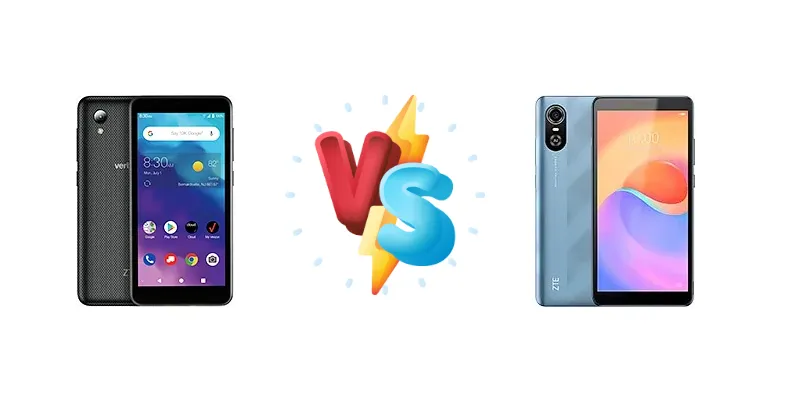
The ZTE Blade Vantage 2 and A31 Plus represent ZTE’s commitment to the ultra-budget smartphone segment. While both aim to deliver essential smartphone functionality at a low price point, they diverge significantly in their core hardware, particularly in their chosen chipsets. This comparison dissects those differences to determine which device offers the best value for users prioritizing performance, efficiency, or a balance of both.
🏆 Quick Verdict
For the average user, the ZTE Blade Vantage 2 emerges as the slightly better choice. Its Mediatek Helio A22, despite being built on a larger node, offers a more modern Cortex-A53 architecture and a higher clock speed, translating to a snappier experience for everyday tasks compared to the A31 Plus’s older Unisoc SC9863A.
| Network |
|---|
| 2G bands | GSM 850 / 900 / 1800 / 1900 | GSM 850 / 900 / 1800 / 1900 |
| 3G bands | HSDPA 850 / 900 / 1900 / 2100 | HSDPA 850 / 900 / 2100 |
| 4G bands | 2, 4, 5, 13 | 1, 2, 3, 5, 7, 8, 20, 28, 38, 40, 41 |
| Speed | HSPA, LTE | HSPA, LTE |
| Technology | GSM / HSPA / LTE | GSM / HSPA / LTE |
| Launch |
|---|
| Announced | 2019, October. Released 2019, October | 2021, October 31 |
| Status | Discontinued | Available. Released 2021, October 31 |
| Body |
|---|
| Dimensions | 137 x 68 x 10.5 mm (5.39 x 2.68 x 0.41 in) | 159.2 x 77.5 x 9.6 mm (6.27 x 3.05 x 0.38 in) |
| SIM | Nano-SIM | Nano-SIM + Nano-SIM |
| Weight | - | - |
| Display |
|---|
| Resolution | 480 x 960 pixels, 18:9 ratio (~215 ppi density) | 480 x 960 pixels, 18:9 ratio (~179 ppi density) |
| Size | 5.0 inches, 64.5 cm2 (~69.3% screen-to-body ratio) | 6.0 inches, 92.9 cm2 (~75.3% screen-to-body ratio) |
| Type | TFT LCD | IPS LCD |
| Platform |
|---|
| CPU | Quad-core 2.0 GHz Cortex-A53 | Octa-core (4x1.6 GHz Cortex-A55 & 4x1.2 GHz Cortex-A55) |
| Chipset | Mediatek MT6761 Helio A22 (12 nm) | Unisoc SC9863A (28 nm) |
| GPU | PowerVR GE8320 | IMG8322 |
| OS | Android 9.0 (Pie) | Android 11 (Go edition) |
| Memory |
|---|
| Card slot | microSDXC | microSDXC |
| Internal | 16GB 2GB RAM | 32GB 1GB RAM |
| | eMMC 5.1 | eMMC 5.1 |
| Main Camera |
|---|
| Features | LED flash | LED flash, HDR |
| Single | 5 MP | 5 MP (up-scaled to 8 MP) |
| Video | 720p@30fps | 720p@30fps |
| Selfie camera |
|---|
| Single | 2 MP | 2 MP (up-scaled to 5 MP) |
| Sound |
|---|
| 3.5mm jack | Yes | Yes |
| 35mm jack | Yes | Yes |
| Loudspeaker | Yes | Yes |
| Comms |
|---|
| Bluetooth | 4.2, A2DP, LE | 4.2, A2DP, LE |
| NFC | No | Yes |
| Positioning | GPS | GPS, GLONASS |
| Radio | No | FM radio |
| USB | microUSB 2.0 | microUSB 2.0 |
| WLAN | Wi-Fi 802.11 b/g/n | Wi-Fi 802.11 b/g/n |
| Features |
|---|
| Sensors | Accelerometer | Accelerometer |
| Battery |
|---|
| Type | Li-Po 2050 mAh, removable | Li-Ion 3000 mAh |
| Misc |
|---|
| Colors | Black | Blue, Gray |
| Price | About 50 EUR | - |
ZTE Blade Vantage 2
- More responsive CPU for everyday tasks
- Modern Cortex-A53 architecture
- Potentially better graphics performance
- Less power-efficient chipset
- Likely shorter battery life under load
- Larger manufacturing node (12nm)
ZTE Blade A31 Plus
- Potentially longer battery life during light use
- Octa-core CPU for multi-tasking (limited by RAM)
- More efficient chipset (28nm)
- Slower CPU performance
- Older Cortex-A55 architecture
- Less responsive user experience
Display Comparison
Neither ZTE provides detailed display specifications. Given their price points, both likely utilize LCD panels with 720p+ resolutions. The A31 Plus’s Unisoc chipset may have limited display output capabilities, potentially resulting in slightly less vibrant colors or lower maximum brightness compared to the Vantage 2. Bezels are expected to be substantial on both devices, reflecting their budget nature.
Camera Comparison
Detailed camera specifications are unavailable. Both phones likely feature a basic rear camera setup with a primary sensor and potentially a depth sensor. Image quality will be heavily reliant on software processing and is unlikely to be a strong point for either device. The aperture and sensor size are unknown, but given the price point, expectations should be tempered. Any differences in camera performance will likely be minimal and attributable to software optimization rather than hardware.
Performance
The core difference lies in the chipsets. The ZTE Blade Vantage 2’s Mediatek MT6761 Helio A22 (12nm) features a quad-core Cortex-A53 CPU clocked at 2.0 GHz. This is a relatively modern, albeit entry-level, architecture. Conversely, the ZTE Blade A31 Plus utilizes the Unisoc SC9863A (28nm) with an octa-core configuration – four Cortex-A55 cores at 1.6 GHz and four at 1.2 GHz. While the A31 Plus boasts more cores, the older Cortex-A55 architecture and lower clock speeds result in lower single-core performance. The Helio A22’s larger 12nm node is less efficient than the A31 Plus’s 28nm, but the architectural improvements and higher clock speed provide a noticeable performance advantage in most scenarios. The A31 Plus’s octa-core design *could* offer better multi-tasking, but the limited RAM (likely 2GB on both) will quickly become a bottleneck.
Battery Life
Battery capacity is not specified for either device. However, the Unisoc SC9863A’s more efficient octa-core design *could* translate to slightly longer battery life on the ZTE Blade A31 Plus, especially during light usage. The Helio A22’s higher power draw will likely result in shorter battery life under load. Charging wattage is also unknown, but both are expected to ship with a standard 5W charger, resulting in slow charging times – likely exceeding 3 hours for a full charge.
Buying Guide
Buy the ZTE Blade Vantage 2 if you need a phone that feels responsive for basic tasks like browsing, social media, and messaging. Its more powerful CPU will handle these workloads with less lag. Buy the ZTE Blade A31 Plus if you prioritize potentially longer battery life due to the more efficient (though less powerful) octa-core configuration and are willing to accept a slower overall user experience. This phone is best suited for extremely light usage.
Frequently Asked Questions
❓ Will the ZTE Blade A31 Plus struggle with popular apps like Facebook or WhatsApp?
The Unisoc SC9863A in the A31 Plus is a very basic chipset. While it *can* run these apps, you may experience noticeable lag when scrolling through feeds, loading images, or switching between apps. The Vantage 2’s Helio A22 will provide a smoother experience, even if it’s not perfect.
❓ Is either phone suitable for playing mobile games?
Neither phone is ideal for gaming. Both chipsets lack dedicated GPUs capable of handling demanding games at playable frame rates. Simple 2D games might be playable at low settings, but don’t expect a good experience with popular titles like PUBG or Call of Duty.
❓ How much storage does each phone have, and can it be expanded?
Storage capacity is not specified in the provided data. However, budget phones typically come with 16GB or 32GB of internal storage. Both phones likely feature a microSD card slot for storage expansion, allowing you to add more space for photos, videos, and apps.