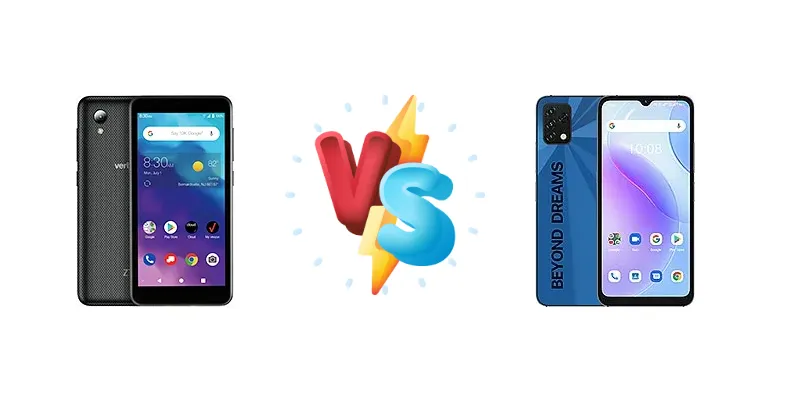
The sub-$150 smartphone market is fiercely competitive. Both the ZTE Blade Vantage 2 and the Umidigi A11S aim to deliver essential smartphone functionality at an incredibly affordable price. However, they take different approaches to achieving this, with distinct chipset choices that significantly impact performance and user experience. This comparison will dissect those differences to help you choose the right device.
🏆 Quick Verdict
For most users, the Umidigi A11S offers a more compelling experience. Its Unisoc Tiger T310 chipset, featuring a Cortex-A75 core, provides a noticeable performance boost over the ZTE Blade Vantage 2’s MediaTek Helio A22, making it better suited for everyday tasks and light multitasking. While both phones are entry-level, the A11S delivers more for the money.
| Network |
|---|
| 2G bands | GSM 850 / 900 / 1800 / 1900 | GSM 850 / 900 / 1800 / 1900 |
| 3G bands | HSDPA 850 / 900 / 1900 / 2100 | HSDPA 800 / 850 / 900 / 1700(AWS) / 1900 / 2100 |
| 4G bands | 2, 4, 5, 13 | 1, 2, 3, 4, 5, 7, 8, 12, 13, 17, 18, 19, 20, 26, 28, 34, 38, 39, 40, 41, 66 |
| Speed | HSPA, LTE | HSPA, LTE |
| Technology | GSM / HSPA / LTE | GSM / HSPA / LTE |
| Launch |
|---|
| Announced | 2019, October. Released 2019, October | 2021. Released 2021 |
| Status | Discontinued | Discontinued |
| Body |
|---|
| Dimensions | 137 x 68 x 10.5 mm (5.39 x 2.68 x 0.41 in) | 162.2 x 75 x 9.2 mm (6.39 x 2.95 x 0.36 in) |
| SIM | Nano-SIM | Nano-SIM + Nano-SIM |
| Weight | - | 225 g (7.94 oz) |
| Display |
|---|
| Resolution | 480 x 960 pixels, 18:9 ratio (~215 ppi density) | 720 x 1600 pixels, 20:9 ratio (~269 ppi density) |
| Size | 5.0 inches, 64.5 cm2 (~69.3% screen-to-body ratio) | 6.53 inches, 102.9 cm2 (~84.6% screen-to-body ratio) |
| Type | TFT LCD | IPS LCD |
| Platform |
|---|
| CPU | Quad-core 2.0 GHz Cortex-A53 | Quad-core (1x2.0 GHz Cortex-A75 & 3x1.8 GHz Cortex-A55) |
| Chipset | Mediatek MT6761 Helio A22 (12 nm) | Unisoc Tiger T310 (12nm) |
| GPU | PowerVR GE8320 | PowerVR GE8300 |
| OS | Android 9.0 (Pie) | Android 11 |
| Memory |
|---|
| Card slot | microSDXC | microSDXC (dedicated slot) |
| Internal | 16GB 2GB RAM | 32GB 4GB RAM, 64GB 4GB RAM |
| | eMMC 5.1 | - |
| Main Camera |
|---|
| Features | LED flash | Dual-LED flash, HDR, panorama |
| Single | 5 MP | - |
| Triple | - | 16 MP, f/2.0, (wide), AF
8 MP, 120˚ (ultrawide)
5 MP (macro) |
| Video | 720p@30fps | 1080p@30fps |
| Selfie camera |
|---|
| Single | 2 MP | 8 MP, f/2.2, (wide) |
| Video | - | 1080p@30fps |
| Sound |
|---|
| 3.5mm jack | Yes | - |
| 35mm jack | Yes | Yes |
| Loudspeaker | Yes | Yes |
| Comms |
|---|
| Bluetooth | 4.2, A2DP, LE | 5.0, A2DP, LE |
| NFC | No | No |
| Positioning | GPS | GPS, GLONASS, GALILEO |
| Radio | No | No |
| USB | microUSB 2.0 | USB Type-C, OTG |
| WLAN | Wi-Fi 802.11 b/g/n | Wi-Fi 802.11 a/b/g/n/ac, dual-band, Wi-Fi Direct |
| Features |
|---|
| Sensors | Accelerometer | Accelerometer, proximity, compass |
| Battery |
|---|
| Charging | - | 10W wired |
| Type | Li-Po 2050 mAh, removable | 5150 mAh |
| Misc |
|---|
| Colors | Black | Mist Blue, Frost Grey |
| Price | About 50 EUR | - |
ZTE Blade Vantage 2
- Potentially longer software support from ZTE.
- Power-efficient MediaTek Helio A22 chipset.
- Established brand reputation.
- Significantly weaker CPU performance compared to the Umidigi A11S.
- Likely slower app loading times and multitasking.
- Charging speed is unknown and potentially slow.
Umidigi A11S
- More powerful Unisoc Tiger T310 chipset with Cortex-A75 core.
- Snappier performance for everyday tasks.
- 10W wired charging included.
- Less established brand reputation.
- Potentially shorter software support lifecycle.
- Chipset may consume more power during intensive use.
Display Comparison
Neither ZTE nor Umidigi provide detailed display specifications beyond the basic panel size. Given the price point, both likely utilize IPS LCD panels. The absence of information regarding brightness, color gamut coverage, or refresh rates suggests both displays are geared towards functional visibility rather than media consumption. Bezels are expected to be substantial on both devices, typical of this segment. Color accuracy is likely to be standard, prioritizing power efficiency over fidelity.
Camera Comparison
Camera details are sparse for both devices. It’s safe to assume both feature basic camera setups geared towards casual photography. Without sensor size or aperture information, a direct comparison is difficult. However, the focus should be on the image processing capabilities of the respective chipsets. The Unisoc T310’s ISP (Image Signal Processor) is likely more advanced than the Helio A22’s, potentially leading to better image quality in favorable lighting conditions. The prevalence of low-resolution auxiliary cameras (often 2MP) in this price range suggests these should be largely ignored; the primary sensor will be the determining factor, and without specs, the Umidigi has a slight edge due to the more capable chipset.
Performance
The core difference lies in the chipsets. The ZTE Blade Vantage 2 uses the MediaTek Helio A22, a quad-core processor based on the Cortex-A53 architecture at 2.0 GHz. The Umidigi A11S, however, employs the Unisoc Tiger T310, also quad-core, but with a heterogeneous architecture: one Cortex-A75 core at 2.0 GHz and three Cortex-A55 cores at 1.8 GHz. This is a significant advantage for the A11S. The Cortex-A75 offers substantially higher single-core performance than the A53, resulting in snappier app launches and smoother multitasking. While both use 12nm process technology, the architectural difference translates to a more responsive user experience on the Umidigi A11S. RAM configurations are not specified, but the chipset advantage will be felt regardless.
Battery Life
Battery capacity is not specified for either device. However, the Umidigi A11S includes 10W wired charging, while the ZTE Blade Vantage 2’s charging speed is unknown. Given the likely battery capacities (estimated around 4000-5000 mAh for both), the 10W charging on the A11S will provide a reasonable, if not rapid, recharge time. The Helio A22 in the ZTE Blade Vantage 2 is known for its power efficiency, potentially offsetting the charging advantage of the A11S, but the more demanding chipset in the A11S will likely consume more power during active use.
Buying Guide
Buy the ZTE Blade Vantage 2 if you prioritize simplicity and a potentially longer software support lifecycle from a more established brand, and your usage is limited to basic calling, texting, and very light app use. Buy the Umidigi A11S if you want a more responsive experience for social media, browsing, and occasional gaming, and are comfortable with a less-known brand offering more processing power for the price.
Frequently Asked Questions
❓ Will the Umidigi A11S struggle with popular social media apps like Facebook and Instagram?
While not a powerhouse, the Umidigi A11S’s Unisoc Tiger T310 chipset, particularly the Cortex-A75 core, is capable of running social media apps smoothly. You may experience some slowdown with multiple apps open simultaneously, but for typical social media usage, it should be adequate.
❓ Is the ZTE Blade Vantage 2 a good choice for someone who primarily uses their phone for calls and texts?
Yes, the ZTE Blade Vantage 2 is a suitable option for basic communication. Its power-efficient Helio A22 chipset will contribute to good battery life for calls and texts, and the phone’s simplicity may appeal to users who don’t require advanced features.
❓ Can either of these phones handle light gaming, like Candy Crush or Subway Surfers?
The Umidigi A11S is better equipped for light gaming due to its more powerful processor. While neither phone is designed for demanding games, the A11S will provide a smoother experience with casual titles like Candy Crush or Subway Surfers. The ZTE Blade Vantage 2 may struggle with even these simpler games.