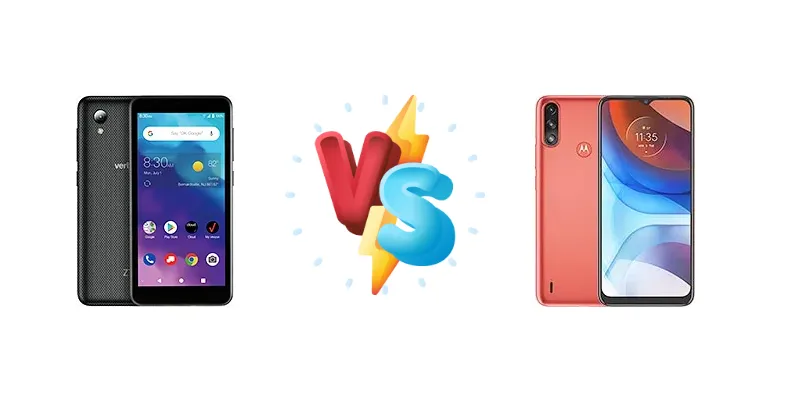
The ZTE Blade Vantage 2 and Motorola Moto E7i Power represent the extreme end of the budget smartphone spectrum. Both aim to deliver essential smartphone functionality at the lowest possible price point, but they take drastically different approaches to achieving this. The ZTE leverages a newer, albeit modest, MediaTek chipset, while the Motorola opts for an older, octa-core Unisoc processor. This comparison will dissect these choices and determine which device provides the better user experience.
🏆 Quick Verdict
For the average user prioritizing basic tasks like calling, texting, and light social media, the Motorola Moto E7i Power emerges as the slightly better choice. Its octa-core processor, despite being built on an older 28nm process, offers a more responsive multitasking experience than the ZTE's quad-core Helio A22, and the inclusion of 10W charging is a practical benefit.
| Network |
|---|
| 2G bands | GSM 850 / 900 / 1800 / 1900 | GSM 850 / 900 / 1800 / 1900 |
| 3G bands | HSDPA 850 / 900 / 1900 / 2100 | HSDPA 850 / 900 / 1700(AWS) / 1900 / 2100 |
| 4G bands | 2, 4, 5, 13 | LTE |
| Speed | HSPA, LTE | HSPA, LTE |
| Technology | GSM / HSPA / LTE | GSM / HSPA / LTE |
| Launch |
|---|
| Announced | 2019, October. Released 2019, October | 2021, February 23 |
| Status | Discontinued | Available. Released 2021, March 15 |
| Body |
|---|
| Build | - | Glass front, plastic back, plastic frame |
| Dimensions | 137 x 68 x 10.5 mm (5.39 x 2.68 x 0.41 in) | 165.1 x 75.9 x 9.2 mm (6.5 x 2.99 x 0.36 in) |
| SIM | Nano-SIM | Nano-SIM + Nano-SIM |
| Weight | - | 200 g (7.05 oz) |
| | - | Water-repellent design |
| Display |
|---|
| Resolution | 480 x 960 pixels, 18:9 ratio (~215 ppi density) | 720 x 1600 pixels, 20:9 ratio (~270 ppi density) |
| Size | 5.0 inches, 64.5 cm2 (~69.3% screen-to-body ratio) | 6.51 inches, 102.3 cm2 (~81.7% screen-to-body ratio) |
| Type | TFT LCD | IPS LCD, 380 nits (typ) |
| Platform |
|---|
| CPU | Quad-core 2.0 GHz Cortex-A53 | Octa-core (4x1.6 GHz Cortex-A55 & 4x1.2 GHz Cortex-A55) |
| Chipset | Mediatek MT6761 Helio A22 (12 nm) | Unisoc SC9863A (28 nm) |
| GPU | PowerVR GE8320 | IMG8322 |
| OS | Android 9.0 (Pie) | Android 10 (Go edition) |
| Memory |
|---|
| Card slot | microSDXC | microSDXC (uses shared SIM slot) |
| Internal | 16GB 2GB RAM | 32GB 2GB RAM |
| | eMMC 5.1 | eMMC 5.1 |
| Main Camera |
|---|
| Dual | - | 13 MP, f/2.0, 26mm (wide), 1/3.1", 1.12µm, PDAF
2 MP (macro) |
| Features | LED flash | LED flash, HDR, panorama |
| Single | 5 MP | - |
| Video | 720p@30fps | 1080p@30fps |
| Selfie camera |
|---|
| Features | - | HDR |
| Single | 2 MP | 5 MP, f/2.2, 27mm (wide), 1.12µm |
| Video | - | 1080p@30fps |
| Sound |
|---|
| 3.5mm jack | Yes | Yes |
| 35mm jack | Yes | Yes |
| Loudspeaker | Yes | Yes |
| Comms |
|---|
| Bluetooth | 4.2, A2DP, LE | 4.2, A2DP |
| NFC | No | No |
| Positioning | GPS | GPS, GLONASS, GALILEO |
| Radio | No | Unspecified |
| USB | microUSB 2.0 | USB Type-C 2.0 |
| WLAN | Wi-Fi 802.11 b/g/n | Wi-Fi 802.11 b/g/n |
| Features |
|---|
| Sensors | Accelerometer | Fingerprint (rear-mounted), accelerometer, proximity |
| Battery |
|---|
| Charging | - | 10W wired |
| Type | Li-Po 2050 mAh, removable | Li-Ion 5000 mAh |
| Misc |
|---|
| Colors | Black | Tahiti Blue, Coral Red |
| Models | - | XT2097-13 |
| Price | About 50 EUR | About 120 EUR |
ZTE Blade Vantage 2
- Potentially better power efficiency due to 12nm process.
- Simpler software experience (likely Android Go).
- May be slightly cheaper than the Motorola.
- Quad-core processor limits multitasking.
- Likely slower app loading times.
- No information on charging capabilities.
Motorola Moto E7i Power
- Octa-core processor offers better multitasking.
- 10W wired charging provides convenient replenishment.
- Potentially better image processing due to ISP.
- Less efficient 28nm process.
- May have a shorter battery life under heavy use.
- Unisoc chipset may have limited software support.
Display Comparison
Neither device boasts a standout display. Given the price point, details like panel type and resolution are not provided. However, the focus should be on usability. The ZTE's reliance on the Helio A22 suggests a potentially lower GPU capability, which could translate to less smooth scrolling and animations compared to the Motorola. While both likely feature similar LCD panels, the Motorola's processor may be able to drive the display more efficiently, resulting in a slightly more responsive feel.
Camera Comparison
Both devices are likely to feature basic camera setups, and detailed sensor information is absent. It's safe to assume both will include a primary camera and potentially a secondary depth or macro sensor. Given the target market, image quality will be adequate for casual snapshots but shouldn't be expected to compete with higher-end devices. The processor's image signal processor (ISP) plays a crucial role, and the Unisoc SC9863A, with its octa-core configuration, may offer slightly better image processing capabilities than the Helio A22, potentially resulting in marginally better dynamic range and noise reduction.
Performance
The core architectural difference is stark. The ZTE Blade Vantage 2 utilizes the MediaTek MT6761 Helio A22, a quad-core processor built on a more efficient 12nm process. However, the Motorola Moto E7i Power counters with the Unisoc SC9863A, an octa-core chip, albeit fabricated on a less efficient 28nm node. While the A22 benefits from a smaller manufacturing process, the E7i Power’s eight Cortex-A55 cores (four at 1.6GHz and four at 1.2GHz) offer superior multitasking capabilities. The A22 will likely struggle with more than a few apps open simultaneously, while the E7i Power can handle a moderate workload more gracefully. The Unisoc chip's architecture, while older, provides a wider bandwidth for parallel processing.
Battery Life
Battery capacity details are missing for the ZTE Blade Vantage 2, but given its focus on efficiency, it likely features a modest battery. The Motorola Moto E7i Power benefits from 10W wired charging, a feature absent from many phones in this price bracket. While 10W is slow by modern standards, it provides a reliable way to replenish the battery, unlike relying solely on infrequent charging sessions. The Unisoc chip’s less efficient 28nm process will likely draw more power, but the 10W charging mitigates this to some extent, offering a practical advantage over a potentially larger battery with no charging capability.
Buying Guide
Buy the ZTE Blade Vantage 2 if you need a phone primarily for static tasks like media consumption and infrequent communication, and are willing to accept slower app loading times and limited multitasking. Buy the Motorola Moto E7i Power if you prefer a more fluid user experience for everyday tasks, appreciate the convenience of even slow charging, and anticipate needing to run multiple apps simultaneously, even if only for short periods.
Frequently Asked Questions
❓ Will the Motorola Moto E7i Power struggle with popular apps like WhatsApp and Facebook?
While the Unisoc SC9863A isn't a powerhouse, its octa-core configuration should handle apps like WhatsApp and Facebook without significant issues. Expect some loading times, but the phone should remain usable for these core communication tasks. The ZTE Blade Vantage 2 may exhibit more noticeable lag when switching between these apps.
❓ Is the 10W charging on the Motorola Moto E7i Power fast enough for daily use?
10W charging is slow by today's standards, taking several hours for a full charge. However, it's a significant benefit over having no charging capability at all. It allows for topping up the battery overnight or during downtime, ensuring the phone is ready for use throughout the day. It's a practical feature for users who don't want to worry about running out of power unexpectedly.
❓ Can the ZTE Blade Vantage 2 handle basic mobile gaming?
The ZTE Blade Vantage 2's Helio A22 processor is not designed for gaming. While it can run very simple 2D games, expect significant frame rate drops and lag in more demanding titles. The Motorola Moto E7i Power, with its octa-core processor, will offer a slightly better gaming experience, but still limited to basic games at low settings.