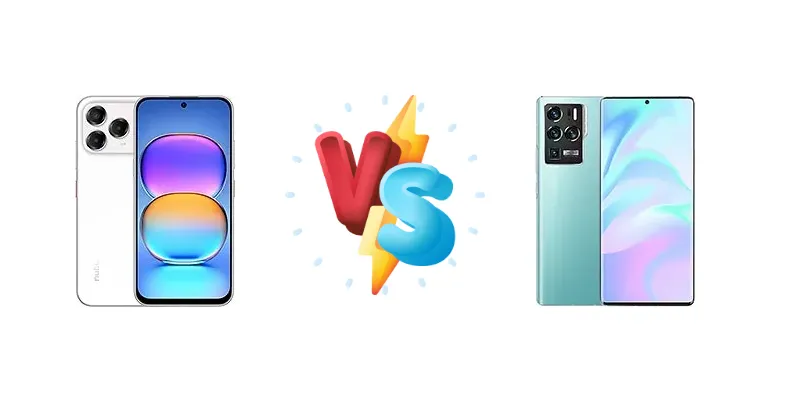
ZTE offers a diverse smartphone lineup, and the Blade V80 Pro and Axon 30 Ultra 5G represent opposite ends of their spectrum. The Blade V80 Pro aims for affordability, while the Axon 30 Ultra 5G targets a flagship experience. This comparison dissects their key differences to determine which device delivers the best value for your needs.
🏆 Quick Verdict
For the average user prioritizing performance and camera capabilities, the ZTE Axon 30 Ultra 5G is the clear winner. Its Snapdragon 888 chipset and superior charging speed justify the price premium. However, the Blade V80 Pro remains a compelling option for budget-conscious buyers who prioritize basic functionality.
| Network |
|---|
| 2G bands | GSM 850 / 900 / 1800 / 1900 | GSM 850 / 900 / 1800 / 1900 |
| 3G bands | HSDPA 850 / 900 / 1900 / 2100 | HSDPA 850 / 900 / 1700(AWS) / 1900 / 2100 |
| 4G bands | LTE | 1, 2, 3, 4, 5, 7, 8, 12, 17, 18, 19, 20, 26, 28, 34, 38, 39, 40, 41 |
| 5G bands | - | 1, 3, 28, 41, 78, 79 SA/NSA |
| Speed | HSPA, LTE | HSPA, LTE, 5G |
| Technology | GSM / HSPA / LTE | GSM / CDMA / HSPA / LTE / 5G |
| | - | CDMA 800 |
| Launch |
|---|
| Announced | 2025, November | 2021, April 15 |
| Status | Coming soon. Exp. release 2025, December | Available. Released 2021, April 19 |
| Body |
|---|
| Build | Glass front, plastic frame | Glass front (Gorilla Glass 5), glass back (Gorilla Glass 5), aluminum frame |
| Dimensions | 166 x 79 x 7.7 mm (6.54 x 3.11 x 0.30 in) | 161.5 x 73 x 8 mm (6.36 x 2.87 x 0.31 in) |
| SIM | Nano-SIM + Nano-SIM | Nano-SIM + Nano-SIM |
| Weight | 195 g (6.88 oz) | 188 g (6.63 oz) |
| Display |
|---|
| Protection | - | Corning Gorilla Glass 5 |
| Resolution | 900 x 1940 pixels, 19.5:9 ratio (~317 ppi density) | 1080 x 2400 pixels, 20:9 ratio (~395 ppi density) |
| Size | 6.75 inches, 112.2 cm2 (~85.6% screen-to-body ratio) | 6.67 inches, 107.4 cm2 (~91.1% screen-to-body ratio) |
| Type | IPS LCD, 120Hz, 1000 nits (HBM) | AMOLED, 1B colors, 144Hz, HDR10+ |
| Platform |
|---|
| CPU | Octa-core (2x2.2 GHz Cortex-A75 & 6x2.0 GHz Cortex-A55) | Octa-core (1x2.84 GHz Cortex-X1 & 3x2.42 GHz Cortex-A78 & 4x1.80 GHz Cortex-A55) |
| Chipset | Unisoc T7280 (12 nm) | Qualcomm SM8350 Snapdragon 888 5G (5 nm) |
| GPU | Mali-G57 MP1 | Adreno 660 |
| OS | Android 16 | Android 11, MyOS 11 |
| Memory |
|---|
| Card slot | microSDXC | No |
| Internal | 256GB 8GB RAM | 128GB 8GB RAM, 256GB 8GB RAM, 256GB 12GB RAM, 1TB 16GB RAM, 1TB 18GB RAM |
| | - | UFS 3.1 |
| Main Camera |
|---|
| Dual | 108 MP, f/1.8, (wide), PDAF
Auxiliary lenses | - |
| Features | LED flash, HDR, panorama | Laser AF, Dual-LED flash, panorama, HDR |
| Quad | - | 64 MP, f/1.6, 26mm (wide), 1/1.72", 0.8µm, PDAF, OIS
64 MP, f/1.9, 35mm (standard), 1/1.97", 0.7µm, PDAF
8 MP, f/3.4, 123mm (periscope telephoto), 1/4.0", PDAF, OIS, 5x optical zoom
64 MP, f/2.2, 13mm, 120˚ (ultrawide), 1/1.97", 0.7µm |
| Single | - | 16 MP, (wide) |
| Video | 1080p@30fps | 8K@30fps, 4K@30/60fps, 1080p@30fps, gyro-EIS, HDR10, 10‑bit video |
| Selfie camera |
|---|
| Features | - | HDR |
| Single | 16 MP | 16 MP, (wide) |
| Video | 1080p@30fps | 4K@30fps, 1080p@30fps |
| Sound |
|---|
| 3.5mm jack | - | No |
| 35mm jack | Yes | No |
| Loudspeaker | Yes | Yes, with stereo speakers |
| | - | 24-bit/192kHz audio |
| Comms |
|---|
| Bluetooth | 5.2, A2DP, LE | 5.2, A2DP, LE |
| NFC | Unspecified | Yes |
| Positioning | GPS, GALILEO, GLONASS | GPS, GLONASS, GALILEO, BDS |
| Radio | Unspecified | No |
| USB | USB Type-C 2.0, OTG | USB Type-C 3.1, OTG |
| WLAN | Wi-Fi 802.11 a/b/g/n/ac, dual-band | Wi-Fi 802.11 a/b/g/n/ac/6e, dual-band, Wi-Fi Direct |
| Features |
|---|
| Sensors | Fingerprint (side-mounted), accelerometer, proximity, compass | Fingerprint (under display, optical), accelerometer, gyro, proximity, compass |
| Battery |
|---|
| Charging | 22.5W wired
10W reverse wired | 65W wired, PD3.0, QC4 |
| Type | 5000 mAh | Li-Po 4600 mAh |
| Misc |
|---|
| Colors | White | Black, White, Blue, Light Brown, Aerospace Edition |
| Models | - | A2022P, A2022PG |
| Price | - | About 550 EUR |
| Tests |
|---|
| Battery life | - |
Endurance rating 91h
|
| Camera | - |
Photo / Video |
| Display | - |
Contrast ratio: Infinite (nominal) |
| Loudspeaker | - |
-24.6 LUFS (Very good)
|
| Performance | - |
AnTuTu: 703270 (v8)
GeekBench: 3582 (v5.1)
GFXBench: 54fps (ES 3.1 onscreen) |
ZTE Blade V80 Pro
- Affordable price point
- Reverse wired charging for accessories
- Decent battery endurance (91h)
- Significantly weaker processor
- Slower charging speed
- Likely inferior camera performance
ZTE Axon 30 Ultra 5G
- Flagship-level performance with Snapdragon 888
- 65W fast charging with PD3.0/QC4
- Brighter display for better outdoor visibility
- Higher price tag
- No reverse wireless charging
- Potentially higher thermal throttling under sustained load
Display Comparison
The ZTE Axon 30 Ultra 5G boasts a significantly brighter display, reaching a measured 698 nits, compared to an unspecified brightness for the Blade V80 Pro. While both phones offer a 'Photo/Video' capable display, the Axon 30 Ultra’s higher peak brightness translates to better visibility in direct sunlight. The Axon 30 Ultra also features an infinite (nominal) contrast ratio, suggesting a superior viewing experience with deeper blacks, though the Blade V80 Pro’s panel characteristics remain unknown. The absence of refresh rate data for the Blade V80 Pro suggests a standard 60Hz panel, while the Axon 30 Ultra likely offers a smoother experience.
Camera Comparison
Both phones are listed as having 'Photo/Video' capabilities, but the underlying hardware likely differs significantly. While specific sensor details are missing for both, the Axon 30 Ultra’s flagship positioning suggests a more advanced camera system with larger sensors and optical image stabilization (OIS). The Blade V80 Pro likely relies on a more basic camera setup to keep costs down. The absence of details on lens apertures and sensor sizes makes a precise comparison impossible, but the Axon 30 Ultra is expected to deliver superior image quality, especially in low-light conditions.
Performance
The performance gap between these devices is substantial. The ZTE Axon 30 Ultra 5G is powered by the Qualcomm SM8350 Snapdragon 888 5G (5 nm), featuring a Cortex-X1 prime core clocked at 2.84 GHz. This contrasts sharply with the Unisoc T7280 (12 nm) in the Blade V80 Pro, which utilizes Cortex-A75 cores at 2.2 GHz. The 5nm fabrication process of the Snapdragon 888 offers significantly improved power efficiency and thermal performance, allowing for sustained peak performance during demanding tasks. The Axon 30 Ultra’s CPU architecture, with its Cortex-X1, is designed for flagship-level responsiveness, while the Blade V80 Pro is geared towards everyday use.
Battery Life
Interestingly, both phones share an endurance rating of 91 hours. However, this doesn't tell the whole story. The Axon 30 Ultra 5G supports 65W wired charging with PD3.0 and QC4, enabling significantly faster charging times compared to the Blade V80 Pro’s 22.5W charging. While the Blade V80 Pro offers 10W reverse wired charging, a feature absent on the Axon 30 Ultra, the faster charging speed of the Axon 30 Ultra is more impactful for most users. The efficiency of the Snapdragon 888’s 5nm process also contributes to better battery life under heavy load.
Buying Guide
Buy the ZTE Blade V80 Pro if you need a reliable, affordable smartphone for everyday tasks like calling, texting, and light social media use. You'll appreciate its reverse wired charging for topping up accessories. Buy the ZTE Axon 30 Ultra 5G if you prioritize a high-performance experience for gaming, photography, and demanding applications, and value fast charging and a brighter display.
Frequently Asked Questions
❓ Is the Unisoc T7280 in the Blade V80 Pro capable of running demanding games like PUBG or Genshin Impact?
While the Unisoc T7280 can run these games, expect to make significant compromises in graphics settings and frame rates. The chipset's processing power and GPU are not optimized for high-end gaming, and you may experience stuttering or lag, especially during intense scenes. It's best suited for casual gaming or less demanding titles.
❓ Does the Snapdragon 888 in the Axon 30 Ultra 5G tend to overheat during prolonged gaming sessions?
The Snapdragon 888 is known to generate heat under sustained load. ZTE likely implemented thermal management solutions, such as vapor chamber cooling, to mitigate this. While some throttling may occur during extended gaming, the Axon 30 Ultra 5G's cooling system should prevent significant performance degradation. Monitoring temperatures during gameplay is recommended.
❓ How long does it realistically take to fully charge the ZTE Axon 30 Ultra 5G from 0% to 100%?
With its 65W fast charging support, the ZTE Axon 30 Ultra 5G can typically charge from 0% to 100% in approximately 35-45 minutes, depending on the charger and cable used. This is a substantial improvement over the Blade V80 Pro's slower 22.5W charging.