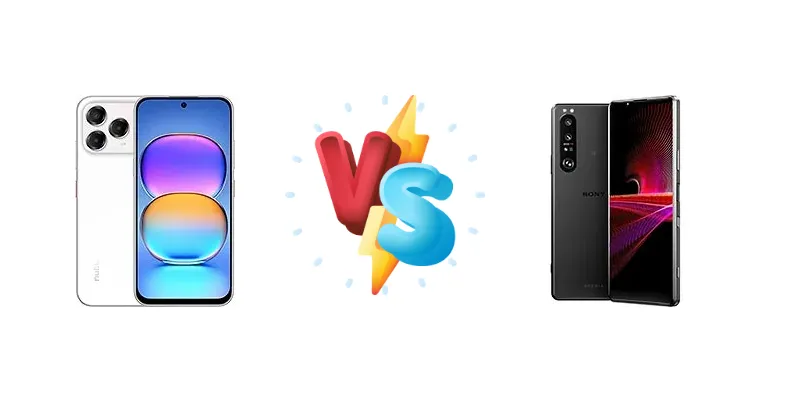
The ZTE Blade V80 Pro represents a compelling entry point into the 5G smartphone market, prioritizing affordability. Conversely, the Sony Xperia 1 III stands as a no-compromise flagship, boasting a premium build, cutting-edge performance, and a professional-grade camera system. This comparison dissects the core differences between these devices, helping you determine which aligns best with your priorities and budget.
🏆 Quick Verdict
For the average user prioritizing value, the ZTE Blade V80 Pro offers a functional 5G experience at a significantly lower price. However, the Sony Xperia 1 III is the clear winner for those demanding top-tier performance, a superior camera, and a premium user experience, justifying its higher cost.
| Network |
|---|
| 2G bands | GSM 850 / 900 / 1800 / 1900 | GSM 850 / 900 / 1800 / 1900 |
| 3G bands | HSDPA 850 / 900 / 1900 / 2100 | HSDPA 800 / 850 / 900 / 1700(AWS) / 1900 / 2100 |
| 4G bands | LTE | 1, 2, 3, 4, 5, 7, 8, 12, 13, 17, 19, 20, 25, 26, 28, 29, 32, 34, 38, 39, 40, 41, 46, 66 - Europe |
| 5G bands | - | 1, 3, 5, 7, 8, 20, 28, 38, 40, 41, 77, 78 SA/NSA/Sub6 - Europe |
| Speed | HSPA, LTE | HSPA, LTE, 5G |
| Technology | GSM / HSPA / LTE | GSM / HSPA / LTE / 5G |
| | - | SA/NSA/Sub6/mmWave - USA (specific) |
| Launch |
|---|
| Announced | 2025, November | 2021, April 14 |
| Status | Coming soon. Exp. release 2025, December | Available. Released 2021, August 25 |
| Body |
|---|
| Build | Glass front, plastic frame | Glass front (Gorilla Glass Victus), glass back (Gorilla Glass 6), aluminum frame |
| Dimensions | 166 x 79 x 7.7 mm (6.54 x 3.11 x 0.30 in) | 165 x 71 x 8.2 mm (6.50 x 2.80 x 0.32 in) |
| SIM | Nano-SIM + Nano-SIM | Nano-SIM + Nano-SIM |
| Weight | 195 g (6.88 oz) | 186 g / 187.1 g (mmWave) (6.56 oz) |
| | - | IP65/IP68 dust/water resistant (up to 1.5m for 30 min) |
| Display |
|---|
| Protection | - | Corning Gorilla Glass Victus |
| Resolution | 900 x 1940 pixels, 19.5:9 ratio (~317 ppi density) | 1644 x 3840 pixels, 21:9 ratio (~643 ppi density) |
| Size | 6.75 inches, 112.2 cm2 (~85.6% screen-to-body ratio) | 6.5 inches, 98.6 cm2 (~84.2% screen-to-body ratio) |
| Type | IPS LCD, 120Hz, 1000 nits (HBM) | OLED, 1B colors, 120Hz, HDR BT.2020 |
| | - | Runs at 1096 x 2560 pixels except for select use cases |
| Platform |
|---|
| CPU | Octa-core (2x2.2 GHz Cortex-A75 & 6x2.0 GHz Cortex-A55) | Octa-core (1x2.84 GHz Cortex-X1 & 3x2.42 GHz Cortex-A78 & 4x1.80 GHz Cortex-A55) |
| Chipset | Unisoc T7280 (12 nm) | Qualcomm SM8350 Snapdragon 888 5G (5 nm) |
| GPU | Mali-G57 MP1 | Adreno 660 |
| OS | Android 16 | Android 11, upgradable to Android 13 |
| Memory |
|---|
| Card slot | microSDXC | microSDXC (uses shared SIM slot) |
| Internal | 256GB 8GB RAM | 256GB 12GB RAM, 512GB 12GB RAM |
| | - | UFS 3.X |
| Main Camera |
|---|
| Dual | 108 MP, f/1.8, (wide), PDAF
Auxiliary lenses | - |
| Features | LED flash, HDR, panorama | Zeiss optics, Zeiss T* lens coating, color spectrum sensor, LED flash, panorama, HDR, eye tracking |
| Single | - | 8 MP, f/2.0, 24mm (wide), 1/4", 1.12µm |
| Triple | - | 12 MP, f/1.7, 24mm (wide), 1/1.7", 1.8µm, dual pixel PDAF, OIS
12 MP, f/2.3, 70mm (telephoto), f/2.8, 105mm (telephoto), 1/2.9", dual pixel PDAF, 3x/4.4x optical zoom, OIS
12 MP, f/2.2, 124˚, 16mm (ultrawide), 1/2.6", dual pixel PDAF
0.3 MP, TOF 3D, (depth) |
| Video | 1080p@30fps | 4K@24/25/30/60/120fps HDR, 1080p@30/60/120fps; 5-axis gyro-EIS, OIS |
| Selfie camera |
|---|
| Features | - | HDR |
| Single | 16 MP | 8 MP, f/2.0, 24mm (wide), 1/4.0", 1.12µm |
| Video | 1080p@30fps | 1080p@30fps, 5-axis gyro-EIS |
| Sound |
|---|
| 3.5mm jack | - | Yes |
| 35mm jack | Yes | Yes |
| Loudspeaker | Yes | Yes, with stereo speakers |
| | - | 24-bit/192kHz audio
Dynamic vibration system |
| Comms |
|---|
| Bluetooth | 5.2, A2DP, LE | 5.2, A2DP, LE, aptX HD, aptX Adaptive |
| NFC | Unspecified | Yes |
| Positioning | GPS, GALILEO, GLONASS | GPS, GLONASS, BDS, GALILEO, QZSS |
| Radio | Unspecified | No |
| USB | USB Type-C 2.0, OTG | USB Type-C 3.1, OTG, video output |
| WLAN | Wi-Fi 802.11 a/b/g/n/ac, dual-band | Wi-Fi 802.11 a/b/g/n/ac/6, dual-band, Wi-Fi Direct, DLNA |
| Features |
|---|
| Sensors | Fingerprint (side-mounted), accelerometer, proximity, compass | Fingerprint (side-mounted), accelerometer, gyro, proximity, barometer, compass |
| | - | Native Sony Alpha camera support |
| Battery |
|---|
| Charging | 22.5W wired
10W reverse wired | 30W wired, PD, 50% in 30 min
Wireless
Reverse wireless |
| Type | 5000 mAh | Li-Po 4500 mAh |
| Misc |
|---|
| Colors | White | Frosted Black, Frosted Gray, Frosted Purple |
| Models | - | XQBC62/V, XQBC52V.UKCX, SO-51B, SOG03, A101SO, XQ-BC62, XQ-BC72, XQ-BC52, XQ-BC01, XQ-BC11, XQ-BC21, XQ-BC72 |
| Price | - | € 505.26 / $ 903.43 |
| Tests |
|---|
| Battery life | - |
Endurance rating 82h
|
| Camera | - |
Photo / Video |
| Display | - |
Contrast ratio: Infinite (nominal) |
| Loudspeaker | - |
-26.5 LUFS (Good)
|
| Performance | - |
AnTuTu: 607423 (v8)
GeekBench: 3515 (v5.1)
GFXBench: 54fps (ES 3.1 onscreen) |
ZTE Blade V80 Pro
- Significantly lower price point
- Reverse wired charging capability
- Decent battery endurance (82h)
- Less powerful processor (Unisoc T7280)
- Inferior camera system
- Slower charging speeds
Sony Xperia 1 III
- Flagship-level performance (Snapdragon 888)
- Superior camera capabilities
- Faster charging (30W wired, wireless, reverse wireless)
- Much higher price
- Potential for thermal throttling under heavy load (though mitigated by 5nm process)
- Premium price may not be justified for basic users
Display Comparison
The Sony Xperia 1 III’s display boasts a measured peak brightness of 620 nits, offering excellent visibility in outdoor conditions, a feature likely absent in the Blade V80 Pro. While the Blade V80 Pro’s display specifications are not provided, it’s reasonable to assume a lower peak brightness. The Xperia 1 III’s infinite contrast ratio (nominal) suggests a high-quality OLED panel, delivering deep blacks and vibrant colors. The absence of LTPO technology in either device means refresh rate scaling isn’t a factor here, but the Xperia 1 III’s overall display quality is expected to be significantly superior.
Camera Comparison
Both devices feature photo/video capabilities, but the Sony Xperia 1 III is expected to excel due to its flagship status and Sony’s renowned camera technology. While specific sensor details are missing for both, the Xperia 1 III likely incorporates a larger main sensor and more advanced image processing algorithms. The Blade V80 Pro, targeting a lower price point, will likely feature a more basic camera system. The Xperia 1 III’s video capabilities are also expected to be superior, potentially offering features like 8K recording and advanced stabilization.
Performance
The core difference lies in the chipsets: the ZTE Blade V80 Pro utilizes the Unisoc T7280 (12nm), while the Sony Xperia 1 III is powered by the Qualcomm Snapdragon 888 5G (5nm). The Snapdragon 888’s 5nm process node provides a substantial advantage in power efficiency and thermal management compared to the Unisoc T7280’s 12nm node, translating to less throttling during sustained workloads. The Xperia 1 III’s CPU configuration – a Cortex-X1 prime core alongside Cortex-A78 and A55 cores – offers significantly higher single-core and multi-core performance than the Blade V80 Pro’s Cortex-A75 and A55 setup. This difference is crucial for demanding tasks like gaming and video editing.
Battery Life
Both phones share an endurance rating of 82 hours, suggesting comparable battery life under similar usage scenarios. However, the Sony Xperia 1 III’s 30W wired charging with PD and 50% charge in 30 minutes provides a significantly faster charging experience than the ZTE Blade V80 Pro’s 22.5W wired charging. The Xperia 1 III also offers wireless and reverse wireless charging, features absent on the Blade V80 Pro. While the Blade V80 Pro offers 10W reverse wired charging, the Xperia 1 III’s wireless reverse charging provides greater convenience.
Buying Guide
Buy the ZTE Blade V80 Pro if you need a reliable, affordable 5G smartphone for everyday tasks like browsing, social media, and light media consumption. You'll appreciate its reverse wired charging and decent battery life without breaking the bank. Buy the Sony Xperia 1 III if you prioritize professional-grade photography and videography, demanding performance for gaming and multitasking, and a premium, feature-rich smartphone experience. Its superior display and faster charging are also key benefits.
Frequently Asked Questions
❓ Is the Unisoc T7280 in the ZTE Blade V80 Pro capable of handling demanding games?
While the Unisoc T7280 can run many games, it will struggle with graphically intensive titles at higher settings. Expect reduced frame rates and potential lag compared to the Snapdragon 888 in the Xperia 1 III. It's best suited for casual gaming and less demanding titles.
❓ Does the Sony Xperia 1 III overheat during prolonged gaming sessions?
The Snapdragon 888 is known to generate heat under sustained load. However, the Xperia 1 III’s 5nm process node and Sony’s thermal management system help mitigate throttling. While some heat is expected, it shouldn’t significantly impact performance for most gaming sessions.
❓ What type of charging cable does the ZTE Blade V80 Pro use?
Given the 22.5W charging, the ZTE Blade V80 Pro likely uses a USB-C cable and charging adapter. However, the specific standard (e.g., Quick Charge, Power Delivery) isn't specified in the provided data.
❓ How does the camera on the Sony Xperia 1 III perform in low-light conditions?
Sony’s Xperia 1 III is expected to excel in low-light photography due to its larger sensor (likely) and advanced image processing. Features like night mode and optical image stabilization (OIS) will contribute to brighter, clearer images with reduced noise.