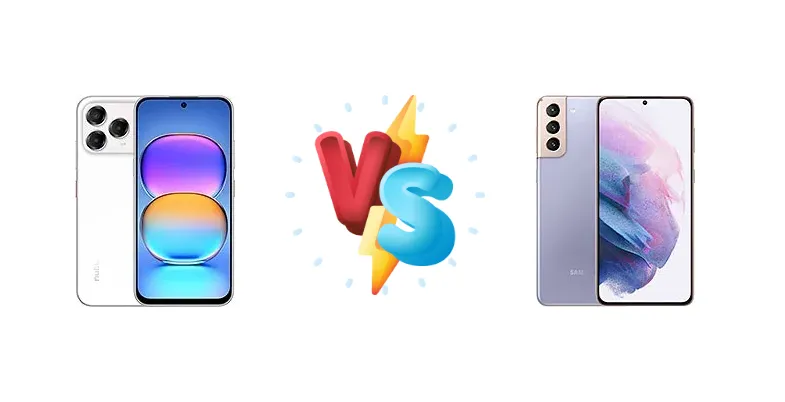
The Samsung Galaxy S21+ 5G, while no longer the newest flagship, remains a potent contender, especially as prices fall. But can it justify its cost against a more affordable option like the ZTE Blade V80 Pro? This comparison dives deep into the specs and real-world implications to determine which phone delivers the best value for your money.
🏆 Quick Verdict
For the average user prioritizing a smooth, responsive experience and a capable camera, the Samsung Galaxy S21+ 5G is the clear winner. Its significantly more powerful chipset and superior display justify the higher price. However, the ZTE Blade V80 Pro offers a compelling budget option for basic tasks.
| Network |
|---|
| 2G bands | GSM 850 / 900 / 1800 / 1900 | GSM 850 / 900 / 1800 / 1900 |
| 3G bands | HSDPA 850 / 900 / 1900 / 2100 | HSDPA 850 / 900 / 1700(AWS) / 1900 / 2100 |
| 4G bands | LTE | 1, 2, 3, 4, 5, 7, 8, 12, 13, 14, 18, 19, 20, 25, 26, 28, 30, 38, 39, 40, 41, 46, 48, 66, 71 - SM-G996U1 |
| 5G bands | - | 2, 5, 25, 41, 66, 71, 260, 261 SA/NSA/Sub6/mmWave - SM-G996U1 |
| Speed | HSPA, LTE | HSPA 42.2/5.76 Mbps, LTE (7CA) Cat20 2000/200 Mbps, 5G (5+ Gbps DL) |
| Technology | GSM / HSPA / LTE | GSM / CDMA / HSPA / EVDO / LTE / 5G |
| | - | 1, 3, 5, 7, 8, 20, 28, 38, 40, 41, 66, 77, 78 SA/NSA/Sub6 - SM-G996B |
| Launch |
|---|
| Announced | 2025, November | 2021, January 14 |
| Status | Coming soon. Exp. release 2025, December | Available. Released 2021, January 29 |
| Body |
|---|
| Build | Glass front, plastic frame | Glass front (Gorilla Glass Victus), glass back (Gorilla Glass Victus), aluminum frame |
| Dimensions | 166 x 79 x 7.7 mm (6.54 x 3.11 x 0.30 in) | 161.5 x 75.6 x 7.8 mm (6.36 x 2.98 x 0.31 in) |
| SIM | Nano-SIM + Nano-SIM | · Nano-SIM + eSIM· Nano-SIM + Nano-SIM + eSIM (max 2 at a time) |
| Weight | 195 g (6.88 oz) | 200 g (Sub6), 202 g (mmWave) (7.05 oz) |
| | - | IP68 dust/water resistant (up to 1.5m for 30 min) |
| Display |
|---|
| Protection | - | Corning Gorilla Glass Victus |
| Resolution | 900 x 1940 pixels, 19.5:9 ratio (~317 ppi density) | 1080 x 2400 pixels, 20:9 ratio (~394 ppi density) |
| Size | 6.75 inches, 112.2 cm2 (~85.6% screen-to-body ratio) | 6.7 inches, 107.8 cm2 (~88.3% screen-to-body ratio) |
| Type | IPS LCD, 120Hz, 1000 nits (HBM) | Dynamic AMOLED 2X, 120Hz, HDR10+, 1300 nits (peak) |
| | - | Always-on display |
| Platform |
|---|
| CPU | Octa-core (2x2.2 GHz Cortex-A75 & 6x2.0 GHz Cortex-A55) | Octa-core (1x2.9 GHz Cortex-X1 & 3x2.80 GHz Cortex-A78 & 4x2.2 GHz Cortex-A55) - InternationalOcta-core (1x2.84 GHz Cortex-X1 & 3x2.42 GHz Cortex-A78 & 4x1.80 GHz Cortex-A55) - USA/China |
| Chipset | Unisoc T7280 (12 nm) | Exynos 2100 (5 nm) - InternationalQualcomm SM8350 Snapdragon 888 5G (5 nm) - USA/China |
| GPU | Mali-G57 MP1 | Mali-G78 MP14 - InternationalAdreno 660 - USA/China |
| OS | Android 16 | Android 11, up to 4 major Android upgrades, One UI 6.1 |
| Memory |
|---|
| Card slot | microSDXC | No |
| Internal | 256GB 8GB RAM | 128GB 8GB RAM, 256GB 8GB RAM |
| | - | UFS 3.1 |
| Main Camera |
|---|
| Dual | 108 MP, f/1.8, (wide), PDAF
Auxiliary lenses | - |
| Features | LED flash, HDR, panorama | LED flash, auto-HDR, panorama |
| Triple | - | 12 MP, f/1.8, 26mm (wide), 1/1.76", 1.8µm, dual pixel PDAF, OIS
64 MP, f/2.0, 29mm (telephoto), 1/1.72", 0.8µm, PDAF, OIS, 1.1x optical zoom, 3x hybrid zoom
12 MP, f/2.2, 13mm, 120˚ (ultrawide), 1/2.55" 1.4µm, Super Steady video |
| Video | 1080p@30fps | 8K@24fps, 4K@30/60fps, 1080p@30/60/120/240fps, HDR10+, stereo sound rec., gyro-EIS |
| Selfie camera |
|---|
| Features | - | HDR |
| Single | 16 MP | 10 MP, f/2.2, 26mm (wide), 1/3.24", 1.22µm, dual pixel PDAF |
| Video | 1080p@30fps | 4K@30/60fps, 1080p@30fps |
| Sound |
|---|
| 3.5mm jack | - | No |
| 35mm jack | Yes | No |
| Loudspeaker | Yes | Yes, with stereo speakers |
| | - | 32-bit/384kHz audio
Tuned by AKG |
| Comms |
|---|
| Bluetooth | 5.2, A2DP, LE | 5.0, A2DP, LE |
| NFC | Unspecified | Yes |
| Positioning | GPS, GALILEO, GLONASS | GPS, GLONASS, BDS, GALILEO |
| Radio | Unspecified | FM radio (Snapdragon model only; market/operator dependent) |
| USB | USB Type-C 2.0, OTG | USB Type-C 3.2, OTG |
| WLAN | Wi-Fi 802.11 a/b/g/n/ac, dual-band | Wi-Fi 802.11 a/b/g/n/ac/6, dual-band, Wi-Fi Direct |
| Features |
|---|
| Sensors | Fingerprint (side-mounted), accelerometer, proximity, compass | Fingerprint (under display, ultrasonic), accelerometer, gyro, proximity, compass, barometer |
| | - | Samsung DeX, Samsung Wireless DeX (desktop experience support)
Bixby natural language commands and dictation
Samsung Pay (Visa, MasterCard certified)
Ultra Wideband (UWB) support |
| Battery |
|---|
| Charging | 22.5W wired
10W reverse wired | 25W wired, PD3.0
15W wireless (Qi)
4.5W reverse wireless |
| Type | 5000 mAh | Li-Ion 4800 mAh |
| Misc |
|---|
| Colors | White | Phantom Black, Phantom Silver, Phantom Violet, Phantom Pink, Phantom Gold, Phantom Red |
| Models | - | SM-G996B, SM-G996B/DS, SM-G996U, SM-G996U1, SM-G996W, SM-G996N, SM-G9960 |
| Price | - | $ 162.99 / £ 185.00 / € 199.00 |
| SAR | - | 0.65 W/kg (head) 0.95 W/kg (body) |
| SAR EU | - | 0.54 W/kg (head) 1.33 W/kg (body) |
| Tests |
|---|
| Battery life | - |
Endurance rating 114h
|
| Camera | - |
Photo / Video |
| Display | - |
Contrast ratio: Infinite (nominal) |
| Loudspeaker | - |
-25.8 LUFS (Very good)
|
| Performance | - |
AnTuTu: 622276 (v8)
GeekBench: 3476 (v5.1)
GFXBench: 54fps (ES 3.1 onscreen) |
ZTE Blade V80 Pro
- Significantly more affordable
- Decent battery endurance (114h)
- Reverse wired charging capability
- Underpowered Unisoc T7280 chipset
- Inferior display quality
- Less capable camera system
Samsung Galaxy S21+ 5G
- Powerful Exynos 2100 or Snapdragon 888 chipset
- Bright and vibrant display (883 nits)
- Versatile camera system with advanced features
- Higher price point
- Can be prone to thermal throttling under heavy load
- Battery life is comparable to the V80 Pro despite higher specs
Display Comparison
The Samsung Galaxy S21+ 5G boasts a significantly more premium display experience. While both phones lack detailed display specs beyond brightness, the S21+'s measured 883 nits peak brightness ensures excellent visibility even outdoors. The 'Infinite' contrast ratio suggests a high-quality AMOLED panel, offering deep blacks and vibrant colors. The Blade V80 Pro, lacking these details, likely utilizes a less advanced LCD panel, resulting in lower contrast and potentially washed-out colors in direct sunlight. The S21+'s display is geared towards media consumption and gaming, while the V80 Pro's is likely adequate for basic use.
Camera Comparison
Both phones feature 'Photo / Video' capabilities, but the implementation differs greatly. The S21+ benefits from Samsung’s image processing expertise and likely a larger, more sophisticated sensor array (specs not provided). While the Blade V80 Pro likely includes a multi-camera setup, the absence of sensor size details suggests it won’t compete with the S21+ in image quality, especially in low-light conditions. The S21+'s camera system is designed for capturing detailed photos and videos, while the V80 Pro’s is likely sufficient for casual snapshots. We can assume the S21+ will offer features like optical image stabilization (OIS) for sharper images and smoother videos, a feature likely absent on the V80 Pro.
Performance
The performance gap is substantial. The Samsung Galaxy S21+ 5G, equipped with either the Exynos 2100 (International) or Snapdragon 888 (USA/China) built on a 5nm process, delivers significantly faster processing speeds than the ZTE Blade V80 Pro’s Unisoc T7280 (12nm). The S21+'s CPU configuration – Cortex-X1, A78, and A55 cores – is architecturally superior, offering better single-core and multi-core performance. This translates to snappier app launches, smoother multitasking, and a more enjoyable gaming experience. The Unisoc T7280, while capable for everyday tasks, will struggle with demanding games and applications. The 5nm fabrication process of the S21+'s chipset also contributes to better thermal efficiency, reducing throttling during sustained workloads.
Battery Life
Both phones share an endurance rating of 114 hours, suggesting comparable battery life under similar usage scenarios. However, the S21+’s 25W wired charging with PD3.0 support is faster than the Blade V80 Pro’s 22.5W charging. The S21+ also offers 15W wireless charging (Qi) and 4.5W reverse wireless charging, features absent on the V80 Pro. While the battery capacity isn't specified for either device, the S21+'s faster charging and wireless capabilities provide greater convenience and flexibility. The V80 Pro's 10W reverse wired charging is a niche feature, but useful for topping up accessories.
Buying Guide
Buy the ZTE Blade V80 Pro if you need a functional smartphone for essential tasks like calling, texting, and light social media use, and your budget is extremely limited. Buy the Samsung Galaxy S21+ 5G if you prioritize performance for gaming and demanding apps, a brighter and more vibrant display, and a more versatile camera system, and are willing to spend more.
Frequently Asked Questions
❓ Does the Exynos 2100 chip in the international S21+ 5G overheat during prolonged gaming sessions?
The Exynos 2100 was known to run warmer than the Snapdragon 888, potentially leading to thermal throttling during extended gaming. However, Samsung implemented software optimizations to mitigate this issue, and the S21+'s cooling system is generally adequate for most gaming scenarios. Expect some performance reduction after prolonged use, but it shouldn't be a deal-breaker.
❓ Is the 2MP macro camera on the ZTE Blade V80 Pro actually useful for taking detailed close-up photos?
Generally, 2MP macro cameras on budget phones offer limited detail and image quality. The small sensor size and lack of optical image stabilization result in soft, noisy images. While it can be fun to experiment with, don't expect professional-level macro photography from the Blade V80 Pro.
❓ Can the Samsung Galaxy S21+ 5G reliably maintain 60fps in demanding games like PUBG Mobile at high graphics settings?
Yes, the Snapdragon 888 or Exynos 2100 in the S21+ 5G are capable of running PUBG Mobile at high graphics settings and maintaining a stable 60fps. However, prolonged gaming sessions may lead to some thermal throttling, potentially causing frame rate drops. Optimizing in-game settings can help mitigate this.
❓ How long does it realistically take to fully charge the ZTE Blade V80 Pro from 0% to 100% using the included charger?
With 22.5W charging, expect a full charge from 0% to 100% to take approximately 1 hour and 45 minutes to 2 hours, depending on usage during charging. It won't be as fast as the S21+'s 25W charging, but it's still reasonably quick for a budget device.