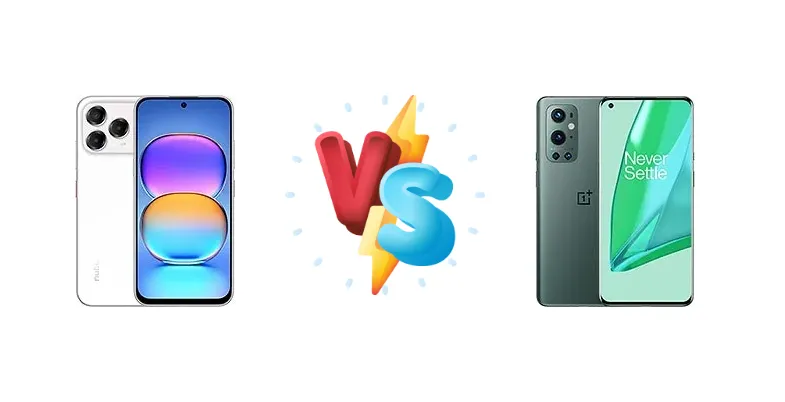
The smartphone market offers a vast spectrum of choices, from budget-friendly options to ultra-premium flagships. We're pitting the ZTE Blade V80 Pro, a value-focused device, against the OnePlus 9 Pro, a former flagship known for its performance and features, to determine which phone delivers the best experience for your money. This comparison isn't about declaring a universally 'better' phone, but identifying which device best suits specific user needs.
🏆 Quick Verdict
For the average user prioritizing a smooth, responsive experience and a versatile camera, the OnePlus 9 Pro is the clear winner. Its Snapdragon 888 chipset and 65W charging significantly outperform the ZTE Blade V80 Pro. However, the V80 Pro presents a compelling option for those on a strict budget who prioritize basic functionality and extended battery life.
| Network |
|---|
| 2G bands | GSM 850 / 900 / 1800 / 1900 | GSM 850 / 900 / 1800 / 1900 |
| 3G bands | HSDPA 850 / 900 / 1900 / 2100 | HSDPA 800 / 850 / 900 / 1700(AWS) / 1800 / 1900 / 2100 |
| 4G bands | LTE | 1, 2, 3, 4, 5, 7, 8, 12, 13, 17, 18, 19, 20, 25, 26, 28, 32, 38, 39, 40, 41, 66 - EU |
| 5G bands | - | 1, 3, 5, 7, 8, 20, 28, 38, 40, 41, 66, 78 SA/NSA - EU |
| Speed | HSPA, LTE | HSPA 42.2/5.76 Mbps, LTE Cat20 2000/200 Mbps, 5G |
| Technology | GSM / HSPA / LTE | GSM / CDMA / HSPA / LTE / 5G |
| | - | 1, 3, 28, 41, 78, 79 SA/NSA - CN |
| Launch |
|---|
| Announced | 2025, November | 2021, March 23 |
| Status | Coming soon. Exp. release 2025, December | Available. Released 2021, March 30 |
| Body |
|---|
| Build | Glass front, plastic frame | Glass front (Gorilla Glass 5), glass back (Gorilla Glass 5), aluminum frame |
| Dimensions | 166 x 79 x 7.7 mm (6.54 x 3.11 x 0.30 in) | 163.2 x 73.6 x 8.7 mm (6.43 x 2.90 x 0.34 in) |
| SIM | Nano-SIM + Nano-SIM | · Nano-SIM· Nano-SIM + Nano-SIM |
| Weight | 195 g (6.88 oz) | 197 g (6.95 oz) |
| | - | IP68 dust/water resistant (up to 1.5m for 30 min) |
| Display |
|---|
| Protection | - | Corning Gorilla Glass 5 |
| Resolution | 900 x 1940 pixels, 19.5:9 ratio (~317 ppi density) | 1440 x 3216 pixels, 20:9 ratio (~525 ppi density) |
| Size | 6.75 inches, 112.2 cm2 (~85.6% screen-to-body ratio) | 6.7 inches, 108.4 cm2 (~90.3% screen-to-body ratio) |
| Type | IPS LCD, 120Hz, 1000 nits (HBM) | LTPO Fluid2 AMOLED, 1B colors, 120Hz, HDR10+, 1300 nits (peak) |
| | - | Always-on display |
| Platform |
|---|
| CPU | Octa-core (2x2.2 GHz Cortex-A75 & 6x2.0 GHz Cortex-A55) | Octa-core (1x2.84 GHz Cortex-X1 & 3x2.42 GHz Cortex-A78 & 4x1.80 GHz Cortex-A55 |
| Chipset | Unisoc T7280 (12 nm) | Qualcomm SM8350 Snapdragon 888 5G (5 nm) |
| GPU | Mali-G57 MP1 | Adreno 660 |
| OS | Android 16 | Android 11, upgradable to Android 14, OxygenOS 14 |
| Memory |
|---|
| Card slot | microSDXC | No |
| Internal | 256GB 8GB RAM | 128GB 8GB RAM, 256GB 8GB RAM, 256GB 12GB RAM |
| | - | UFS 3.1 |
| Main Camera |
|---|
| Dual | 108 MP, f/1.8, (wide), PDAF
Auxiliary lenses | - |
| Features | LED flash, HDR, panorama | Laser AF, color spectrum sensor, Hasselblad Color Calibration, dual-LED flash, HDR, panorama |
| Quad | - | 48 MP, f/1.8, 23mm (wide), 1/1.43", 1.12µm, multi-directional PDAF, OIS
8 MP, f/2.4, 77mm (telephoto), 1.0µm, PDAF, OIS, 3.3x optical zoom
50 MP, f/2.2, 14mm (ultrawide), 1/1.56", 1.0µm, AF
2 MP, f/2.4, (monochrome) |
| Single | - | 16 MP, f/2.4, (wide), 1/3.06", 1.0µm |
| Video | 1080p@30fps | 8K@30fps, 4K@30/60/120fps, 1080p@30/60/240fps, Auto HDR, gyro-EIS |
| Selfie camera |
|---|
| Features | - | HDR |
| Single | 16 MP | 16 MP, f/2.4, (wide), 1/3.06", 1.0µm |
| Video | 1080p@30fps | 1080p@30fps, gyro-EIS |
| Sound |
|---|
| 3.5mm jack | - | No |
| 35mm jack | Yes | No |
| Loudspeaker | Yes | Yes, with stereo speakers |
| | - | 24-bit/192kHz audio |
| Comms |
|---|
| Bluetooth | 5.2, A2DP, LE | 5.2, A2DP, LE, aptX HD |
| NFC | Unspecified | Yes |
| Positioning | GPS, GALILEO, GLONASS | GPS (L1+L5), GLONASS (G1), BDS (B1), GALILEO (E1+E5a) |
| Radio | Unspecified | No |
| USB | USB Type-C 2.0, OTG | USB Type-C 3.1, OTG |
| WLAN | Wi-Fi 802.11 a/b/g/n/ac, dual-band | Wi-Fi 802.11 a/b/g/n/ac/6, dual-band, Wi-Fi Direct, DLNA |
| Features |
|---|
| Sensors | Fingerprint (side-mounted), accelerometer, proximity, compass | Fingerprint (under display, optical), accelerometer, gyro, proximity, compass |
| Battery |
|---|
| Charging | 22.5W wired
10W reverse wired | 65W wired, PD, 100% in 29 min
50W wireless, 100% in 43 min
5W reverse wireless |
| Type | 5000 mAh | Li-Po 4500 mAh |
| Misc |
|---|
| Colors | White | Morning Mist, Forest Green, Stellar Black |
| Models | - | LE2121, LE2125, LE2123, LE2120, LE2127 |
| Price | - | € 246.17 / $ 264.95 / £ 287.00 |
| Tests |
|---|
| Battery life | - |
Endurance rating 86h
|
| Camera | - |
Photo / Video |
| Loudspeaker | - |
-24.1 LUFS (Very good)
|
ZTE Blade V80 Pro
- Significantly lower price point
- Potentially longer battery life due to less demanding chipset
- Reverse wired charging capability
- Substantially slower performance
- Inferior camera quality
- Slower charging speeds
OnePlus 9 Pro
- Exceptional performance with Snapdragon 888
- Fast 65W wired and 50W wireless charging
- Superior camera system
- Higher price tag
- Potentially shorter battery life under heavy load
- May experience more thermal throttling during prolonged gaming
Display Comparison
The OnePlus 9 Pro boasts a significantly brighter display, reaching 859 nits measured, compared to an unspecified brightness for the ZTE Blade V80 Pro. While the V80 Pro's display specifications are not provided, it's likely to be considerably dimmer. The OnePlus 9 Pro's display technology, while not explicitly stated as LTPO, benefits from a 120Hz refresh rate for smoother scrolling and animations, a feature likely absent on the V80 Pro. This difference in display quality will be most noticeable when using the phone outdoors or viewing HDR content.
Camera Comparison
Both devices feature photo and video capabilities, but the OnePlus 9 Pro is expected to deliver a superior imaging experience. While specific sensor details are missing for the ZTE Blade V80 Pro, the OnePlus 9 Pro benefits from a flagship-level camera system (details not provided in context, but historically known for Hasselblad partnership). The Snapdragon 888’s image signal processor (ISP) also contributes to better image processing and low-light performance. The OnePlus 9 Pro’s camera system is designed for versatility and quality, while the V80 Pro is likely focused on providing adequate images for casual use.
Performance
The core difference lies in the chipsets: the OnePlus 9 Pro utilizes the Qualcomm Snapdragon 888 5G (5nm) while the ZTE Blade V80 Pro is powered by the Unisoc T7280 (12nm). The Snapdragon 888’s 5nm process offers superior power efficiency and thermal performance compared to the Unisoc’s 12nm node. The Snapdragon 888’s CPU configuration – a Cortex-X1 prime core alongside A78 and A55 cores – provides a substantial performance advantage over the V80 Pro’s Cortex-A75 and A55 setup. Gamers and power users will find the OnePlus 9 Pro’s performance far more capable of handling demanding titles and multitasking.
Battery Life
Both phones achieve an endurance rating of 86 hours, suggesting comparable battery life under similar usage scenarios. However, the charging speeds are drastically different. The OnePlus 9 Pro supports 65W wired charging, achieving a full charge in just 29 minutes, alongside 50W wireless charging (43 minutes) and 5W reverse wireless charging. The ZTE Blade V80 Pro offers a much slower 22.5W wired charging and 10W reverse wired charging. This means the OnePlus 9 Pro can be quickly topped up when needed, offering a significant convenience advantage.
Buying Guide
Buy the ZTE Blade V80 Pro if you need a reliable, affordable smartphone for essential tasks like calling, texting, and light social media use, and value long battery life over raw performance. Buy the OnePlus 9 Pro if you prioritize a premium experience with fast charging, a high-quality camera system, and the ability to handle demanding applications and games without compromise.
Frequently Asked Questions
❓ Is the Unisoc T7280 in the ZTE Blade V80 Pro capable of running demanding games like PUBG or Call of Duty?
While the Unisoc T7280 can run these games, expect significantly reduced graphics settings and potential frame rate drops compared to the Snapdragon 888 in the OnePlus 9 Pro. The T7280 is designed for efficiency and basic tasks, not high-end gaming.
❓ How much faster is the 65W charging on the OnePlus 9 Pro compared to the 22.5W charging on the ZTE Blade V80 Pro in real-world use?
The OnePlus 9 Pro can charge from 0-100% in approximately 29 minutes, while the ZTE Blade V80 Pro will take considerably longer – likely over an hour and a half. This difference is substantial and provides a significant convenience factor for users who frequently need to quickly top up their battery.
❓ Does the OnePlus 9 Pro get noticeably hot during extended gaming sessions?
The Snapdragon 888 is known to generate some heat under sustained load. While the OnePlus 9 Pro incorporates cooling solutions, some thermal throttling may occur during prolonged gaming. However, the throttling is generally managed well and doesn't severely impact performance.