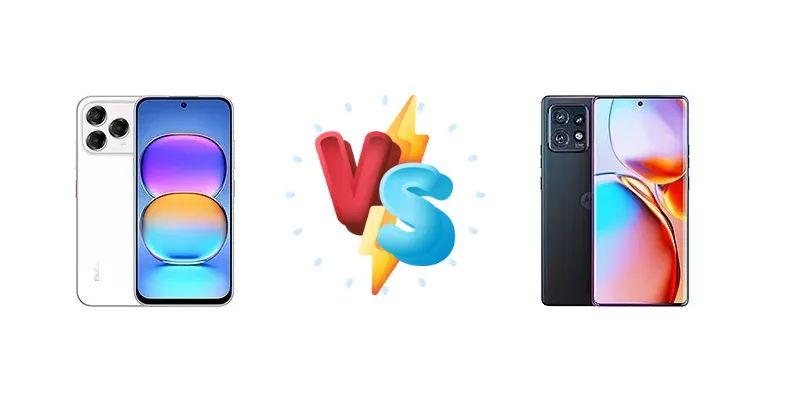
The Motorola Edge+ (2023) represents a current-generation flagship experience, while the ZTE Blade V80 Pro aims to deliver a solid smartphone experience at a significantly lower price point. This comparison dissects the core differences between these devices, focusing on how their contrasting chipsets and feature sets impact real-world usage.
🏆 Quick Verdict
For users prioritizing raw performance, gaming, and fast charging, the Motorola Edge+ (2023) is the clear winner. However, the ZTE Blade V80 Pro offers a compelling value proposition for those seeking a functional and reliable smartphone without the flagship price tag.
| Network |
|---|
| 2G bands | GSM 850 / 900 / 1800 / 1900 | GSM 850 / 900 / 1800 / 1900 |
| 3G bands | HSDPA 850 / 900 / 1900 / 2100 | HSDPA 850 / 900 / 1700(AWS) / 1900 / 2100 |
| 4G bands | LTE | 1, 2, 3, 4, 5, 7, 8, 12, 13, 14, 17, 18, 20, 25, 26, 28, 29, 30, 38, 39, 40, 41, 41, 46, 48, 66, 71 |
| 5G bands | - | 1, 2, 3, 5, 7, 12, 14, 20, 25, 26, 28, 29, 30, 38, 41, 41, 48, 66, 70, 71, 77, 78 SA/NSA/Sub6/mmWave |
| Speed | HSPA, LTE | HSPA, LTE, 5G |
| Technology | GSM / HSPA / LTE | GSM / HSPA / LTE / 5G |
| Launch |
|---|
| Announced | 2025, November | 2023, May 02 |
| Status | Coming soon. Exp. release 2025, December | Available. Released 2023, May 19 |
| Body |
|---|
| Build | Glass front, plastic frame | Glass front (Gorilla Glass Victus), glass back (Gorilla Glass Victus), aluminum frame |
| Dimensions | 166 x 79 x 7.7 mm (6.54 x 3.11 x 0.30 in) | 161.2 x 74 x 8.6 mm (6.35 x 2.91 x 0.34 in) |
| SIM | Nano-SIM + Nano-SIM | Nano-SIM + eSIM |
| Weight | 195 g (6.88 oz) | 203 g (7.16 oz) |
| | - | IP68 dust/water resistant (up to 1.5m for 30 min) |
| Display |
|---|
| Protection | - | Corning Gorilla Glass Victus |
| Resolution | 900 x 1940 pixels, 19.5:9 ratio (~317 ppi density) | 1080 x 2400 pixels, 20:9 ratio (~395 ppi density) |
| Size | 6.75 inches, 112.2 cm2 (~85.6% screen-to-body ratio) | 6.67 inches, 107.4 cm2 (~90.0% screen-to-body ratio) |
| Type | IPS LCD, 120Hz, 1000 nits (HBM) | OLED, 1B colors, 165Hz, HDR10+, Dolby Vision, 1300 nits (peak) |
| Platform |
|---|
| CPU | Octa-core (2x2.2 GHz Cortex-A75 & 6x2.0 GHz Cortex-A55) | Octa-core (1x3.2 GHz Cortex-X3 & 2x2.8 GHz Cortex-A715 & 2x2.8 GHz Cortex-A710 & 3x2.0 GHz Cortex-A510) |
| Chipset | Unisoc T7280 (12 nm) | Qualcomm SM8550-AB Snapdragon 8 Gen 2 (4 nm) |
| GPU | Mali-G57 MP1 | Adreno 740 |
| OS | Android 16 | Android 13, upgradable to Android 14 |
| Memory |
|---|
| Card slot | microSDXC | No |
| Internal | 256GB 8GB RAM | 512GB 8GB RAM |
| | - | UFS 4.0 |
| Main Camera |
|---|
| Dual | 108 MP, f/1.8, (wide), PDAF
Auxiliary lenses | - |
| Features | LED flash, HDR, panorama | Dual-LED flash, panorama, HDR |
| Triple | - | 50 MP, f/1.8, (wide), 1/1.55", 1.0µm, multi-directional PDAF, OIS
12 MP, f/1.6, (telephoto), 1/2.93", 1.22µm, PDAF, 2x optical zoom
50 MP, f/2.2, 114˚ (ultrawide), 1/2.76", 0.64µm, AF |
| Video | 1080p@30fps | 8K@30fps, 4K@30/60fps, 1080p@30/60/120/240/960fps, 10-bit HDR10+, gyro-EIS |
| Selfie camera |
|---|
| Features | - | HDR |
| Single | 16 MP | 60 MP, f/2.2, (wide), 1/2.8", 0.61µm |
| Video | 1080p@30fps | 4K@30/60fps, 1080p@30/60/120/240fps |
| Sound |
|---|
| 3.5mm jack | - | No |
| 35mm jack | Yes | No |
| Loudspeaker | Yes | Yes, with stereo speakers |
| Comms |
|---|
| Bluetooth | 5.2, A2DP, LE | 5.3, A2DP, LE, aptX HD, aptX Adaptive |
| NFC | Unspecified | Yes |
| Positioning | GPS, GALILEO, GLONASS | GPS, GLONASS, GALILEO, BDS |
| Radio | Unspecified | No |
| USB | USB Type-C 2.0, OTG | USB Type-C 3.2, OTG, DisplayPort 1.4 |
| WLAN | Wi-Fi 802.11 a/b/g/n/ac, dual-band | Wi-Fi 802.11 a/b/g/n/ac/6e/7, tri-band, Wi-Fi Direct |
| Features |
|---|
| Sensors | Fingerprint (side-mounted), accelerometer, proximity, compass | Fingerprint (under display, optical), accelerometer, gyro, proximity, compass, barometer |
| | - | Ready For 3.5 support |
| Battery |
|---|
| Charging | 22.5W wired
10W reverse wired | 68W wired
15W wireless
5W reverse wired
5W reverse wireless |
| Type | 5000 mAh | Li-Po 5100 mAh |
| Misc |
|---|
| Colors | White | Interstellar Black |
| Price | - | $ 298.99 |
ZTE Blade V80 Pro
- Excellent value for money
- Reliable for basic smartphone tasks
- Reverse wired charging capability
- Significantly slower performance
- Outdated chipset technology
- Likely inferior camera quality
Motorola Edge+ (2023)
- Flagship-level performance with Snapdragon 8 Gen 2
- Ultra-fast 68W wired charging
- Wireless and reverse wireless charging
- Higher price point
- Potential for thermal throttling under extreme load
- May be overkill for basic users
Display Comparison
While display specifications aren't provided for the ZTE Blade V80 Pro, we can infer it utilizes a standard LCD panel given its price point. The Motorola Edge+ (2023) likely features an OLED display, offering superior contrast and color accuracy. The difference in chipset manufacturing processes – 12nm for the Unisoc T7280 versus 4nm for the Snapdragon 8 Gen 2 – doesn't directly impact the display, but the Edge+’s more advanced panel will provide a visually richer experience. The lack of information on refresh rates for the Blade V80 Pro suggests a standard 60Hz panel, while the Edge+ likely boasts a 144Hz or higher refresh rate for smoother scrolling and animations.
Camera Comparison
Without detailed camera specifications for the ZTE Blade V80 Pro, a direct comparison is limited. However, given its price bracket, it likely features a basic camera setup focused on functionality rather than image quality. The Motorola Edge+ (2023) is expected to have a more sophisticated camera system, potentially including larger sensors, optical image stabilization (OIS), and advanced image processing algorithms. The Snapdragon 8 Gen 2’s ISP (Image Signal Processor) is also significantly more powerful, enabling features like faster autofocus, improved low-light performance, and higher-quality video recording. The absence of details on the Blade V80 Pro’s camera suggests it won’t compete with the Edge+ in image quality or features.
Performance
The core difference lies in the chipsets. The Qualcomm Snapdragon 8 Gen 2 (4nm) in the Motorola Edge+ (2023) is a flagship processor built on a significantly more efficient node than the Unisoc T7280 (12nm) found in the ZTE Blade V80 Pro. The Snapdragon 8 Gen 2’s octa-core configuration, featuring a Cortex-X3 prime core clocked at 3.2 GHz, delivers substantially higher CPU and GPU performance. This translates to faster app loading times, smoother multitasking, and a far superior gaming experience. The Unisoc T7280, while capable for everyday tasks, will struggle with graphically intensive games and demanding applications. The Snapdragon 8 Gen 2’s architecture also benefits from improved thermal management, reducing throttling during sustained workloads.
Battery Life
The Motorola Edge+ (2023) boasts a significant advantage in charging speed with its 68W wired charging capability, allowing for a full charge in under 40 minutes. The ZTE Blade V80 Pro’s 22.5W charging is considerably slower. While battery capacity isn’t specified for either device, the Snapdragon 8 Gen 2’s 4nm process contributes to better power efficiency, potentially offsetting a smaller battery size compared to the Blade V80 Pro. The Edge+ also offers 15W wireless charging and both 5W reverse wired and wireless charging, features absent on the Blade V80 Pro, adding to its convenience.
Buying Guide
Buy the ZTE Blade V80 Pro if you need a dependable daily driver for basic tasks like calling, texting, browsing, and light social media use, and value affordability above all else. Buy the Motorola Edge+ (2023) if you demand the fastest possible performance for demanding apps, gaming, and content creation, and are willing to pay a premium for features like 68W fast charging and a more advanced chipset.
Frequently Asked Questions
❓ Will the Unisoc T7280 in the ZTE Blade V80 Pro struggle with demanding games like Genshin Impact?
Yes, the Unisoc T7280 is a mid-range processor and will likely struggle to run graphically intensive games like Genshin Impact at high settings. Expect lower frame rates and potential stuttering. The Motorola Edge+ (2023)'s Snapdragon 8 Gen 2 is designed for such titles, providing a smooth and enjoyable gaming experience.
❓ How much faster is the 68W charging on the Motorola Edge+ (2023) compared to the 22.5W charging on the ZTE Blade V80 Pro?
The 68W charging on the Motorola Edge+ (2023) is significantly faster. While exact times depend on battery capacity, it can likely charge from 0-100% in under 40 minutes, whereas the ZTE Blade V80 Pro's 22.5W charging will take well over an hour, potentially closer to two hours, for a full charge.
❓ Does the Motorola Edge+ (2023) get noticeably hot during extended gaming sessions?
The Snapdragon 8 Gen 2 is generally efficient, but it can still generate heat under sustained load. While Motorola likely implements thermal management solutions, some throttling may occur during prolonged gaming. However, it will likely manage heat better than the Unisoc T7280 in the ZTE Blade V80 Pro.