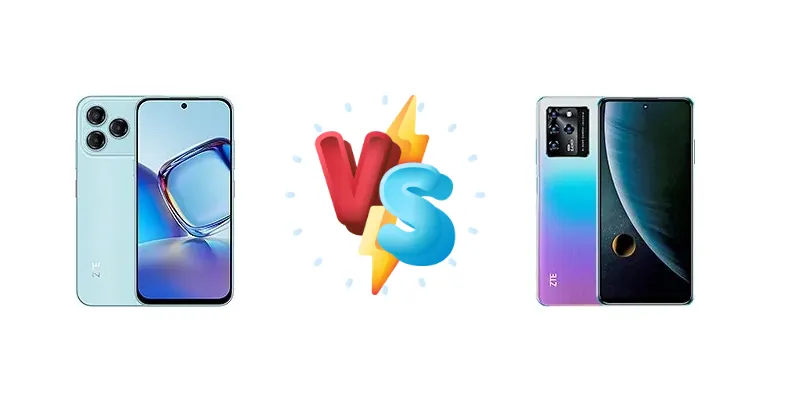
ZTE's Blade series consistently targets the value-conscious consumer. The Blade V80 Design and V30 represent recent iterations, both powered by Unisoc chipsets. This comparison dissects their specifications to determine which device delivers the most compelling experience for everyday tasks and light multimedia use.
🏆 Quick Verdict
For most users, the ZTE Blade V80 Design emerges as the better choice. Its Unisoc T7280 chipset, featuring slightly higher clocked Cortex-A75 cores, provides a noticeable performance edge in demanding applications, while the 22.5W charging offers faster power-ups compared to the V30’s 18W.
| Network |
|---|
| 2G bands | GSM 850 / 900 / 1800 / 1900 | GSM 850 / 900 / 1800 / 1900 |
| 3G bands | HSDPA 850 / 900 / 1900 / 2100 | HSDPA 850 / 1700(AWS) / 1900 - Mexico |
| 4G bands | 1, 3, 5, 7, 8, 20, 28, 38, 40, 41 | 1, 2, 3, 4, 5, 7, 12, 13, 26, 28, 66 - Mexico |
| Speed | HSPA, LTE | HSPA, LTE |
| Technology | GSM / HSPA / LTE | GSM / HSPA / LTE |
| Launch |
|---|
| Announced | 2025, November 10 | 2021, July 16 |
| Status | Available. Released 2025, November | Available. Released 2021, September 01 |
| Body |
|---|
| Build | Glass front, plastic frame | - |
| Dimensions | 166 x 79 x 7.7 mm (6.54 x 3.11 x 0.30 in) | 165.8 x 77.8 x 8.9 mm (6.53 x 3.06 x 0.35 in) |
| SIM | Nano-SIM + Nano-SIM | Nano-SIM + Nano-SIM |
| Weight | 191 g (6.74 oz) | 193 g (6.81 oz) |
| Display |
|---|
| Resolution | 900 x 1940 pixels, 19.5:9 ratio (~317 ppi density) | 1080 x 2400 pixels, 20:9 ratio (~395 ppi density) |
| Size | 6.75 inches, 112.2 cm2 (~85.6% screen-to-body ratio) | 6.67 inches, 107.4 cm2 (~83.3% screen-to-body ratio) |
| Type | IPS LCD, 120Hz, 1000 nits (HBM) | IPS LCD |
| Platform |
|---|
| CPU | Octa-core (2x2.2 GHz Cortex-A75 & 6x2.0 GHz Cortex-A55) | Octa-core (2x2.0 GHz Cortex-A75 & 6x2.0 GHz Cortex-A55) |
| Chipset | Unisoc T7280 (12 nm) | Unisoc Tiger T618 (12 nm) |
| GPU | Mali-G57 MP1 | Mali G52 MP2 |
| OS | Android 16 | Android 11 |
| Memory |
|---|
| Card slot | Unspecified | microSDXC |
| Internal | 256GB 8GB RAM | 128GB 4GB RAM |
| Main Camera |
|---|
| Dual | 50 MP, f/1.8, (wide), PDAF
Auxiliary lens | - |
| Features | LED flash, HDR, panorama | LED flash, HDR, panorama |
| Single | - | 16 MP, f/2.0, (wide) |
| Triple | - | 64 MP, f/1.8, 26mm (wide), PDAF
8 MP, f/2.4, 120˚, 16mm (ultrawide)
5 MP (macro)
Auxiliary lens |
| Video | 1080p@30fps | 1080p@30fps |
| Selfie camera |
|---|
| Single | 16 MP | 16 MP, f/2.0, (wide) |
| Video | 1080p@30fps | - |
| Sound |
|---|
| 3.5mm jack | - | Yes |
| 35mm jack | Yes | Yes |
| Loudspeaker | Yes | Yes |
| Comms |
|---|
| Bluetooth | 5.2, A2DP, LE | 5.0, A2DP, LE |
| NFC | Yes (market/region dependent) | No |
| Positioning | GPS, GALILEO, GLONASS | GPS |
| Radio | Unspecified | Unspecified |
| USB | USB Type-C 2.0, OTG | USB Type-C 2.0 |
| WLAN | Wi-Fi 802.11 a/b/g/n/ac, dual-band | Wi-Fi 802.11 b/g/n/ac |
| Features |
|---|
| Sensors | Fingerprint (side-mounted), accelerometer, proximity, compass | Fingerprint (side-mounted), accelerometer, gyro, proximity |
| Battery |
|---|
| Charging | 22.5W wired
10W reverse wired | 18W wired |
| Type | 5000 mAh | Li-Po 5000 mAh |
| Misc |
|---|
| Colors | Midnight Black, Pale Amber, Celadon Cyan, Peach Fuzz | Black, Blue |
| Models | Z2575 | 9030 |
| Price | About 120 EUR | About 200 EUR |
ZTE Blade V80 Design
- Faster 22.5W charging for quicker power-ups.
- Slightly higher clocked CPU cores for improved performance.
- Potentially better multitasking capabilities.
- May experience slightly higher power consumption due to faster CPU.
- Software updates may be less frequent compared to some competitors.
ZTE Blade V30
- Potentially more streamlined software experience (region dependent).
- Competitive price point for basic smartphone functionality.
- Sufficient performance for everyday tasks.
- Slower 18W charging.
- Slightly lower CPU clock speeds may result in slower app loading.
Display Comparison
Both devices utilize 12nm chipsets, suggesting similar power constraints impacting display capabilities. While specific display specs (resolution, panel type) are missing, the focus here is on performance. The absence of high refresh rates on either device indicates a prioritization of battery life over visual fluidity. Bezels are likely comparable given the budget positioning of both phones.
Camera Comparison
Without detailed camera specifications, a direct comparison is limited. Both phones likely feature a multi-camera setup geared towards social media sharing rather than professional photography. The absence of information regarding sensor size and optical image stabilization (OIS) suggests both rely on software processing for image enhancement. It’s reasonable to assume both will perform adequately in well-lit conditions, but struggle in low-light scenarios. Focusing on the primary sensor resolution would be key to differentiating camera quality, but that data is unavailable.
Performance
The core difference lies in the chipsets. The ZTE Blade V80 Design’s Unisoc T7280 features 2x2.2 GHz Cortex-A75 cores, while the V30’s Unisoc Tiger T618 has 2x2.0 GHz Cortex-A75 cores. This 200MHz clock speed difference, while seemingly small, translates to a measurable performance advantage for the V80 Design in CPU-bound tasks. Both utilize the same 6x2.0 GHz Cortex-A55 efficiency cores, meaning multi-core performance will be similar. The 12nm fabrication process is consistent across both, suggesting comparable thermal characteristics. Users engaging in more demanding applications will likely see a smoother experience on the V80 Design.
Battery Life
Battery capacity is not specified for either device. However, the V80 Design’s 22.5W wired charging significantly outperforms the V30’s 18W. This translates to a faster 0-100% charge time, reducing downtime. While a larger battery capacity on the V30 could offset the slower charging, the V80 Design’s faster charging is a tangible benefit for users who prioritize quick top-ups.
Buying Guide
Buy the ZTE Blade V80 Design if you prioritize slightly better performance for multitasking and app loading, and value faster charging speeds. This phone is ideal for users who frequently switch between apps or enjoy casual gaming. Buy the ZTE Blade V30 if you prefer a potentially more streamlined software experience (depending on regional variations) and are less concerned with maximizing raw processing power. It’s a solid option for basic communication and media consumption.
Frequently Asked Questions
❓ Will the Unisoc T7280 in the V80 Design handle popular games like PUBG Mobile?
The Unisoc T7280 is capable of running PUBG Mobile, but likely at medium graphics settings and frame rates to maintain a stable experience. The chipset isn't designed for high-end gaming, so expect some compromises in visual fidelity.
❓ How long will it take to fully charge the ZTE Blade V80 Design with the 22.5W charger?
While a precise time is unavailable without battery capacity data, the 22.5W charging should fully charge the device in approximately 1.5 to 2.5 hours, depending on usage during charging. This is significantly faster than the V30’s 18W charging.
❓ Is the software on either of these phones heavily customized with bloatware?
ZTE's Blade series historically includes some pre-installed apps. The extent of bloatware can vary by region and carrier. Users should expect to potentially uninstall some unwanted applications after initial setup.
❓ Does the ZTE Blade V30 support VoLTE and VoWiFi for improved call quality?
Support for VoLTE and VoWiFi depends on the carrier and region. It's crucial to check with your mobile provider to confirm compatibility before purchasing either device.