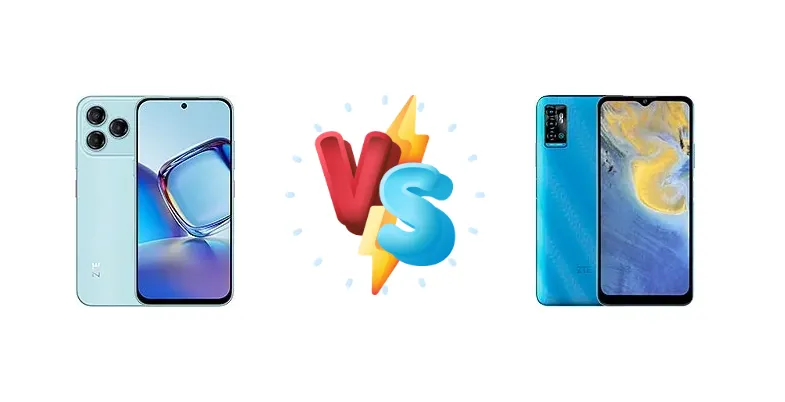
The ZTE Blade V80 Design and A71 represent ZTE’s commitment to the budget smartphone market, but they target slightly different users. The V80 Design aims for a more responsive experience with a newer chipset, while the A71 focuses on affordability. This comparison dissects the key differences to determine which device delivers the best value for your money.
🏆 Quick Verdict
For most users, the ZTE Blade V80 Design is the superior choice. Its Unisoc T7280 chipset, built on a 12nm process, provides a substantial performance advantage over the A71’s older, 28nm Unisoc SC9863A. While both phones cater to the budget segment, the V80 Design offers a noticeably smoother user experience.
| Network |
|---|
| 2G bands | GSM 850 / 900 / 1800 / 1900 | GSM 850 / 900 / 1800 / 1900 |
| 3G bands | HSDPA 850 / 900 / 1900 / 2100 | HSDPA 850 / 900 / 2100 |
| 4G bands | 1, 3, 5, 7, 8, 20, 28, 38, 40, 41 | 1, 3, 5, 7, 8, 20, 28, 38, 40, 41 |
| Speed | HSPA, LTE | HSPA, LTE |
| Technology | GSM / HSPA / LTE | GSM / HSPA / LTE |
| Launch |
|---|
| Announced | 2025, November 10 | 2021, October 07 |
| Status | Available. Released 2025, November | Available. Released 2021, October 07 |
| Body |
|---|
| Build | Glass front, plastic frame | - |
| Dimensions | 166 x 79 x 7.7 mm (6.54 x 3.11 x 0.30 in) | 165.2 x 75.2 x 8.2 mm (6.50 x 2.96 x 0.32 in) |
| SIM | Nano-SIM + Nano-SIM | Nano-SIM + Nano-SIM |
| Weight | 191 g (6.74 oz) | 180 g (6.35 oz) |
| Display |
|---|
| Resolution | 900 x 1940 pixels, 19.5:9 ratio (~317 ppi density) | 720 x 1600 pixels, 20:9 ratio (~269 ppi density) |
| Size | 6.75 inches, 112.2 cm2 (~85.6% screen-to-body ratio) | 6.52 inches, 102.6 cm2 (~82.6% screen-to-body ratio) |
| Type | IPS LCD, 120Hz, 1000 nits (HBM) | IPS LCD |
| Platform |
|---|
| CPU | Octa-core (2x2.2 GHz Cortex-A75 & 6x2.0 GHz Cortex-A55) | Octa-core (4x1.6 GHz Cortex-A55 & 4x1.2 GHz Cortex-A55) |
| Chipset | Unisoc T7280 (12 nm) | Unisoc SC9863A (28 nm) |
| GPU | Mali-G57 MP1 | IMG8322 |
| OS | Android 16 | Android 11 |
| Memory |
|---|
| Card slot | Unspecified | microSDXC |
| Internal | 256GB 8GB RAM | 64GB 3GB RAM |
| Main Camera |
|---|
| Dual | 50 MP, f/1.8, (wide), PDAF
Auxiliary lens | - |
| Features | LED flash, HDR, panorama | LED flash, HDR |
| Triple | - | 16 MP, f/1.8, (wide), AF
8 MP, f/2.2, 120˚, (ultrawide)
Auxiliary lens |
| Video | 1080p@30fps | 1080p@30fps |
| Selfie camera |
|---|
| Single | 16 MP | 8 MP |
| Video | 1080p@30fps | 1080p@30fps |
| Sound |
|---|
| 3.5mm jack | - | Yes |
| 35mm jack | Yes | Yes |
| Loudspeaker | Yes | Yes |
| Comms |
|---|
| Bluetooth | 5.2, A2DP, LE | 4.2, A2DP, LE |
| NFC | Yes (market/region dependent) | Yes |
| Positioning | GPS, GALILEO, GLONASS | GPS, GLONASS |
| Radio | Unspecified | FM radio |
| USB | USB Type-C 2.0, OTG | USB Type-C 2.0 |
| WLAN | Wi-Fi 802.11 a/b/g/n/ac, dual-band | Wi-Fi 802.11 b/g/n |
| Features |
|---|
| Sensors | Fingerprint (side-mounted), accelerometer, proximity, compass | Fingerprint (side-mounted), accelerometer, proximity |
| Battery |
|---|
| Charging | 22.5W wired
10W reverse wired | - |
| Type | 5000 mAh | Li-Ion 4000 mAh |
| Misc |
|---|
| Colors | Midnight Black, Pale Amber, Celadon Cyan, Peach Fuzz | Blue, Gray, Green |
| Models | Z2575 | A7030 |
| Price | About 120 EUR | About 90 EUR |
ZTE Blade V80 Design
- Significantly faster processor (Unisoc T7280)
- Faster 22.5W wired charging
- 10W reverse wired charging capability
- May be slightly more expensive than the A71
- Display specifications are unknown, potentially similar to A71
ZTE Blade A71
- More affordable price point
- Functional for basic smartphone tasks
- Acceptable for users with minimal smartphone needs
- Slow processor (Unisoc SC9863A)
- Less efficient 28nm process
- Slower charging speeds
Display Comparison
Display specifications are not provided in the context data. However, given the price points, both devices likely feature LCD panels with 720p+ resolution. The V80 Design, being a slightly newer model, *may* benefit from improved color calibration or slightly higher peak brightness, but this is speculative. Bezels are likely to be substantial on both devices, typical of this market segment.
Camera Comparison
Camera details are limited. Both phones likely feature a multi-camera setup, but the quality will heavily depend on sensor size and image processing. Without specific sensor information, it’s difficult to make a definitive judgment. However, the V80 Design’s more powerful chipset *could* enable more sophisticated image processing algorithms, potentially leading to better image quality in challenging lighting conditions. The presence of a 2MP macro camera on either device is unlikely to significantly impact the overall camera experience.
Performance
The core difference lies in the chipsets. The ZTE Blade V80 Design’s Unisoc T7280, fabricated on a 12nm process, features an octa-core configuration with two high-performance Cortex-A75 cores clocked at 2.2 GHz and six efficiency-focused Cortex-A55 cores at 2.0 GHz. This architecture provides a significant boost in CPU performance compared to the ZTE Blade A71’s Unisoc SC9863A. The A71 utilizes an octa-core setup of four Cortex-A55 cores at 1.6 GHz and another four at 1.2 GHz. The 28nm process of the SC9863A is significantly less efficient, leading to higher power consumption and potentially more thermal throttling under sustained load. The A75 cores in the V80 Design will handle demanding tasks far more effectively, resulting in a snappier experience.
Battery Life
Battery capacity is not specified for either device. However, the V80 Design’s 22.5W wired charging is a clear advantage over the A71’s unspecified charging speed. The 10W reverse wired charging on the V80 Design is a useful feature for topping up accessories. Even with a similar battery capacity, the V80 Design will likely achieve faster charging times, reducing downtime. The more efficient Unisoc T7280 chipset may also contribute to slightly better battery life during typical usage.
Buying Guide
Buy the ZTE Blade V80 Design if you prioritize a responsive user interface, smoother multitasking, and faster app loading times. This phone is ideal for users who frequently switch between applications or enjoy casual gaming. Buy the ZTE Blade A71 if your primary needs are basic communication – calls, texts, and light web browsing – and you are on an extremely tight budget where every dollar counts. The A71 is a functional device for minimal smartphone usage.
Frequently Asked Questions
❓ Will the ZTE Blade V80 Design handle demanding games like PUBG Mobile?
While not a gaming powerhouse, the Unisoc T7280 in the V80 Design is capable of running PUBG Mobile at medium settings with acceptable frame rates. The A71’s SC9863A would likely struggle with consistent performance, even at the lowest settings.
❓ Is the 10W reverse charging on the V80 Design useful for accessories like wireless earbuds?
Yes, the 10W reverse charging is a convenient feature for topping up small accessories like wireless earbuds or a smartwatch. It won’t fully charge them quickly, but it can provide a useful boost when you’re away from a power outlet.
❓ How much of a performance difference will I notice between the two chipsets in everyday tasks?
The difference will be quite noticeable. The V80 Design’s T7280 will result in faster app loading times, smoother multitasking, and a more responsive user interface. The A71’s SC9863A may exhibit lag and slowdowns when running multiple apps or demanding tasks.