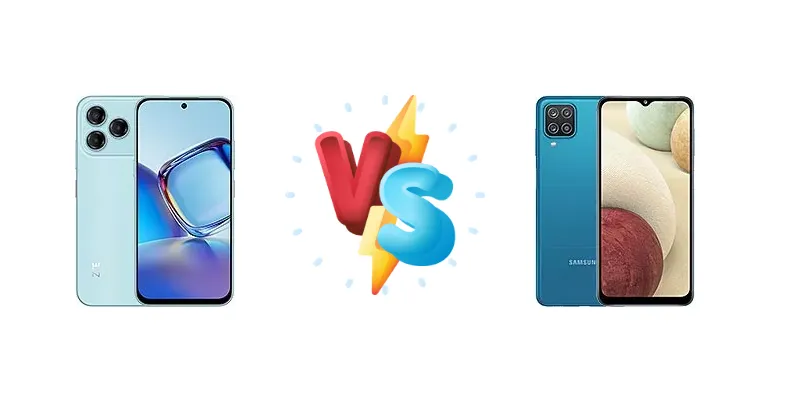
The sub-$150 smartphone market is fiercely competitive. The ZTE Blade V80 Design and Samsung Galaxy A12 (India) both aim to deliver essential features at an accessible price. However, they take different approaches to achieving this, with the ZTE leveraging a newer Unisoc chipset and faster charging, while the Samsung relies on its established Exynos platform. This comparison dissects their strengths and weaknesses to determine which offers the best value.
🏆 Quick Verdict
For the average user prioritizing sustained performance and a more efficient processor, the Samsung Galaxy A12 (India) emerges as the better choice. Its Exynos 850, built on an 8nm process, offers superior power efficiency and a more balanced CPU configuration compared to the ZTE's Unisoc T7280, despite the latter's faster clock speeds on some cores.
| Network |
|---|
| 2G bands | GSM 850 / 900 / 1800 / 1900 | GSM 850 / 900 / 1800 / 1900 |
| 3G bands | HSDPA 850 / 900 / 1900 / 2100 | HSDPA 850 / 900 / 2100 |
| 4G bands | 1, 3, 5, 7, 8, 20, 28, 38, 40, 41 | 1, 3, 5, 7, 8, 20, 28, 38, 40, 41 |
| Speed | HSPA, LTE | HSPA 42.2/5.76 Mbps, LTE Cat4 150/50 Mbps |
| Technology | GSM / HSPA / LTE | GSM / HSPA / LTE |
| Launch |
|---|
| Announced | 2025, November 10 | 2021, August 12 |
| Status | Available. Released 2025, November | Available. Released 2021, August 12 |
| Body |
|---|
| Build | Glass front, plastic frame | Glass front, plastic back, plastic frame |
| Dimensions | 166 x 79 x 7.7 mm (6.54 x 3.11 x 0.30 in) | 164 x 75.8 x 8.9 mm (6.46 x 2.98 x 0.35 in) |
| SIM | Nano-SIM + Nano-SIM | · Nano-SIM· Nano-SIM + Nano-SIM |
| Weight | 191 g (6.74 oz) | 205 g (7.23 oz) |
| Display |
|---|
| Resolution | 900 x 1940 pixels, 19.5:9 ratio (~317 ppi density) | 720 x 1600 pixels, 20:9 ratio (~270 ppi density) |
| Size | 6.75 inches, 112.2 cm2 (~85.6% screen-to-body ratio) | 6.5 inches, 102.0 cm2 (~82.1% screen-to-body ratio) |
| Type | IPS LCD, 120Hz, 1000 nits (HBM) | PLS LCD |
| Platform |
|---|
| CPU | Octa-core (2x2.2 GHz Cortex-A75 & 6x2.0 GHz Cortex-A55) | Octa-core (4x2.0 GHz Cortex-A55 & 4x2.0 GHz Cortex-A55) |
| Chipset | Unisoc T7280 (12 nm) | Exynos 850 (8 nm) |
| GPU | Mali-G57 MP1 | Mali-G52 |
| OS | Android 16 | Android 11, upgradable to Android 13, One UI 5.1 |
| Memory |
|---|
| Card slot | Unspecified | microSDXC (dedicated slot) |
| Internal | 256GB 8GB RAM | 64GB 4GB RAM, 128GB 4GB RAM, 128GB 6GB RAM |
| | - | eMMC 5.1 |
| Main Camera |
|---|
| Dual | 50 MP, f/1.8, (wide), PDAF
Auxiliary lens | - |
| Features | LED flash, HDR, panorama | LED flash, panorama, HDR |
| Quad | - | 48 MP, f/2.0, 26mm (wide), AF
5 MP, f/2.2, 123˚ (ultrawide)
2 MP (macro)
Auxiliary lens |
| Video | 1080p@30fps | 1080p@30fps |
| Selfie camera |
|---|
| Single | 16 MP | 8 MP, f/2.2 |
| Video | 1080p@30fps | 1080p@30fps |
| Sound |
|---|
| 3.5mm jack | - | Yes |
| 35mm jack | Yes | Yes |
| Loudspeaker | Yes | Yes |
| Comms |
|---|
| Bluetooth | 5.2, A2DP, LE | 5.0, A2DP, LE |
| NFC | Yes (market/region dependent) | No |
| Positioning | GPS, GALILEO, GLONASS | GPS, GLONASS, GALILEO, BDS |
| Radio | Unspecified | FM radio, RDS, recording |
| USB | USB Type-C 2.0, OTG | USB Type-C 2.0 |
| WLAN | Wi-Fi 802.11 a/b/g/n/ac, dual-band | Wi-Fi 802.11 b/g/n, Wi-Fi Direct |
| Features |
|---|
| Sensors | Fingerprint (side-mounted), accelerometer, proximity, compass | Fingerprint (side-mounted), accelerometer |
| | - | Virtual proximity sensing |
| Battery |
|---|
| Charging | 22.5W wired
10W reverse wired | 15W wired |
| Type | 5000 mAh | Li-Po 5000 mAh |
| Misc |
|---|
| Colors | Midnight Black, Pale Amber, Celadon Cyan, Peach Fuzz | Black, Blue, White |
| Models | Z2575 | SM-A127F, SM-A127F/DS |
| Price | About 120 EUR | About 160 EUR |
| SAR | - | 0.79 W/kg (head) |
ZTE Blade V80 Design
- Faster 22.5W charging
- Potentially higher peak CPU performance (Cortex-A75 cores)
- May offer a more aggressive price point
- Less efficient Unisoc T7280 chipset (12nm)
- Potentially more thermal throttling
- Less established brand reputation
Samsung Galaxy A12 (India)
- More efficient Exynos 850 chipset (8nm)
- Balanced CPU core configuration for multitasking
- Established Samsung brand and software support
- Slower 15W charging
- May be slightly more expensive
- 2MP macro camera is largely ineffective
Display Comparison
Neither device boasts a standout display. Details regarding panel type (IPS, TFT) and resolution are missing, but both likely target a 720p+ resolution common in this price bracket. The focus here shifts to processing power, as the display demands are relatively low. Bezels are expected to be substantial on both, impacting immersion. Color accuracy is unlikely to be a key strength on either device.
Camera Comparison
Camera performance is likely to be similar, with both devices relying on budget sensors. Details on sensor size and aperture are unavailable, but the inclusion of a 2MP macro lens on the Galaxy A12 is largely a marketing gimmick. Image processing will likely favor Samsung’s typically vibrant and saturated style, while the ZTE’s processing is less predictable. Without specific sensor details, it’s difficult to declare a clear winner, but the Exynos 850’s ISP (Image Signal Processor) may offer slightly better noise reduction and dynamic range.
Performance
The chipset is the core differentiator. The Samsung Galaxy A12’s Exynos 850 (8nm) employs a more efficient architecture with eight Cortex-A55 cores, optimized for sustained workloads. While the ZTE Blade V80 Design’s Unisoc T7280 (12nm) features two higher-clocked Cortex-A75 cores for peak performance, the six Cortex-A55 cores are likely to struggle with multitasking compared to the Exynos 850’s homogenous core setup. The 8nm process of the Exynos 850 translates to better thermal management, reducing the likelihood of throttling during extended gaming or video playback. The Unisoc T7280’s 12nm process will generate more heat, potentially impacting sustained performance.
Battery Life
Battery capacity is not specified for either device, but both likely fall in the 4000-5000mAh range. However, the ZTE Blade V80 Design’s 22.5W wired charging significantly outperforms the Samsung Galaxy A12’s 15W charging. This means the ZTE can replenish its battery much faster, a crucial advantage for users who frequently run low on power. While the Exynos 850’s efficiency may offset some of this difference in daily use, the ZTE offers a clear win in terms of charging speed.
Buying Guide
Buy the ZTE Blade V80 Design if you prioritize faster charging speeds and occasionally need a performance burst for short tasks, benefiting from the Cortex-A75 cores. Buy the Samsung Galaxy A12 (India) if you value consistent performance across all applications, better power efficiency for all-day use, and the established reliability of the Samsung ecosystem.
Frequently Asked Questions
❓ Does the Unisoc T7280 in the ZTE Blade V80 Design overheat during prolonged gaming sessions?
The Unisoc T7280, built on a 12nm process, is more prone to thermal throttling than the Samsung Galaxy A12’s Exynos 850 (8nm). Expect performance to decrease after 20-30 minutes of demanding games, potentially leading to noticeable lag and frame drops.
❓ Is the 2MP macro camera on the Samsung Galaxy A12 (India) actually useful for taking detailed close-up photos?
Generally, 2MP macro cameras on budget phones produce images with limited detail and sharpness. The small sensor size and lack of autofocus result in blurry and often unusable photos. It's primarily a marketing feature and shouldn't be a deciding factor in your purchase.
❓ Will the Samsung Galaxy A12 (India) handle popular games like PUBG Mobile smoothly?
The Exynos 850 can run PUBG Mobile at medium settings with a stable frame rate. However, don't expect to max out the graphics settings. The phone may experience some frame drops during intense firefights, but overall, the gaming experience should be acceptable for casual players.
❓ How long does it take to fully charge the ZTE Blade V80 Design with the 22.5W charger?
While a precise time is unavailable, the 22.5W charging should fully charge the ZTE Blade V80 Design in approximately 1 hour and 30 minutes to 2 hours, depending on the battery capacity. This is significantly faster than the Samsung Galaxy A12’s 15W charging.