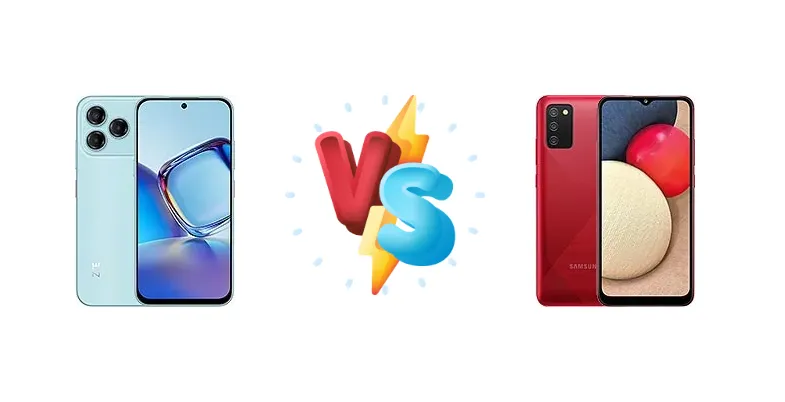
The ZTE Blade V80 Design and Samsung Galaxy A02s represent the lower end of the smartphone market, targeting users prioritizing affordability. However, they take different approaches to achieving that price point. The V80 Design focuses on a more modern chipset for improved performance, while the A02s relies on Samsung's brand recognition and a focus on basic functionality. This comparison will dissect their key differences to help you determine which best suits your needs.
🏆 Quick Verdict
For the average user seeking a responsive experience, the ZTE Blade V80 Design is the better choice. Its Unisoc T7280 chipset, built on a more efficient 12nm process, delivers significantly better performance than the aging Snapdragon 450 in the A02s. While both offer similar battery endurance, the V80 Design’s faster charging is a welcome addition.
| Network |
|---|
| 2G bands | GSM 850 / 900 / 1800 / 1900 | GSM 850 / 900 / 1800 / 1900 |
| 3G bands | HSDPA 850 / 900 / 1900 / 2100 | HSDPA 850 / 900 / 2100 |
| 4G bands | 1, 3, 5, 7, 8, 20, 28, 38, 40, 41 | 1, 3, 5, 7, 8, 20, 28, 38, 40, 41 |
| Speed | HSPA, LTE | HSPA 42.2/5.76 Mbps, LTE Cat4 150/50 Mbps |
| Technology | GSM / HSPA / LTE | GSM / HSPA / LTE |
| Launch |
|---|
| Announced | 2025, November 10 | 2020, November 24. Released 2021, January 04 |
| Status | Available. Released 2025, November | Discontinued |
| Body |
|---|
| Build | Glass front, plastic frame | Glass front, plastic back, plastic frame |
| Dimensions | 166 x 79 x 7.7 mm (6.54 x 3.11 x 0.30 in) | 164.2 x 75.9 x 9.1 mm (6.46 x 2.99 x 0.36 in) |
| SIM | Nano-SIM + Nano-SIM | · Nano-SIM· Nano-SIM + Nano-SIM |
| Weight | 191 g (6.74 oz) | 196 g (6.91 oz) |
| Display |
|---|
| Protection | - | Scratch-resistant glass |
| Resolution | 900 x 1940 pixels, 19.5:9 ratio (~317 ppi density) | 720 x 1600 pixels, 20:9 ratio (~270 ppi density) |
| Size | 6.75 inches, 112.2 cm2 (~85.6% screen-to-body ratio) | 6.5 inches, 102.0 cm2 (~81.8% screen-to-body ratio) |
| Type | IPS LCD, 120Hz, 1000 nits (HBM) | PLS LCD |
| Platform |
|---|
| CPU | Octa-core (2x2.2 GHz Cortex-A75 & 6x2.0 GHz Cortex-A55) | Octa-core 1.8 GHz Cortex-A53 |
| Chipset | Unisoc T7280 (12 nm) | Qualcomm SDM450 Snapdragon 450 (14 nm) |
| GPU | Mali-G57 MP1 | Adreno 506 |
| OS | Android 16 | Android 10, upgradable to Android 12, One UI 4.1 |
| Memory |
|---|
| Card slot | Unspecified | microSDXC (dedicated slot) |
| Internal | 256GB 8GB RAM | 16GB 1GB RAM, 32GB 2GB RAM, 32GB 3GB RAM, 32GB 4GB RAM, 64GB 3GB RAM, 64GB 4GB RAM |
| | - | eMMC 5.1 |
| Main Camera |
|---|
| Dual | 50 MP, f/1.8, (wide), PDAF
Auxiliary lens | - |
| Features | LED flash, HDR, panorama | LED flash |
| Single | - | 3.15 MP |
| Triple | - | 13 MP, f/2.2, (wide), AF
2 MP (macro)
Auxiliary lens |
| Video | 1080p@30fps | 1080p@30fps |
| Selfie camera |
|---|
| Single | 16 MP | 5 MP, f/2.2 |
| Video | 1080p@30fps | - |
| Sound |
|---|
| 3.5mm jack | - | Yes |
| 35mm jack | Yes | Yes |
| Loudspeaker | Yes | Yes |
| Comms |
|---|
| Bluetooth | 5.2, A2DP, LE | 4.2, A2DP |
| NFC | Yes (market/region dependent) | No |
| Positioning | GPS, GALILEO, GLONASS | GPS, GLONASS, GALILEO, BDS |
| Radio | Unspecified | Unspecified |
| USB | USB Type-C 2.0, OTG | USB Type-C 2.0 |
| WLAN | Wi-Fi 802.11 a/b/g/n/ac, dual-band | Wi-Fi 802.11 b/g/n, Wi-Fi Direct |
| Features |
|---|
| Sensors | Fingerprint (side-mounted), accelerometer, proximity, compass | Accelerometer, proximity |
| Battery |
|---|
| Charging | 22.5W wired
10W reverse wired | 15W wired |
| Stand-by | - | Up to 530 h (2G) / Up to 530 h (3G) |
| Talk time | - | Up to 6 h 12 min (2G) / Up to 6 h 18 min (3G) |
| Type | 5000 mAh | Li-Po 5000 mAh |
| Misc |
|---|
| Colors | Midnight Black, Pale Amber, Celadon Cyan, Peach Fuzz | Black, White, Red, Blue |
| Models | Z2575 | SM-A025F, SM-A025F/DS, SM-A025G, SM-A025G/DS, SM-A025M, SM-A025M/DS, SM-A025U, SM-A025V, SM-A025A, SM-A025U1, SM-A025AZ, SM-S124DL |
| Price | About 120 EUR | About 110 EUR |
| SAR | - | 1.15 W/kg (head) 0.79 W/kg (body) |
| SAR EU | - | 0.40 W/kg (head) 1.37 W/kg (body) |
| Tests |
|---|
| Audio quality | - |
Noise -81.4dB / Crosstalk -80.5dB |
| Battery life | - |
Endurance rating 114h
|
| Camera | - |
Photo / Video |
| Display | - |
Contrast ratio: 1765:1 (nominal) |
| Loudspeaker | - |
-29.8 LUFS (Average)
|
| Performance | - |
AnTuTu: 90811 (v8)
GeekBench: 495 (v5.1)
GFXBench: 6.1fps (ES 3.1 onscreen) |
ZTE Blade V80 Design
- Significantly faster processor for smoother performance
- Faster 22.5W charging
- 10W reverse wired charging
- More efficient 12nm chipset
- Display specifications are unknown
- Camera details are limited
Samsung Galaxy A02s
- Samsung brand recognition
- Acceptable display brightness (406 nits)
- Long battery endurance (114h)
- Simple and straightforward user experience
- Aging Snapdragon 450 processor
- Slower 15W charging
- Limited performance for demanding apps
- Likely poor low-light camera performance
Display Comparison
Both devices offer basic displays suitable for their price range. The Samsung Galaxy A02s boasts a measured peak brightness of 406 nits and a 1765:1 contrast ratio, providing acceptable visibility indoors. However, the ZTE Blade V80 Design’s display specifications are not provided, making a direct comparison difficult. Given the market segment, it’s likely to be similar in quality, but the lack of data prevents a definitive assessment. Both likely utilize LCD panels, and neither is expected to offer high color accuracy or wide viewing angles.
Camera Comparison
Both phones feature basic camera setups, and detailed specifications are limited. Both are listed as having Photo/Video capabilities, but without sensor size, aperture, or image processing details, a meaningful comparison is impossible. It’s safe to assume both will perform adequately in good lighting conditions, but struggle in low light. The presence of a 2MP macro camera on the A02s is unlikely to provide significant value, as the low resolution and lack of optical image stabilization will result in blurry and uninspiring images. The V80 Design’s camera performance remains unknown without further details.
Performance
The performance gap is the most significant differentiator. The ZTE Blade V80 Design’s Unisoc T7280, fabricated on a 12nm process, features an octa-core configuration with two Cortex-A75 cores clocked at 2.2 GHz and six Cortex-A55 cores at 2.0 GHz. This architecture provides a substantial performance boost over the Samsung Galaxy A02s’ Qualcomm Snapdragon 450 (14nm), which utilizes eight Cortex-A53 cores clocked at 1.8 GHz. The A75 cores in the V80 Design offer significantly higher single-core performance, crucial for app launch times and general responsiveness. The 12nm process also contributes to better power efficiency, potentially offsetting the slightly higher clock speeds. The Snapdragon 450 is showing its age, and will struggle with multitasking and modern applications.
Battery Life
Both the ZTE Blade V80 Design and Samsung Galaxy A02s achieve an endurance rating of 114 hours, suggesting similar real-world battery life. However, the V80 Design offers a significant advantage in charging speed with 22.5W wired charging, compared to the A02s’ 15W charging. This translates to a faster 0-100% charge time for the V80 Design. Furthermore, the V80 Design includes 10W reverse wired charging, allowing it to act as a power bank for other devices – a feature absent on the A02s.
Buying Guide
Buy the ZTE Blade V80 Design if you need a phone capable of handling everyday tasks smoothly, including social media, light gaming, and video streaming. Its more powerful processor will provide a noticeably snappier experience. Buy the Samsung Galaxy A02s if you prioritize brand familiarity and a simple, straightforward user experience, and your usage is limited to basic communication and very light app usage. The A02s is a functional device, but it will struggle with demanding applications.
Frequently Asked Questions
❓ Is the Unisoc T7280 in the ZTE Blade V80 Design a reliable processor?
While Unisoc isn't as well-known as Qualcomm or MediaTek, the T7280 is a capable processor for entry-level smartphones. Its Cortex-A75 cores provide a noticeable performance improvement over the Snapdragon 450, making it suitable for everyday tasks and light gaming. It's a solid choice for a budget device.
❓ Will the Samsung Galaxy A02s struggle with popular apps like TikTok or Instagram?
Yes, the Snapdragon 450 in the A02s is likely to struggle with demanding apps like TikTok and Instagram, especially when multitasking. You may experience lag, slow loading times, and occasional crashes. The phone will be functional, but the experience won't be smooth or enjoyable.
❓ How long does it realistically take to fully charge the ZTE Blade V80 Design?
With 22.5W charging, the ZTE Blade V80 Design should fully charge from 0% to 100% in approximately 1 hour and 30 minutes to 2 hours, depending on usage during charging. This is significantly faster than the Samsung Galaxy A02s' 15W charging.
❓ Does the Samsung Galaxy A02s support widevine L1 for HD streaming?
Unfortunately, the Samsung Galaxy A02s does *not* support Widevine L1, meaning you will be limited to SD (Standard Definition) streaming on services like Netflix and Amazon Prime Video. This is a significant limitation for users who enjoy watching videos on their phones.