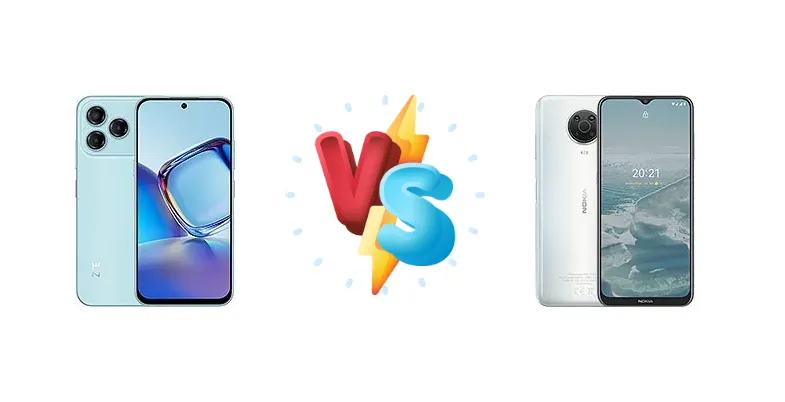
The ZTE Blade V80 Design and Nokia G20 represent two compelling options in the ultra-budget smartphone space. While both aim to deliver essential smartphone functionality at an accessible price point, they diverge significantly in their internal hardware, particularly in chipset choice and charging capabilities. This comparison will dissect these differences to determine which device offers the best value for specific user needs.
🏆 Quick Verdict
For the average user prioritizing responsiveness and faster charging, the ZTE Blade V80 Design emerges as the stronger contender. Its Unisoc T7280 chipset, featuring Cortex-A75 cores, provides a noticeable performance edge over the Nokia G20’s Helio G35, and the 22.5W charging is significantly faster than the Nokia’s 10W.
| Network |
|---|
| 2G bands | GSM 850 / 900 / 1800 / 1900 | GSM 850 / 900 / 1800 / 1900 |
| 3G bands | HSDPA 850 / 900 / 1900 / 2100 | HSDPA 850 / 900 / 1900 / 2100 - International |
| 4G bands | 1, 3, 5, 7, 8, 20, 28, 38, 40, 41 | 1, 3, 5, 7, 8, 20, 28, 38, 40, 41 - International |
| Speed | HSPA, LTE | HSPA 42.2/5.76 Mbps, LTE Cat4 150/50 Mbps |
| Technology | GSM / HSPA / LTE | GSM / HSPA / LTE |
| | - | 1, 2, 3, 4, 5, 7, 8, 12, 17, 28, 66 - LATAM |
| Launch |
|---|
| Announced | 2025, November 10 | 2021, April 08 |
| Status | Available. Released 2025, November | Available. Released 2021, May 17 |
| Body |
|---|
| Build | Glass front, plastic frame | - |
| Dimensions | 166 x 79 x 7.7 mm (6.54 x 3.11 x 0.30 in) | 164.9 x 76 x 9.2 mm (6.49 x 2.99 x 0.36 in) |
| SIM | Nano-SIM + Nano-SIM | · Nano-SIM· Nano-SIM + Nano-SIM |
| Weight | 191 g (6.74 oz) | 197 g (6.95 oz) |
| | - | Splash protection |
| Display |
|---|
| Resolution | 900 x 1940 pixels, 19.5:9 ratio (~317 ppi density) | 720 x 1600 pixels, 20:9 ratio (~269 ppi density) |
| Size | 6.75 inches, 112.2 cm2 (~85.6% screen-to-body ratio) | 6.52 inches, 102.6 cm2 (~81.9% screen-to-body ratio) |
| Type | IPS LCD, 120Hz, 1000 nits (HBM) | IPS LCD |
| Platform |
|---|
| CPU | Octa-core (2x2.2 GHz Cortex-A75 & 6x2.0 GHz Cortex-A55) | Octa-core (4x2.3 GHz Cortex-A53 & 4x1.8 GHz Cortex-A53) |
| Chipset | Unisoc T7280 (12 nm) | Mediatek MT6765G Helio G35 (12 nm) |
| GPU | Mali-G57 MP1 | PowerVR GE8320 |
| OS | Android 16 | Android 11, upgradable to Android 13 |
| Memory |
|---|
| Card slot | Unspecified | microSDXC (dedicated slot) |
| Internal | 256GB 8GB RAM | 64GB 4GB RAM, 128GB 4GB RAM |
| Main Camera |
|---|
| Dual | 50 MP, f/1.8, (wide), PDAF
Auxiliary lens | - |
| Features | LED flash, HDR, panorama | LED flash, HDR, panorama |
| Quad | - | 48 MP, f/1.8, (wide), PDAF
5 MP, (ultrawide)
2 MP (macro)
Auxiliary lens |
| Single | - | 8 MP, (wide) |
| Video | 1080p@30fps | 1080p@30fps |
| Selfie camera |
|---|
| Single | 16 MP | 8 MP, (wide) |
| Video | 1080p@30fps | 1080p@30fps |
| Sound |
|---|
| 3.5mm jack | - | Yes |
| 35mm jack | Yes | Yes |
| Loudspeaker | Yes | Yes |
| Comms |
|---|
| Bluetooth | 5.2, A2DP, LE | 5.0, A2DP, LE |
| NFC | Yes (market/region dependent) | Yes (market/region dependent) |
| Positioning | GPS, GALILEO, GLONASS | GPS, GLONASS, BDS |
| Radio | Unspecified | FM radio |
| USB | USB Type-C 2.0, OTG | USB Type-C 2.0, OTG |
| WLAN | Wi-Fi 802.11 a/b/g/n/ac, dual-band | Wi-Fi 802.11 b/g/n |
| Features |
|---|
| Sensors | Fingerprint (side-mounted), accelerometer, proximity, compass | Fingerprint (side-mounted), accelerometer, gyro, proximity |
| Battery |
|---|
| Charging | 22.5W wired
10W reverse wired | 10W wired |
| Type | 5000 mAh | Li-Po 5050 mAh |
| Misc |
|---|
| Colors | Midnight Black, Pale Amber, Celadon Cyan, Peach Fuzz | Glacier, Night |
| Models | Z2575 | TA-1336, TA-1343, TA-1347, TA-1372, TA-1365 |
| Price | About 120 EUR | About 90 EUR |
| SAR | - | 1.01 W/kg (head) 1.02 W/kg (body) |
| SAR EU | - | 0.49 W/kg (head) 1.13 W/kg (body) |
ZTE Blade V80 Design
- Faster 22.5W charging significantly reduces downtime.
- More powerful Unisoc T7280 chipset delivers smoother performance.
- 10W reverse wired charging offers added convenience.
- Brand recognition may be lower than Nokia.
- Software update commitment is potentially less robust.
Nokia G20
- Nokia’s reputation for software reliability and updates.
- Clean Android experience with minimal bloatware.
- Potentially longer software support lifecycle.
- Slower 10W charging is a significant drawback.
- Less powerful MediaTek Helio G35 chipset struggles with demanding tasks.
- Lacks reverse charging functionality.
Display Comparison
Neither device boasts a standout display. Given the context data focuses on internal components, we can infer both likely utilize standard LCD panels common in this price bracket. Bezels are likely substantial on both, and color accuracy will be adequate but not exceptional. The absence of high refresh rates or advanced features like LTPO suggests a focus on cost reduction over visual fidelity.
Camera Comparison
Without detailed camera specifications, a direct comparison is difficult. However, it’s reasonable to assume both phones feature basic camera setups geared towards casual photography. The absence of information regarding sensor size or optical image stabilization suggests neither device will excel in low-light conditions. Image processing will likely be heavily reliant on software algorithms to enhance image quality, and the results will likely be comparable, leaning towards acceptable for social media sharing rather than professional-grade photography.
Performance
The core difference lies in the chipsets. The ZTE Blade V80 Design’s Unisoc T7280, built on a 12nm process, utilizes a heterogeneous core configuration with 2x 2.2 GHz Cortex-A75 cores and 6x 2.0 GHz Cortex-A55 cores. This architecture provides a significant performance boost over the Nokia G20’s MediaTek Helio G35, which employs a homogenous octa-core setup of 4x 2.3 GHz Cortex-A53 and 4x 1.8 GHz Cortex-A53 cores. The Cortex-A75 cores in the V80 Design offer substantially higher single-core performance, translating to snappier app launches and smoother multitasking. While both are 12nm chips, the architectural advantage of the A75 cores gives the ZTE a clear edge. The G35's reliance on older A53 cores will result in noticeable slowdowns with demanding applications.
Battery Life
While battery capacity isn't specified, the charging capabilities are a key differentiator. The ZTE Blade V80 Design supports 22.5W wired charging, and even offers 10W reverse wired charging – a feature absent on the Nokia G20. The Nokia G20 is limited to 10W wired charging. This means the V80 Design will significantly reduce charging times, allowing users to quickly top up their battery when needed. The inclusion of reverse wired charging on the V80 Design adds a degree of versatility, enabling it to act as a power bank for other devices, albeit at a slower rate.
Buying Guide
Buy the ZTE Blade V80 Design if you need a phone capable of handling moderate multitasking and appreciate quicker charging times, making it ideal for users who frequently consume media or rely on their phone throughout the day. Buy the Nokia G20 if you prioritize a simple, clean Android experience and long-term software support, and are willing to trade performance and charging speed for potentially longer software updates and a more established brand reputation.
Frequently Asked Questions
❓ Will the Unisoc T7280 in the ZTE Blade V80 Design handle demanding games like PUBG Mobile?
While the Unisoc T7280 is a step up from the Helio G35, PUBG Mobile may require reduced graphics settings for a consistently smooth experience. The Cortex-A75 cores provide a performance boost, but the chipset isn't designed for high-end gaming. Expect playable frame rates at medium settings.
❓ How long will it take to fully charge the ZTE Blade V80 Design with the 22.5W charger?
Assuming a typical battery capacity for this class of device (around 5000mAh), a full charge from 0% to 100% with the 22.5W charger should take approximately 1 hour and 45 minutes to 2 hours. This is significantly faster than the Nokia G20’s 10W charging, which could take over 3 hours.
❓ Does the Nokia G20 receive regular Android updates and security patches?
Nokia is known for its commitment to providing regular software updates and security patches, even on its budget devices. The G20 is likely to receive at least two major Android version updates and three years of security patches, offering peace of mind regarding software support.
❓ Is the reverse charging feature on the ZTE Blade V80 Design useful in practice?
The 10W reverse charging is primarily useful for topping up accessories like wireless earbuds or a smartwatch in an emergency. It won't rapidly charge another phone, but it provides a convenient way to share power when an outlet isn't available.