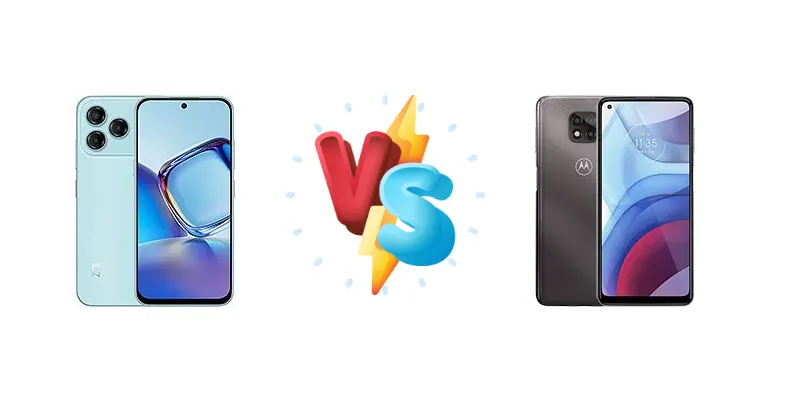
The sub-$200 smartphone market is fiercely competitive. The ZTE Blade V80 Design and Motorola Moto G Power (2021) both aim to deliver essential features at an accessible price. However, they take different approaches to achieving this, primarily through their chipset choices. This comparison dissects those differences, focusing on performance, battery life, and charging capabilities to determine which device offers the best value.
🏆 Quick Verdict
For the average user prioritizing sustained performance and a more refined software experience, the Motorola Moto G Power (2021) is the better choice. While the ZTE Blade V80 Design boasts faster 22.5W charging, the Snapdragon 662 in the Moto G Power provides a smoother, more consistent experience, especially during multitasking and gaming.
| Network |
|---|
| 2G bands | GSM 850 / 900 / 1800 / 1900 | GSM 850 / 900 / 1800 / 1900 |
| 3G bands | HSDPA 850 / 900 / 1900 / 2100 | HSDPA 850 / 900 / 1700(AWS) / 1900 / 2100 |
| 4G bands | 1, 3, 5, 7, 8, 20, 28, 38, 40, 41 | 1, 2, 3, 4, 5, 7, 8, 12, 13, 14, 17, 25, 26, 29, 30, 38, 41, 66, 71 |
| Speed | HSPA, LTE | HSPA, LTE |
| Technology | GSM / HSPA / LTE | GSM / CDMA / HSPA / EVDO / LTE |
| | - | CDMA2000 1xEV-DO |
| Launch |
|---|
| Announced | 2025, November 10 | 2021, January 08 |
| Status | Available. Released 2025, November | Available. Released 2021, January 14 |
| Body |
|---|
| Build | Glass front, plastic frame | Glass front, plastic back, plastic frame |
| Dimensions | 166 x 79 x 7.7 mm (6.54 x 3.11 x 0.30 in) | 165.3 x 75.9 x 9.5 mm (6.51 x 2.99 x 0.37 in) |
| SIM | Nano-SIM + Nano-SIM | Nano-SIM |
| Weight | 191 g (6.74 oz) | 206.5 g (7.30 oz) |
| | - | Water-repellent coating |
| Display |
|---|
| Resolution | 900 x 1940 pixels, 19.5:9 ratio (~317 ppi density) | 720 x 1600 pixels, 20:9 ratio (~266 ppi density) |
| Size | 6.75 inches, 112.2 cm2 (~85.6% screen-to-body ratio) | 6.6 inches, 105.2 cm2 (~83.8% screen-to-body ratio) |
| Type | IPS LCD, 120Hz, 1000 nits (HBM) | IPS LCD |
| Platform |
|---|
| CPU | Octa-core (2x2.2 GHz Cortex-A75 & 6x2.0 GHz Cortex-A55) | Octa-core (4x2.0 GHz Kryo 260 Gold & 4x1.8 GHz Kryo 260 Silver) |
| Chipset | Unisoc T7280 (12 nm) | Qualcomm SM6115 Snapdragon 662 (11 nm) |
| GPU | Mali-G57 MP1 | Adreno 610 |
| OS | Android 16 | Android 10 |
| Memory |
|---|
| Card slot | Unspecified | microSDXC (dedicated slot) |
| Internal | 256GB 8GB RAM | 32GB 3GB RAM, 64GB 4GB RAM |
| | - | eMMC 5.1 |
| Main Camera |
|---|
| Dual | 50 MP, f/1.8, (wide), PDAF
Auxiliary lens | - |
| Features | LED flash, HDR, panorama | LED flash, HDR, panorama |
| Triple | - | 48 MP, f/1.7, (wide), 1/2.0", 0.8µm, PDAF
2 MP (macro)
Auxiliary lens |
| Video | 1080p@30fps | 1080p@30/60fps, gyro-EIS |
| Selfie camera |
|---|
| Features | - | HDR |
| Single | 16 MP | 8 MP, f/2.0, 1.12µm |
| Video | 1080p@30fps | 1080p@30fps, gyro-EIS |
| Sound |
|---|
| 3.5mm jack | - | Yes |
| 35mm jack | Yes | Yes |
| Loudspeaker | Yes | Yes |
| Comms |
|---|
| Bluetooth | 5.2, A2DP, LE | 5.0, A2DP, LE |
| NFC | Yes (market/region dependent) | No |
| Positioning | GPS, GALILEO, GLONASS | GPS, GLONASS, GALILEO |
| Radio | Unspecified | FM radio |
| USB | USB Type-C 2.0, OTG | USB Type-C 2.0 |
| WLAN | Wi-Fi 802.11 a/b/g/n/ac, dual-band | Wi-Fi 802.11 a/b/g/n/ac, dual-band, Wi-Fi Direct |
| Features |
|---|
| Sensors | Fingerprint (side-mounted), accelerometer, proximity, compass | Fingerprint (side-mounted), accelerometer, gyro, proximity, compass, barometer |
| Battery |
|---|
| Charging | 22.5W wired
10W reverse wired | 15W wired |
| Type | 5000 mAh | Li-Po 5000 mAh |
| Misc |
|---|
| Colors | Midnight Black, Pale Amber, Celadon Cyan, Peach Fuzz | Flash Gray, Polar Silver |
| Models | Z2575 | - |
| Price | About 120 EUR | About 60 EUR |
ZTE Blade V80 Design
- Faster 22.5W wired charging
- Potentially higher peak CPU performance (Unisoc T7280)
- Reverse wired charging capability
- Less efficient chipset (Unisoc T7280)
- Potential for thermal throttling
- Less refined software experience
Motorola Moto G Power (2021)
- More efficient chipset (Snapdragon 662)
- Better sustained performance
- Optimized software experience
- Likely longer battery life
- Slower 15W wired charging
- Less powerful peak CPU performance
- No reverse charging
Display Comparison
Neither device boasts a standout display. Both likely utilize LCD panels, common in this price segment. The focus here is on the internal hardware, as display specs are not provided. Bezels are expected to be noticeable on both, and color accuracy will likely be standard for budget phones. The absence of high refresh rates or advanced panel technologies like LTPO is typical.
Camera Comparison
Without detailed camera specs, a direct comparison is difficult. However, both phones likely feature a primary camera supplemented by auxiliary lenses of limited utility. The Motorola Moto G Power (2021) benefits from Qualcomm’s image signal processor (ISP), which generally delivers better image processing and dynamic range. The ZTE Blade V80 Design’s ISP is less refined, potentially resulting in less detailed and vibrant photos, especially in challenging lighting conditions. Expect both to struggle in low-light scenarios.
Performance
The core difference lies in the chipsets. The ZTE Blade V80 Design utilizes the Unisoc T7280, a 12nm process chip with a Cortex-A75/A55 configuration. This architecture aims for strong peak performance with the A75 cores, but efficiency can be a concern. Conversely, the Motorola Moto G Power (2021) features the Qualcomm Snapdragon 662, built on an 11nm process. While the Snapdragon 662’s Kryo 260 cores aren’t as individually powerful as the A75, Qualcomm’s optimization and the more efficient process node result in better sustained performance and thermal management. The Snapdragon 662’s Adreno 610 GPU also provides a more consistent gaming experience. The Unisoc T7280 may show initial speed, but is likely to throttle under prolonged load.
Battery Life
The Motorola Moto G Power (2021) is renowned for its exceptional battery life, and while the exact capacity isn't provided, it's likely larger than the ZTE Blade V80 Design’s. The Snapdragon 662’s efficiency contributes significantly to this longevity. While the ZTE Blade V80 Design offers faster 22.5W wired charging compared to the Moto G Power’s 15W, the Moto G Power’s larger battery and efficient chipset mean you’ll likely need to utilize that faster charging less frequently. A full charge on the Moto G Power could easily last two days with moderate use, while the ZTE Blade V80 Design may require daily charging.
Buying Guide
Buy the ZTE Blade V80 Design if you prioritize the fastest possible charging speeds and frequently top up your phone throughout the day. Its 22.5W charging is a significant advantage in this price bracket. Buy the Motorola Moto G Power (2021) if you value longer battery life, a more established and optimized software experience, and consistent performance for everyday tasks and light gaming. The Snapdragon 662 offers a more stable platform for long-term use.
Frequently Asked Questions
❓ Will the ZTE Blade V80 Design get noticeably warmer during extended gaming sessions compared to the Moto G Power?
Yes, the Unisoc T7280's 12nm process and potentially less efficient thermal design are likely to result in higher temperatures during prolonged gaming. The Snapdragon 662 in the Moto G Power, with its 11nm process and Qualcomm's thermal management, will maintain cooler operating temperatures and avoid significant performance throttling.
❓ How much faster is the 22.5W charging on the ZTE Blade V80 Design in real-world terms?
While 22.5W is faster than the Moto G Power's 15W, the difference in 0-100% charge time will likely be around 30-60 minutes. However, the Moto G Power's larger battery and efficient chipset mean you won't need to charge as frequently, mitigating the slower charging speed.
❓ Is the Unisoc T7280 capable of running popular games like PUBG Mobile or Call of Duty Mobile?
The Unisoc T7280 can *launch* these games, but expect lower graphics settings and potential frame rate drops, especially during intense action. The Snapdragon 662 in the Moto G Power will provide a smoother and more stable gaming experience, even at medium settings.
❓ Does the Motorola Moto G Power (2021) receive regular software updates?
Motorola's update track record is mixed, but the Moto G Power (2021) generally receives security updates for a reasonable period. Major Android version updates are less frequent, but the software is relatively clean and optimized for performance.