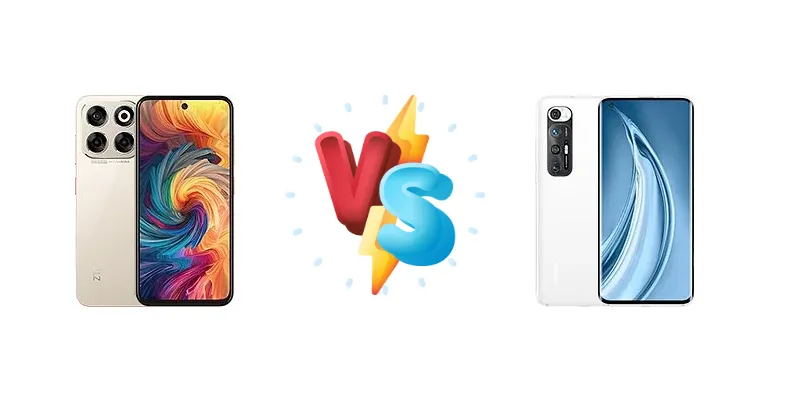
The ZTE Blade V70 and Xiaomi Mi 10S represent distinct approaches to the smartphone market. The V70 focuses on maximizing battery life and offering reliable performance at a budget price point, while the Mi 10S, though an older model, packs a flagship-level Snapdragon 870 processor and faster charging capabilities. This comparison dissects their key differences to help you determine which device best suits your needs.
🏆 Quick Verdict
For the average user prioritizing raw performance and faster charging, the Xiaomi Mi 10S is the clear winner. Its Snapdragon 870 chipset delivers a significantly smoother experience for demanding tasks. However, if extended battery life and a lower price are paramount, the ZTE Blade V70 provides excellent endurance and value.
| Network |
|---|
| 2G bands | GSM 850 / 900 / 1800 / 1900 | GSM 850 / 900 / 1800 / 1900 |
| 3G bands | HSDPA 850 / 900 / 1900 / 2100 | HSDPA 850 / 900 / 1700(AWS) / 1900 / 2100 |
| 4G bands | LTE | 1, 2, 3, 4, 5, 7, 8, 12, 17, 34, 38, 39, 40, 41 |
| 5G bands | - | 1, 3, 41, 78, 79 SA/NSA |
| Speed | HSPA, LTE | HSPA, LTE, 5G |
| Technology | GSM / HSPA / LTE | GSM / HSPA / LTE / 5G |
| Launch |
|---|
| Announced | 2024, November 18 | 2021, March 10 |
| Status | Available. Released 2025, January | Available. Released 2021, March 12 |
| Body |
|---|
| Dimensions | 8.2 mm thickness | 162.6 x 74.8 x 9 mm (6.40 x 2.94 x 0.35 in) |
| SIM | Nano-SIM + Nano-SIM | Nano-SIM + Nano-SIM |
| Weight | - | 208 g (7.34 oz) |
| Display |
|---|
| Protection | Mohs level 4 | Corning Gorilla Glass 5 |
| Resolution | 720 x 1600 pixels, 20:9 ratio (~262 ppi density) | 1080 x 2340 pixels, 19.5:9 ratio (~386 ppi density) |
| Size | 6.7 inches, 108.4 cm2 | 6.67 inches, 109.2 cm2 (~89.8% screen-to-body ratio) |
| Type | IPS LCD, 120Hz | AMOLED, 90Hz, HDR10+, 500 nits (typ), 1120 nits (peak) |
| Platform |
|---|
| CPU | Octa-core 2.0 GHz | Octa-core (1x3.2 GHz Kryo 585 & 3x2.42 GHz Kryo 585 & 4x1.80 GHz Kryo 585) |
| Chipset | - | Qualcomm SM8250-AC Snapdragon 870 5G (7 nm) |
| GPU | - | Adreno 650 |
| OS | Android 14 | Android 11, MIUI 12 |
| Memory |
|---|
| Card slot | microSDXC | No |
| Internal | 256GB 8GB RAM | 128GB 8GB RAM, 256GB 8GB RAM, 256GB 12GB RAM |
| | - | UFS 3.0 |
| Main Camera |
|---|
| Features | LED flash, HDR, panorama | Dual-LED dual-tone flash, HDR, panorama |
| Quad | - | 108 MP, f/1.7, 26mm (wide), 1/1.33", 0.8µm, PDAF, OIS
13 MP, f/2.4, 123˚ (ultrawide)
2 MP (macro)
Auxiliary lens |
| Single | - | 20 MP, (wide), 1/3.4", 0.8µm |
| Triple | 108 MP, f/1.8, (wide), 1/1.67", PDAF
other unspecified cameras | - |
| Video | 1080p@30fps | 8K@30fps, 4K@30/60fps, 1080p@30/60/120fps; gyro-EIS |
| Selfie camera |
|---|
| Features | - | HDR, panorama |
| Single | 16 MP | 20 MP, (wide), 1/3.4", 0.8µm |
| Video | 1080p@30fps | 1080p@30fps, 720p@120fps |
| Sound |
|---|
| 3.5mm jack | - | No |
| 35mm jack | Yes | No |
| Loudspeaker | Yes | Yes, with stereo speakers |
| | - | 24-bit/192kHz audio
Tuned by Harman Kardon |
| Comms |
|---|
| Bluetooth | 5.2, A2DP, LE | 5.1, A2DP, LE, aptX HD, aptX Adaptive |
| Infrared port | - | Yes |
| NFC | Yes (market/region dependent) | Yes |
| Positioning | GPS, GALILEO, GLONASS | GPS (L1+L5), GLONASS (G1), BDS (B1I+B2a), GALILEO (E1+E5a), QZSS (L1+L5) |
| Radio | Unspecified | No |
| USB | USB Type-C 2.0 | USB Type-C 2.0, OTG |
| WLAN | Wi-Fi 802.11 a/b/g/n/ac, dual-band | Wi-Fi 802.11 a/b/g/n/ac/6, dual-band, Wi-Fi Direct |
| Features |
|---|
| Sensors | Fingerprint (side-mounted), accelerometer, proximity | Fingerprint (under display, optical), accelerometer, gyro, proximity, compass, barometer |
| Battery |
|---|
| Charging | 22.5W wired | 33W wired, PD3.0, QC4, 100% in 56 min
30W wireless, 100% in 69 min
10W reverse wireless |
| Type | 5000 mAh | Li-Po 4780 mAh |
| Misc |
|---|
| Colors | Glacier Green, Stardust Gray, Sunshine Gold | Titanium Black, Ice Blue, Pearl White |
| Models | Z2459 | M2102J2SC |
| Price | € 119.00 / £ 155.60 | About 430 EUR |
| EU LABEL |
|---|
| Battery | 60:00h endurance, 800 cycles | - |
| Energy | Class A | - |
| Free fall | Class D (45 falls) | - |
| Repairability | Class B | - |
ZTE Blade V70
- Exceptional battery endurance (60 hours)
- Long battery lifespan (800 cycles)
- More affordable price point
- Significantly slower processor
- Slower charging speeds (22.5W)
Xiaomi Mi 10S
- Powerful Snapdragon 870 5G processor
- Fast 33W wired and 30W wireless charging
- Reverse wireless charging capability
- Likely shorter battery life compared to V70
- Potentially higher price
Display Comparison
Display specifications are absent from the provided data, but considering the Mi 10S was a mid-to-high range device, it likely features a higher resolution and potentially a higher refresh rate panel than the Blade V70. The Mi 10S likely benefits from better color accuracy and brightness due to its higher market positioning. The Blade V70, aiming for affordability, likely utilizes a standard LCD panel.
Camera Comparison
Camera details are limited, but the Mi 10S, being a former flagship contender, likely features a more sophisticated camera system with a larger sensor and optical image stabilization (OIS). While the Blade V70 may offer a usable camera for everyday snapshots, the Mi 10S will deliver superior image quality, especially in low-light conditions. The absence of sensor size information prevents a precise comparison, but the Mi 10S’s brand reputation suggests a more capable imaging experience.
Performance
The Xiaomi Mi 10S’s Qualcomm Snapdragon 870 5G (7nm) chipset is the dominant force here. Its octa-core configuration, with a prime core clocked at 3.2 GHz, provides a substantial performance advantage over the ZTE Blade V70’s octa-core 2.0 GHz processor. The Snapdragon 870’s Adreno 660 GPU also offers significantly superior graphics performance, making the Mi 10S the preferred choice for gamers. The 7nm process node of the Snapdragon 870 also contributes to better thermal efficiency, reducing the likelihood of throttling during sustained workloads.
Battery Life
The ZTE Blade V70 boasts a claimed 60-hour endurance and 800 charge cycles, indicating a focus on long-term battery health and longevity. While the Mi 10S doesn’t have endurance data, its 33W wired charging (with PD3.0 and QC4 support) and 30W wireless charging capabilities offer significantly faster replenishment. The Mi 10S can reach 100% charge in just 56 minutes via wired charging, compared to the V70’s 22.5W charging. The inclusion of 10W reverse wireless charging on the Mi 10S is also a convenience feature absent on the V70.
Buying Guide
Buy the ZTE Blade V70 if you need a phone that can reliably last through a full day (and beyond) on a single charge, and you primarily use your phone for basic tasks like calling, texting, and social media. Buy the Xiaomi Mi 10S if you prefer a faster, more responsive experience for gaming, video editing, or multitasking, and you value the convenience of rapid wired and wireless charging.
Frequently Asked Questions
❓ How much faster is the Xiaomi Mi 10S in real-world use compared to the ZTE Blade V70?
The Snapdragon 870 in the Mi 10S offers a substantial performance uplift – expect significantly faster app loading times, smoother multitasking, and a much more enjoyable gaming experience. Benchmarks would show a difference of at least 50-70% in CPU and GPU performance, translating to a noticeable difference in everyday tasks.
❓ Does the faster charging of the Xiaomi Mi 10S negate its potentially smaller battery capacity (compared to the Blade V70)?
While the Mi 10S’s battery capacity isn’t specified, the 33W charging (and wireless charging options) significantly reduces downtime. Even if the Mi 10S has a slightly smaller battery, the ability to quickly top it up throughout the day can offset the difference, especially for users who aren't heavy users.
❓ Is the 800 charge cycle rating of the ZTE Blade V70 a significant advantage?
Yes, 800 charge cycles indicate that the Blade V70’s battery is designed to retain a higher percentage of its original capacity after extended use. This means the battery will likely remain usable for a longer period before needing replacement, offering better long-term value.