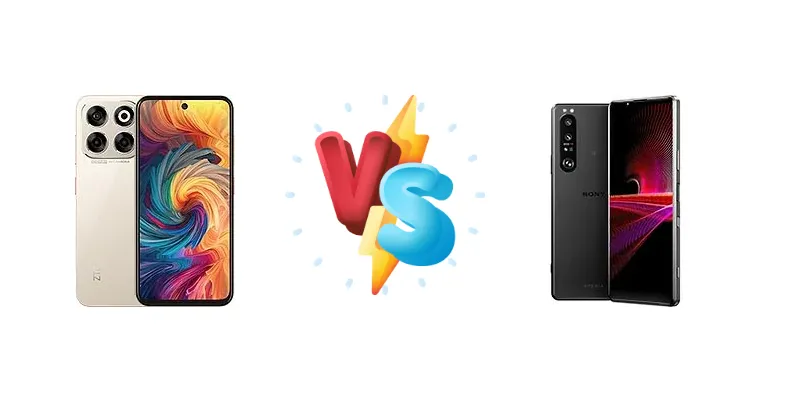
The smartphone market presents a stark contrast between maximizing battery life and chasing flagship features. We pit the ZTE Blade V70, a device prioritizing endurance, against the Sony Xperia 1 III, a premium offering focused on performance and a complete multimedia experience. This comparison isn't about declaring a single 'winner,' but identifying which phone best suits your priorities.
🏆 Quick Verdict
For the average user prioritizing longevity and value, the ZTE Blade V70 emerges as the more practical choice. Its 60-hour battery endurance and 800 charge cycles significantly outperform the Xperia 1 III's 82-hour rating, especially considering the price difference. However, the Xperia 1 III’s Snapdragon 888 and superior display cater to power users and content creators.
| Network |
|---|
| 2G bands | GSM 850 / 900 / 1800 / 1900 | GSM 850 / 900 / 1800 / 1900 |
| 3G bands | HSDPA 850 / 900 / 1900 / 2100 | HSDPA 800 / 850 / 900 / 1700(AWS) / 1900 / 2100 |
| 4G bands | LTE | 1, 2, 3, 4, 5, 7, 8, 12, 13, 17, 19, 20, 25, 26, 28, 29, 32, 34, 38, 39, 40, 41, 46, 66 - Europe |
| 5G bands | - | 1, 3, 5, 7, 8, 20, 28, 38, 40, 41, 77, 78 SA/NSA/Sub6 - Europe |
| Speed | HSPA, LTE | HSPA, LTE, 5G |
| Technology | GSM / HSPA / LTE | GSM / HSPA / LTE / 5G |
| | - | SA/NSA/Sub6/mmWave - USA (specific) |
| Launch |
|---|
| Announced | 2024, November 18 | 2021, April 14 |
| Status | Available. Released 2025, January | Available. Released 2021, August 25 |
| Body |
|---|
| Build | - | Glass front (Gorilla Glass Victus), glass back (Gorilla Glass 6), aluminum frame |
| Dimensions | 8.2 mm thickness | 165 x 71 x 8.2 mm (6.50 x 2.80 x 0.32 in) |
| SIM | Nano-SIM + Nano-SIM | Nano-SIM + Nano-SIM |
| Weight | - | 186 g / 187.1 g (mmWave) (6.56 oz) |
| | - | IP65/IP68 dust/water resistant (up to 1.5m for 30 min) |
| Display |
|---|
| Protection | Mohs level 4 | Corning Gorilla Glass Victus |
| Resolution | 720 x 1600 pixels, 20:9 ratio (~262 ppi density) | 1644 x 3840 pixels, 21:9 ratio (~643 ppi density) |
| Size | 6.7 inches, 108.4 cm2 | 6.5 inches, 98.6 cm2 (~84.2% screen-to-body ratio) |
| Type | IPS LCD, 120Hz | OLED, 1B colors, 120Hz, HDR BT.2020 |
| | - | Runs at 1096 x 2560 pixels except for select use cases |
| Platform |
|---|
| CPU | Octa-core 2.0 GHz | Octa-core (1x2.84 GHz Cortex-X1 & 3x2.42 GHz Cortex-A78 & 4x1.80 GHz Cortex-A55) |
| Chipset | - | Qualcomm SM8350 Snapdragon 888 5G (5 nm) |
| GPU | - | Adreno 660 |
| OS | Android 14 | Android 11, upgradable to Android 13 |
| Memory |
|---|
| Card slot | microSDXC | microSDXC (uses shared SIM slot) |
| Internal | 256GB 8GB RAM | 256GB 12GB RAM, 512GB 12GB RAM |
| | - | UFS 3.X |
| Main Camera |
|---|
| Features | LED flash, HDR, panorama | Zeiss optics, Zeiss T* lens coating, color spectrum sensor, LED flash, panorama, HDR, eye tracking |
| Single | - | 8 MP, f/2.0, 24mm (wide), 1/4", 1.12µm |
| Triple | 108 MP, f/1.8, (wide), 1/1.67", PDAF
other unspecified cameras | 12 MP, f/1.7, 24mm (wide), 1/1.7", 1.8µm, dual pixel PDAF, OIS
12 MP, f/2.3, 70mm (telephoto), f/2.8, 105mm (telephoto), 1/2.9", dual pixel PDAF, 3x/4.4x optical zoom, OIS
12 MP, f/2.2, 124˚, 16mm (ultrawide), 1/2.6", dual pixel PDAF
0.3 MP, TOF 3D, (depth) |
| Video | 1080p@30fps | 4K@24/25/30/60/120fps HDR, 1080p@30/60/120fps; 5-axis gyro-EIS, OIS |
| Selfie camera |
|---|
| Features | - | HDR |
| Single | 16 MP | 8 MP, f/2.0, 24mm (wide), 1/4.0", 1.12µm |
| Video | 1080p@30fps | 1080p@30fps, 5-axis gyro-EIS |
| Sound |
|---|
| 3.5mm jack | - | Yes |
| 35mm jack | Yes | Yes |
| Loudspeaker | Yes | Yes, with stereo speakers |
| | - | 24-bit/192kHz audio
Dynamic vibration system |
| Comms |
|---|
| Bluetooth | 5.2, A2DP, LE | 5.2, A2DP, LE, aptX HD, aptX Adaptive |
| NFC | Yes (market/region dependent) | Yes |
| Positioning | GPS, GALILEO, GLONASS | GPS, GLONASS, BDS, GALILEO, QZSS |
| Radio | Unspecified | No |
| USB | USB Type-C 2.0 | USB Type-C 3.1, OTG, video output |
| WLAN | Wi-Fi 802.11 a/b/g/n/ac, dual-band | Wi-Fi 802.11 a/b/g/n/ac/6, dual-band, Wi-Fi Direct, DLNA |
| Features |
|---|
| Sensors | Fingerprint (side-mounted), accelerometer, proximity | Fingerprint (side-mounted), accelerometer, gyro, proximity, barometer, compass |
| | - | Native Sony Alpha camera support |
| Battery |
|---|
| Charging | 22.5W wired | 30W wired, PD, 50% in 30 min
Wireless
Reverse wireless |
| Type | 5000 mAh | Li-Po 4500 mAh |
| Misc |
|---|
| Colors | Glacier Green, Stardust Gray, Sunshine Gold | Frosted Black, Frosted Gray, Frosted Purple |
| Models | Z2459 | XQBC62/V, XQBC52V.UKCX, SO-51B, SOG03, A101SO, XQ-BC62, XQ-BC72, XQ-BC52, XQ-BC01, XQ-BC11, XQ-BC21, XQ-BC72 |
| Price | € 119.00 / £ 155.60 | € 505.26 / $ 903.43 |
| Tests |
|---|
| Battery life | - |
Endurance rating 82h
|
| Camera | - |
Photo / Video |
| Display | - |
Contrast ratio: Infinite (nominal) |
| Loudspeaker | - |
-26.5 LUFS (Good)
|
| Performance | - |
AnTuTu: 607423 (v8)
GeekBench: 3515 (v5.1)
GFXBench: 54fps (ES 3.1 onscreen) |
| EU LABEL |
|---|
| Battery | 60:00h endurance, 800 cycles | - |
| Energy | Class A | - |
| Free fall | Class D (45 falls) | - |
| Repairability | Class B | - |
ZTE Blade V70
- Exceptional battery endurance (60 hours)
- Long-lasting battery health (800 charge cycles)
- Affordable price point
- Less powerful processor
- Likely lower display quality
Sony Xperia 1 III
- Powerful Snapdragon 888 processor
- Bright and high-quality display (620 nits)
- Fast charging and wireless charging options
- Higher price
- Shorter battery lifespan (fewer charge cycles)
Display Comparison
The Sony Xperia 1 III boasts a significantly brighter display, peaking at 620 nits, crucial for outdoor visibility. While the Blade V70’s display brightness isn’t specified, it’s likely considerably lower. The Xperia 1 III’s infinite contrast ratio suggests a high-quality OLED panel, offering deep blacks and vibrant colors. The Blade V70 likely utilizes an LCD panel, which, while functional, won’t match the Xperia’s visual fidelity. The Xperia 1 III’s display is geared towards content consumption and professional photo/video editing, while the Blade V70’s display is adequate for everyday use.
Camera Comparison
Both devices offer photo and video capabilities, but the Xperia 1 III is expected to deliver a far superior experience. While specific sensor details are missing for both, Sony’s history with camera technology suggests a high-quality sensor and advanced image processing. The Xperia 1 III likely features optical image stabilization (OIS) and a wider range of shooting modes. The Blade V70’s camera is likely adequate for casual snapshots, but won’t compete with the Xperia’s professional-grade capabilities. The Xperia 1 III is for photography enthusiasts, while the Blade V70 is for point-and-shoot simplicity.
Performance
The Xperia 1 III’s Qualcomm Snapdragon 888 5G (5nm) chipset is in a different league than the Blade V70’s octa-core 2.0 GHz processor. The Snapdragon 888’s architecture – a 1x2.84 GHz Cortex-X1, 3x2.42 GHz Cortex-A78, and 4x1.80 GHz Cortex-A55 – provides significantly faster processing speeds and superior graphics performance. The 5nm fabrication process also contributes to better thermal efficiency, reducing throttling during demanding tasks. The Blade V70’s processor is sufficient for basic tasks, but will struggle with graphically intensive games or multitasking. The Xperia 1 III is designed for demanding users, while the Blade V70 is geared towards simplicity.
Battery Life
The Xperia 1 III has an endurance rating of 82 hours, while the ZTE Blade V70 boasts 60 hours. However, the Blade V70’s 800 charge cycles suggest significantly improved long-term battery health. The Xperia 1 III offers faster charging at 30W with PD and 50% charge in 30 minutes, alongside wireless and reverse wireless charging. The Blade V70 charges at 22.5W. While the Xperia 1 III charges faster, the Blade V70’s longevity and lower charging speed may be preferable for users prioritizing battery health over quick top-ups.
Buying Guide
Buy the ZTE Blade V70 if you need a reliable, long-lasting smartphone for everyday tasks, communication, and moderate media consumption, and value extended battery life over cutting-edge features. Buy the Sony Xperia 1 III if you prioritize top-tier performance for gaming, photography, and videography, and demand a premium display and feature set, even at a higher cost.
Frequently Asked Questions
❓ How does the ZTE Blade V70's battery hold up over several years of use compared to the Xperia 1 III?
The Blade V70's 800 charge cycle rating suggests it's designed for long-term battery health. While the Xperia 1 III offers faster charging, its battery capacity may degrade more quickly over time with frequent fast charging cycles. The Blade V70 prioritizes longevity, while the Xperia 1 III prioritizes convenience.
❓ Is the Snapdragon 888 in the Xperia 1 III overkill for everyday tasks like browsing and social media?
Yes, the Snapdragon 888 is significantly more powerful than needed for basic tasks. However, this extra power ensures smooth performance with demanding apps, multitasking, and future software updates. If you primarily use your phone for simple tasks, the Blade V70's processor will suffice.
❓ Does the Sony Xperia 1 III support external displays for productivity?
Yes, the Xperia 1 III, being a flagship device, supports external display output via USB-C, allowing for a desktop-like experience with a monitor, keyboard, and mouse. The ZTE Blade V70 likely lacks this functionality.
❓ What type of user would benefit most from the reverse wireless charging feature on the Xperia 1 III?
The reverse wireless charging feature is most beneficial for users who frequently travel with wireless earbuds or smartwatches. It allows you to top up these accessories using the Xperia 1 III's battery as a power source, eliminating the need for separate chargers.