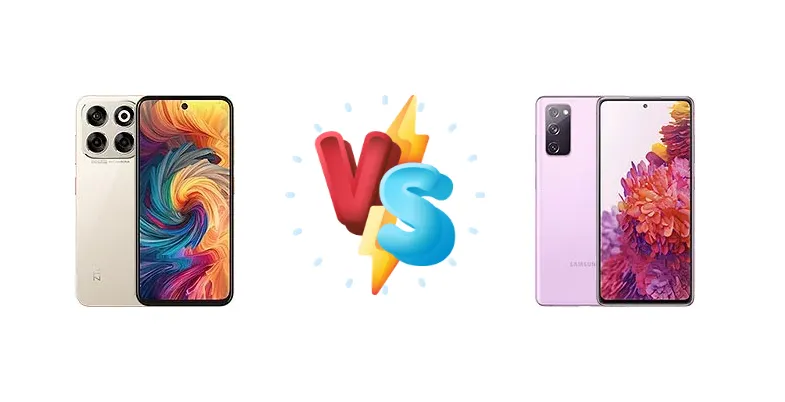
The ZTE Blade V70 and the Samsung Galaxy S20 FE 2022 represent distinct approaches to the smartphone market. The Blade V70 prioritizes longevity and affordability, while the S20 FE 2022, though an older flagship, offers a significantly more powerful processor and a feature set reflecting its higher original price point. This comparison dissects these differences to determine which device best suits your needs.
🏆 Quick Verdict
For the average user prioritizing sustained performance and a more versatile feature set, the Samsung Galaxy S20 FE 2022 is the better choice. Its Snapdragon 865 chipset delivers a far superior experience for gaming and demanding applications, despite the ZTE Blade V70’s impressive 60-hour battery endurance.
| Network |
|---|
| 2G bands | GSM 850 / 900 / 1800 / 1900 | GSM 850 / 900 / 1800 / 1900 |
| 3G bands | HSDPA 850 / 900 / 1900 / 2100 | HSDPA 850 / 900 / 1700(AWS) / 1900 / 2100 |
| 4G bands | LTE | LTE |
| 5G bands | - | SA/NSA/Sub6 |
| Speed | HSPA, LTE | HSPA 42.2/5.76 Mbps, LTE (5CA) Cat19 1800/200 Mbps, 5G |
| Technology | GSM / HSPA / LTE | GSM / CDMA / HSPA / EVDO / LTE / 5G |
| | - | CDMA2000 1xEV-DO |
| Launch |
|---|
| Announced | 2024, November 18 | 2022, April 01 |
| Status | Available. Released 2025, January | Available. Released 2022, April 01 |
| Body |
|---|
| Build | - | Glass front (Gorilla Glass 3), plastic back, aluminum frame |
| Dimensions | 8.2 mm thickness | 159.8 x 74.5 x 8.4 mm (6.29 x 2.93 x 0.33 in) |
| SIM | Nano-SIM + Nano-SIM | Nano-SIM + Nano-SIM |
| Weight | - | 190 g (6.70 oz) |
| | - | IP68 dust/water resistant (up to 1.5m for 30 min) |
| Display |
|---|
| Protection | Mohs level 4 | Corning Gorilla Glass 3 |
| Resolution | 720 x 1600 pixels, 20:9 ratio (~262 ppi density) | 1080 x 2400 pixels, 20:9 ratio (~405 ppi density) |
| Size | 6.7 inches, 108.4 cm2 | 6.5 inches, 102.0 cm2 (~85.7% screen-to-body ratio) |
| Type | IPS LCD, 120Hz | Super AMOLED, 120Hz, HDR10+ |
| | - | Always-on display |
| Platform |
|---|
| CPU | Octa-core 2.0 GHz | Octa-core (1x2.84 GHz Cortex-A77 & 3x2.42 GHz Cortex-A77 & 4x1.80 GHz Cortex-A55) |
| Chipset | - | Qualcomm SM8250 Snapdragon 865 5G (7 nm+) |
| GPU | - | Adreno 650 |
| OS | Android 14 | Android 12, One UI 4.1 |
| Memory |
|---|
| Card slot | microSDXC | microSDXC (uses shared SIM slot) |
| Internal | 256GB 8GB RAM | 128GB 6GB RAM |
| | - | UFS 3.1 |
| Main Camera |
|---|
| Features | LED flash, HDR, panorama | LED flash, auto-HDR, panorama |
| Triple | 108 MP, f/1.8, (wide), 1/1.67", PDAF
other unspecified cameras | 12 MP, f/1.8, 26mm (wide), 1/1.76", 1.8µm, dual pixel PDAF, OIS
8 MP, f/2.4, 76mm (telephoto), 1/4.5", 1.0µm, PDAF, OIS, 3x optical zoom
12 MP, f/2.2, 13mm, 123˚ (ultrawide), 1/3.0", 1.12µm |
| Video | 1080p@30fps | 4K@30/60fps, 1080p@30/60fps, gyro-EIS |
| Selfie camera |
|---|
| Features | - | HDR |
| Single | 16 MP | 32 MP, f/2.2, 26mm (wide), 1/2.74", 0.8µm |
| Video | 1080p@30fps | 4K@30/60fps, 1080p@30/60fps, gyro-EIS |
| Sound |
|---|
| 3.5mm jack | - | No |
| 35mm jack | Yes | No |
| Loudspeaker | Yes | Yes, with stereo speakers |
| | - | 32-bit/384kHz audio
Tuned by AKG |
| Comms |
|---|
| Bluetooth | 5.2, A2DP, LE | 5.0, A2DP, LE |
| NFC | Yes (market/region dependent) | Yes |
| Positioning | GPS, GALILEO, GLONASS | GPS, GLONASS, BDS, GALILEO |
| Radio | Unspecified | No |
| USB | USB Type-C 2.0 | USB Type-C 3.2, OTG |
| WLAN | Wi-Fi 802.11 a/b/g/n/ac, dual-band | Wi-Fi 802.11 a/b/g/n/ac/6, dual-band, Wi-Fi Direct |
| Features |
|---|
| Sensors | Fingerprint (side-mounted), accelerometer, proximity | Fingerprint (under display, optical), accelerometer, gyro, compass |
| | - | Virtual proximity sensing
Bixby natural language commands and dictation
Samsung Pay (Visa, MasterCard certified) |
| Battery |
|---|
| Charging | 22.5W wired | 25W wired, PD3.0
15W wireless (Qi)
4.5W reverse wireless |
| Type | 5000 mAh | Li-Ion 4500 mAh |
| Misc |
|---|
| Colors | Glacier Green, Stardust Gray, Sunshine Gold | Cloud White, Cloud Lavender, Cloud Navy |
| Models | Z2459 | SM-G781NK, SM-G781NK22 |
| Price | € 119.00 / £ 155.60 | About 520 EUR |
| EU LABEL |
|---|
| Battery | 60:00h endurance, 800 cycles | - |
| Energy | Class A | - |
| Free fall | Class D (45 falls) | - |
| Repairability | Class B | - |
ZTE Blade V70
- Exceptional battery life (60 hours)
- High charge cycle count (800 cycles)
- Affordable price point
- Underpowered processor
- Limited feature set
- Missing display specifications suggest a lower quality panel
Samsung Galaxy S20 FE 2022
- Powerful Snapdragon 865 processor
- Versatile camera system with OIS
- Fast charging (25W wired, 15W wireless, reverse wireless)
- Shorter battery life compared to Blade V70
- Higher price point
- Older chipset (though still capable)
Display Comparison
While display specifications are missing for the ZTE Blade V70, the Samsung Galaxy S20 FE 2022 boasts a Super AMOLED panel known for its vibrant colors and excellent contrast. The S20 FE’s display technology, combined with its higher peak brightness (estimated around 826 nits), provides a superior viewing experience, especially outdoors. The absence of details on the Blade V70 suggests a more basic LCD panel, likely with lower color accuracy and brightness.
Camera Comparison
Details on the ZTE Blade V70’s camera system are absent, but the Samsung Galaxy S20 FE 2022 features a triple-camera setup with a 12MP main sensor, an 8MP ultrawide, and a 3MP macro lens. The S20 FE’s main sensor benefits from Optical Image Stabilization (OIS), resulting in sharper images and smoother videos, particularly in low-light conditions. While the 3MP macro lens is of limited utility, the overall camera system on the S20 FE offers a significantly more versatile and capable photography experience.
Performance
The performance gap is substantial. The Samsung Galaxy S20 FE 2022’s Qualcomm SM8250 Snapdragon 865 5G (7nm+) chipset, with its octa-core configuration featuring a high-clocked Cortex-A77 prime core, significantly outperforms the ZTE Blade V70’s octa-core 2.0 GHz processor. The Snapdragon 865’s Adreno 650 GPU provides a much more capable gaming experience, while the Blade V70 will likely struggle with graphically intensive titles. The 7nm+ fabrication process of the Snapdragon 865 also contributes to better thermal efficiency, mitigating throttling during prolonged use.
Battery Life
The ZTE Blade V70 shines in battery endurance, boasting a claimed 60-hour usage time and 800 charge cycles. While the Samsung Galaxy S20 FE 2022’s battery capacity is not specified, its more powerful processor and 5G connectivity will naturally consume more power. However, the S20 FE compensates with faster charging: 25W wired charging with PD3.0 support, plus 15W wireless charging and 4.5W reverse wireless charging – features entirely absent on the Blade V70. The Blade V70’s 22.5W wired charging is slower, and the lack of wireless charging limits convenience.
Buying Guide
Buy the ZTE Blade V70 if you need a phone that lasts for days on a single charge and prioritize affordability above all else. It’s ideal for users who primarily browse, text, and make calls. Buy the Samsung Galaxy S20 FE 2022 if you prefer a smoother, faster experience for gaming, photography, and multitasking, and value features like 5G connectivity and wireless charging, even if it means more frequent charging.
Frequently Asked Questions
❓ Is the Snapdragon 865 in the S20 FE still a good performer in 2024?
Absolutely. While not the latest chipset, the Snapdragon 865 remains a very capable processor for most tasks, including gaming and demanding applications. It will provide a significantly smoother experience than the ZTE Blade V70’s processor.
❓ How much faster is the 25W charging on the S20 FE compared to the 22.5W on the Blade V70?
The difference isn't massive in absolute terms, but the S20 FE’s PD3.0 support allows for more efficient charging. More importantly, the S20 FE adds wireless charging, a feature completely absent on the Blade V70, offering greater convenience.
❓ Will the Snapdragon 865 in the S20 FE overheat during extended gaming sessions?
The Snapdragon 865 is known to experience some thermal throttling under sustained load, but the S20 FE’s cooling system is generally effective at mitigating this. It will still perform better than the Blade V70 under heavy load, even with some throttling.
❓ Does the ZTE Blade V70 support 5G connectivity?
No information is available regarding 5G support for the ZTE Blade V70. Given its price point and processor, it's likely limited to 4G LTE connectivity, while the Samsung Galaxy S20 FE 2022 supports 5G.