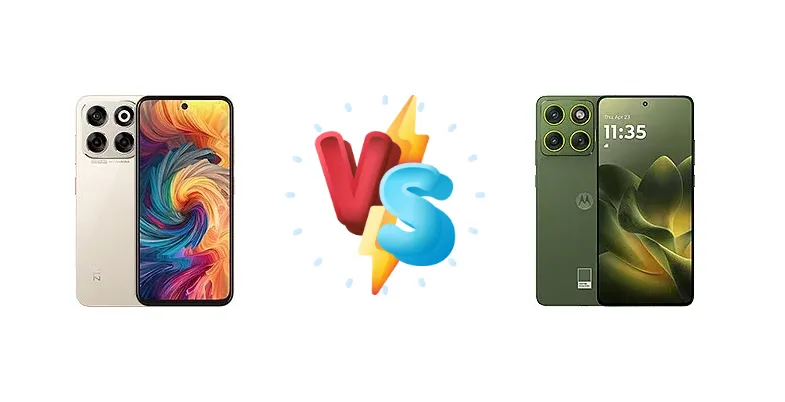
The ZTE Blade V70 and Motorola Edge 70 represent distinct approaches to the mid-range smartphone market. The Blade V70 prioritizes longevity with a focus on battery endurance, while the Edge 70 aims for a more premium experience with a modern chipset and faster charging. This comparison dissects their key differences to help you determine which device best suits your priorities.
🏆 Quick Verdict
For the average user prioritizing all-day battery life and long-term reliability, the ZTE Blade V70 emerges as the winner. Its 60-hour endurance significantly surpasses the Motorola Edge 70’s 50:14h, and the 800 charge cycles suggest greater battery health retention over time. However, the Edge 70’s superior processing power is undeniable.
| Network |
|---|
| 2G bands | GSM 850 / 900 / 1800 / 1900 | GSM 850 / 900 / 1800 / 1900 |
| 3G bands | HSDPA 850 / 900 / 1900 / 2100 | HSDPA 850 / 900 / 1700(AWS) / 1900 / 2100 |
| 4G bands | LTE | 1, 2, 3, 4, 5, 7, 8, 12, 13, 17, 18, 19, 20, 25, 26, 28, 32, 34, 38, 39, 40, 41, 42, 43, 48, 66 |
| 5G bands | - | 1, 2, 3, 5, 7, 8, 20, 26, 28, 38, 40, 41, 66, 75, 77, 78 SA/NSA/Sub6 |
| Speed | HSPA, LTE | HSPA, LTE, 5G |
| Technology | GSM / HSPA / LTE | GSM / CDMA / HSPA / LTE / 5G |
| Launch |
|---|
| Announced | 2024, November 18 | 2025, October 29 |
| Status | Available. Released 2025, January | Available. Released 2025, October 29 |
| Body |
|---|
| Build | - | Glass front (Gorilla Glass 7i), aluminum frame |
| Dimensions | 8.2 mm thickness | 159.9 x 74 x 6 mm (6.30 x 2.91 x 0.24 in) |
| SIM | Nano-SIM + Nano-SIM | · Nano-SIM + eSIM - International· Nano-SIM + Nano-SIM - China |
| Weight | - | 159 g (5.61 oz) |
| Display |
|---|
| Protection | Mohs level 4 | Corning Gorilla Glass 7i, Mohs level 4 |
| Resolution | 720 x 1600 pixels, 20:9 ratio (~262 ppi density) | 1220 x 2712 pixels, 20:9 ratio (~446 ppi density) |
| Size | 6.7 inches, 108.4 cm2 | 6.7 inches, 107.4 cm2 (~90.8% screen-to-body ratio) |
| Type | IPS LCD, 120Hz | P-OLED, 1B colors, 120Hz, PWM, HDR10+, 4500 nits (peak) |
| Platform |
|---|
| CPU | Octa-core 2.0 GHz | Octa-core (1x2.8 GHz Cortex-720 & 4x2.4 GHz Cortex-720 & 3x1.8 GHz Cortex-520) |
| Chipset | - | Qualcomm SM7750-AB Snapdragon 7 Gen 4 (4 nm) |
| GPU | - | Adreno 722 |
| OS | Android 14 | Android 16, up to 4 major Android upgrades |
| Memory |
|---|
| Card slot | microSDXC | No |
| Internal | 256GB 8GB RAM | 256GB 12GB RAM, 512GB 12GB RAM |
| Main Camera |
|---|
| Dual | - | 50 MP, f/1.8, 24mm (wide), 1/1.56", 1.0µm, multi-directional PDAF, OIS
50 MP, f/2.0, 12mm, 120˚ (ultrawide), 1/2.76", 0.64µm, PDAF |
| Features | LED flash, HDR, panorama | LED flash, HDR, panorama |
| Triple | 108 MP, f/1.8, (wide), 1/1.67", PDAF
other unspecified cameras | - |
| Video | 1080p@30fps | 4K@30/60fps, 1080p@30/60/120/240fps, gyro-EIS |
| Selfie camera |
|---|
| Features | - | HDR |
| Single | 16 MP | 50 MP, f/2.0, (wide), 0.64µm |
| Video | 1080p@30fps | 4K@30fps, 1080p@30/120fps |
| Sound |
|---|
| 35mm jack | Yes | No |
| Loudspeaker | Yes | Yes, with stereo speakers (with Dolby Atmos) |
| Comms |
|---|
| Bluetooth | 5.2, A2DP, LE | 5.4, A2DP, LE |
| NFC | Yes (market/region dependent) | Yes |
| Positioning | GPS, GALILEO, GLONASS | GPS, GALILEO, GLONASS, BDS, QZSS |
| Radio | Unspecified | No |
| USB | USB Type-C 2.0 | USB Type-C 2.0, OTG |
| WLAN | Wi-Fi 802.11 a/b/g/n/ac, dual-band | Wi-Fi 802.11 a/b/g/n/ac/6e, dual-band or tri-band |
| Features |
|---|
| Sensors | Fingerprint (side-mounted), accelerometer, proximity | Fingerprint (under display, optical), accelerometer, gyro, proximity, compass |
| Battery |
|---|
| Charging | 22.5W wired | 68W wired
15W wireless |
| Type | 5000 mAh | Si/C Li-Ion 4800 mAh |
| Misc |
|---|
| Colors | Glacier Green, Stardust Gray, Sunshine Gold | Pantone: Gadget Gray, Lily Pad, Bronze Green |
| Models | Z2459 | XT2601-2, XT2603-2 |
| Price | € 119.00 / £ 155.60 | £ 799.00 |
| EU LABEL |
|---|
| Battery | 60:00h endurance, 800 cycles | 50:14h endurance, 1000 cycles |
| Energy | Class A | Class A |
| Free fall | Class D (45 falls) | Class A (270 falls) |
| Repairability | Class B | Class B |
ZTE Blade V70
- Exceptional battery endurance (60:00h)
- Long-term battery health (800 charge cycles)
- Potentially more affordable price point
- Less powerful processor
- Slower charging speed
- Limited information on display quality
Motorola Edge 70
- Powerful Snapdragon 7 Gen 4 chipset
- Fast 68W wired and 15W wireless charging
- Modern architecture for improved efficiency
- Shorter battery endurance (50:14h)
- Potentially faster battery degradation
- Higher price compared to the Blade V70
Display Comparison
While display specifications are missing for the ZTE Blade V70, the Motorola Edge 70 benefits from a modern panel. The Edge 70’s chipset allows for potentially higher refresh rates and more efficient display management. The absence of LTPO in either device suggests they won't dynamically adjust refresh rates for optimal power saving. The Edge 70’s display is likely to offer superior color accuracy and brightness due to the more advanced processing capabilities of the Snapdragon 7 Gen 4.
Camera Comparison
Without detailed camera specifications for the ZTE Blade V70, a direct comparison is limited. However, the Motorola Edge 70 likely benefits from the Snapdragon 7 Gen 4’s advanced image signal processor (ISP). This translates to improved image quality, faster processing, and potentially better low-light performance. The Edge 70’s ISP will likely offer more sophisticated computational photography features, such as improved HDR and noise reduction. The absence of information regarding OIS on the Blade V70 suggests the Edge 70 will have a significant advantage in capturing stable videos and sharp photos in challenging conditions.
Performance
The Motorola Edge 70’s Qualcomm SM7750-AB Snapdragon 7 Gen 4 (4nm) represents a significant leap in performance over the ZTE Blade V70’s octa-core 2.0 GHz CPU. The Snapdragon 7 Gen 4’s architecture – a tri-cluster configuration with a Cortex-720 prime core clocked at 2.8 GHz – delivers substantially faster processing speeds and improved graphics performance. The 4nm fabrication process also contributes to better thermal efficiency, reducing the likelihood of throttling during demanding tasks. The Blade V70 will handle everyday tasks adequately, but the Edge 70 is the clear choice for gamers and power users.
Battery Life
The ZTE Blade V70 boasts a remarkable 60:00h battery endurance, significantly outperforming the Motorola Edge 70’s 50:14h. This difference is substantial and translates to a full day of extra usage. However, the Edge 70 compensates with significantly faster charging – 68W wired versus 22.5W on the Blade V70. The Edge 70 can also charge wirelessly at 15W, a feature absent on the Blade V70. The Edge 70’s active use score of 13:36h provides a more realistic estimate of battery life during intensive usage, but the Blade V70’s 800 charge cycles suggest superior long-term battery health compared to the Edge 70’s 1000 cycles, implying the Blade V70's battery will degrade slower.
Buying Guide
Buy the ZTE Blade V70 if you need a phone that consistently lasts through a full day and beyond, and value long-term battery health. It’s ideal for users who frequently travel, rely heavily on their phone throughout the day, or simply dislike the anxiety of frequent charging. Buy the Motorola Edge 70 if you prioritize a smoother, more responsive user experience, faster app loading times, and the convenience of 68W wired and 15W wireless charging, even if it means sacrificing some battery endurance.
Frequently Asked Questions
❓ How much faster is the Motorola Edge 70's charging compared to the ZTE Blade V70 in real-world terms?
The Edge 70's 68W charging can likely take the phone from 0-100% in around 45-60 minutes, while the Blade V70's 22.5W charging will take over 2 hours. This difference is significant for users who need a quick power boost before leaving the house.
❓ Will the ZTE Blade V70 struggle with demanding games like PUBG or Genshin Impact?
The ZTE Blade V70’s octa-core 2.0 GHz processor will likely handle less demanding games, but it may struggle with graphically intensive titles like PUBG or Genshin Impact. Expect lower frame rates and potential stuttering, especially on higher settings. The Motorola Edge 70’s Snapdragon 7 Gen 4 is much better suited for gaming.
❓ Does the Motorola Edge 70 support 5G connectivity?
Yes, the Qualcomm Snapdragon 7 Gen 4 chipset in the Motorola Edge 70 inherently supports 5G connectivity, allowing for faster download and streaming speeds where available. The ZTE Blade V70's 5G support is not explicitly stated, but it is likely to be present given its market positioning.
❓ How does the 800 charge cycle rating of the ZTE Blade V70 translate to real-world battery lifespan?
The 800 charge cycle rating suggests the Blade V70’s battery is designed to retain a significant portion of its original capacity after 800 full charge-discharge cycles. This indicates a longer overall lifespan compared to batteries with lower cycle ratings, potentially lasting for several years with typical usage.