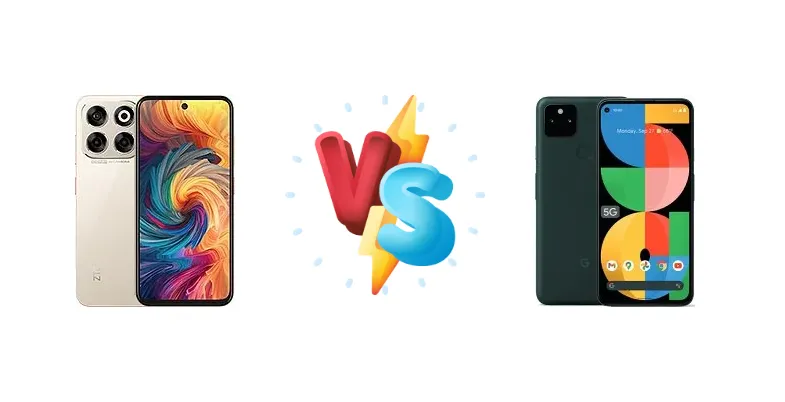
The Google Pixel 5a 5G, once a mid-range champion, now faces competition from newer budget offerings like the ZTE Blade V70. While the Pixel 5a 5G still holds advantages in processing power and display quality, the Blade V70 aggressively targets users prioritizing maximum battery life. This comparison dissects the key differences to help you choose the right phone for your needs.
🏆 Quick Verdict
For the average user, the Google Pixel 5a 5G remains the stronger all-rounder thanks to its superior chipset and brighter display. However, the ZTE Blade V70 is the clear winner for those who absolutely need the longest possible battery life, offering a remarkable 60-hour endurance.
| Network |
|---|
| 2G bands | GSM 850 / 900 / 1800 / 1900 | GSM 850 / 900 / 1800 / 1900 |
| 3G bands | HSDPA 850 / 900 / 1900 / 2100 | HSDPA 850 / 900 / 1700(AWS) / 1900 / 2100 |
| 4G bands | LTE | 1, 2, 3, 4, 5, 7, 8, 12, 13, 14, 17, 18, 19, 20, 25, 26, 28, 29, 30, 32, 38, 39, 40, 41, 42, 46, 48, 66, 71 |
| 5G bands | - | 1, 2, 5, 12, 25, 28, 41, 66, 71, 77, 78 SA/NSA/Sub6 |
| Speed | HSPA, LTE | HSPA, LTE, 5G |
| Technology | GSM / HSPA / LTE | GSM / HSPA / EVDO / LTE / 5G |
| | - | CDMA2000 1xEV-DO |
| Launch |
|---|
| Announced | 2024, November 18 | 2021, August 17 |
| Status | Available. Released 2025, January | Available. Released 2021, August 26 |
| Body |
|---|
| Build | - | Glass front (Gorilla Glass 3), aluminum frame, aluminum back |
| Dimensions | 8.2 mm thickness | 156.2 x 73.2 x 8.8 mm (6.15 x 2.88 x 0.35 in) |
| SIM | Nano-SIM + Nano-SIM | Nano-SIM + eSIM |
| Weight | - | 183 g (6.46 oz) |
| | - | IP67 dust/water resistant (up to 1m for 30 min) |
| Display |
|---|
| Protection | Mohs level 4 | Corning Gorilla Glass 3 |
| Resolution | 720 x 1600 pixels, 20:9 ratio (~262 ppi density) | 1080 x 2400 pixels, 20:9 ratio (~415 ppi density) |
| Size | 6.7 inches, 108.4 cm2 | 6.34 inches, 97.0 cm2 (~84.9% screen-to-body ratio) |
| Type | IPS LCD, 120Hz | OLED, HDR |
| | - | Always-on display |
| Platform |
|---|
| CPU | Octa-core 2.0 GHz | Octa-core (1x2.4 GHz Kryo 475 Prime & 1x2.2 GHz Kryo 475 Gold & 6x1.8 GHz Kryo 475 Silver) |
| Chipset | - | Qualcomm SM7250 Snapdragon 765G 5G (7 nm) |
| GPU | - | Adreno 620 |
| OS | Android 14 | Android 11, upgradable to Android 14 |
| Memory |
|---|
| Card slot | microSDXC | No |
| Internal | 256GB 8GB RAM | 128GB 6GB RAM |
| Main Camera |
|---|
| Dual | - | 12.2 MP, f/1.7, 27mm, (wide), 1/2.55", 1.4µm, dual pixel PDAF, OIS
16 MP, f/2.2, 119˚ (ultrawide), 1.0µm |
| Features | LED flash, HDR, panorama | LED flash, Pixel Shift, Auto-HDR, panorama |
| Single | - | 8 MP, f/2.0, 24mm (wide), 1.12µm |
| Triple | 108 MP, f/1.8, (wide), 1/1.67", PDAF
other unspecified cameras | - |
| Video | 1080p@30fps | 4K@30/60fps, 1080p@30/60/120/240fps; gyro-EIS |
| Selfie camera |
|---|
| Features | - | HDR |
| Single | 16 MP | 8 MP, f/2.0, 24mm (wide), 1.12µm |
| Video | 1080p@30fps | 1080p@30fps |
| Sound |
|---|
| 3.5mm jack | - | Yes |
| 35mm jack | Yes | Yes |
| Loudspeaker | Yes | Yes, with stereo speakers |
| Comms |
|---|
| Bluetooth | 5.2, A2DP, LE | 5.0, A2DP, LE, aptX HD |
| NFC | Yes (market/region dependent) | Yes |
| Positioning | GPS, GALILEO, GLONASS | GPS, GLONASS, GALILEO, QZSS, BDS |
| Radio | Unspecified | No |
| USB | USB Type-C 2.0 | USB Type-C 3.1 |
| WLAN | Wi-Fi 802.11 a/b/g/n/ac, dual-band | Wi-Fi 802.11 a/b/g/n/ac, dual-band, Wi-Fi Direct |
| Features |
|---|
| Sensors | Fingerprint (side-mounted), accelerometer, proximity | Fingerprint (rear-mounted), accelerometer, gyro, proximity, compass, barometer |
| Battery |
|---|
| Charging | 22.5W wired | 18W wired, PD2.0 |
| Type | 5000 mAh | Li-Po 4680 mAh |
| Misc |
|---|
| Colors | Glacier Green, Stardust Gray, Sunshine Gold | Mostly Black |
| Models | Z2459 | G1F8F, G4S1M |
| Price | € 119.00 / £ 155.60 | $ 189.00 / C$ 249.99 |
| Tests |
|---|
| Battery life | - |
Endurance rating 122h
|
| Display | - |
Contrast ratio: Infinite (nominal) |
| Performance | - |
AnTuTu: 291303 (v8)
GeekBench: 1337 (v5.1)
GFXBench: 19fps (ES 3.1 onscreen) |
| EU LABEL |
|---|
| Battery | 60:00h endurance, 800 cycles | - |
| Energy | Class A | - |
| Free fall | Class D (45 falls) | - |
| Repairability | Class B | - |
ZTE Blade V70
- Exceptional battery life (60-hour endurance)
- Faster charging (22.5W)
- 800 charge cycles promise longevity
- Processor performance lags behind the Pixel 5a 5G
- Display brightness and quality are likely inferior
Google Pixel 5a 5G
- More powerful Snapdragon 765G processor
- Brighter and higher-quality display (861 nits)
- Superior camera image processing
- Shorter battery life (122-hour endurance)
- Slower charging (18W)
Display Comparison
The Google Pixel 5a 5G’s display is a clear standout, achieving a measured peak brightness of 861 nits. This translates to excellent visibility outdoors, a significant advantage over the ZTE Blade V70, whose brightness is not specified. The Pixel 5a 5G also boasts an infinite (nominal) contrast ratio, suggesting deep blacks and vibrant colors. While the Blade V70’s panel technology isn’t detailed, the Pixel 5a 5G’s superior specs cater to users who consume a lot of media or work outdoors.
Camera Comparison
Details on the ZTE Blade V70’s camera system are limited, making a direct comparison challenging. However, the Pixel 5a 5G is known for its excellent image processing capabilities, leveraging Google’s computational photography expertise. While sensor size and aperture details are missing for the Blade V70, the Pixel 5a 5G’s camera consistently delivers high-quality photos, particularly in challenging lighting conditions. The Pixel’s image processing excels in dynamic range and detail preservation, offering a more refined photographic experience.
Performance
The Qualcomm Snapdragon 765G in the Pixel 5a 5G, fabricated on a 7nm process, offers a substantial performance advantage over the ZTE Blade V70’s octa-core 2.0 GHz processor. The Snapdragon 765G’s Kryo CPU architecture – with its Prime, Gold, and Silver cores clocked at 2.4 GHz, 2.2 GHz, and 1.8 GHz respectively – provides a more nuanced and efficient performance profile, particularly noticeable in multitasking and demanding applications. The 7nm process also contributes to better thermal management, reducing the likelihood of throttling during extended use. While the Blade V70’s processor is adequate for everyday tasks, the Pixel 5a 5G delivers a noticeably smoother and more responsive experience.
Battery Life
The ZTE Blade V70’s 60-hour endurance rating is its headline feature, significantly exceeding the Pixel 5a 5G’s 122-hour rating. This difference is likely due to a combination of factors, including a more efficient processor and potentially a larger battery capacity (though not specified). The Blade V70 supports 22.5W wired charging, while the Pixel 5a 5G offers 18W charging with PD2.0 support. While the Pixel 5a 5G’s PD2.0 offers faster negotiation and potentially more efficient charging, the Blade V70’s higher wattage suggests a quicker 0-100% charge time, despite the Pixel's more efficient power management.
Buying Guide
Buy the ZTE Blade V70 if you need a phone that can reliably last two to three days on a single charge, and prioritize longevity over peak performance. Buy the Google Pixel 5a 5G if you prefer a smoother user experience, a significantly brighter and more vibrant display, and a more capable camera system, even if it means charging more frequently.
Frequently Asked Questions
❓ How does the ZTE Blade V70's battery hold up over time, given its 800 charge cycle rating?
The 800 charge cycle rating for the ZTE Blade V70 suggests the battery is designed to retain at least 80% of its original capacity after 800 full charge cycles. This is a strong indicator of long-term battery health, exceeding the typical lifespan of many smartphones. However, actual battery degradation will also depend on usage patterns and charging habits.
❓ Is the Snapdragon 765G in the Pixel 5a 5G still capable of handling modern mobile games?
Yes, the Snapdragon 765G remains a capable chipset for most mobile games. While it won't deliver the absolute highest frame rates at maximum settings, it can comfortably handle popular titles like PUBG Mobile and Call of Duty Mobile at medium to high settings. The 7nm process also helps to mitigate thermal throttling during extended gaming sessions.
❓ Does the Pixel 5a 5G's 18W charging with PD2.0 make a significant difference in real-world charging times?
PD2.0 allows for more efficient power delivery and negotiation between the charger and the phone. While the 18W wattage is lower than the ZTE Blade V70's 22.5W, PD2.0 can optimize the charging process, potentially reducing overall charging time and minimizing heat generation. However, the difference in actual charging time may not be dramatic.