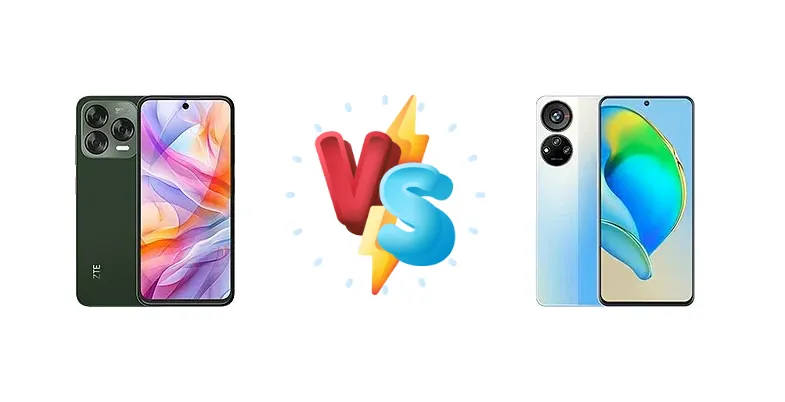
ZTE’s budget lineup offers compelling options, but choosing between the Blade V70 Design and the Axon 40 SE requires a closer look. Both devices leverage Unisoc chipsets to deliver affordability, but differ in CPU clock speeds and overall endurance. This comparison dissects the key specifications to determine which phone provides the best value for your money.
🏆 Quick Verdict
For users prioritizing longevity, the ZTE Blade V70 Design emerges as the winner. Its impressive 40:47h endurance, coupled with 800 battery cycles, significantly outweighs the Axon 40 SE’s slightly faster CPU. However, the Axon 40 SE offers a marginal performance boost for those seeking a bit more responsiveness.
| Network |
|---|
| 2G bands | GSM 850 / 900 / 1800 / 1900 | GSM 850 / 900 / 1800 / 1900 |
| 3G bands | HSDPA 850 / 900 / 1900 / 2100 | HSDPA 850 / 900 / 2100 |
| 4G bands | 1, 3, 5, 7, 8, 20, 28, 38, 40, 41 | 1, 2, 3, 4, 5, 7, 12, 13, 28, 66 |
| Speed | HSPA, LTE | HSPA, LTE |
| Technology | GSM / HSPA / LTE | GSM / HSPA / LTE |
| Launch |
|---|
| Announced | 2024, November 22 | 2022, October 20 |
| Status | Available. Released 2024, November 28 | Available. Released 2022, October 25 |
| Body |
|---|
| Build | Glass front, plastic frame, glass back or silicone polymer (eco leather) back | - |
| Dimensions | 165.8 x 77.1 x 8.2 mm (6.53 x 3.04 x 0.32 in) | 163.5 x 75.8 x 7.6 mm (6.44 x 2.98 x 0.30 in) |
| SIM | Nano-SIM + Nano-SIM | Nano-SIM + Nano-SIM |
| Weight | 206 g (7.27 oz) | 182 g (6.42 oz) |
| Display |
|---|
| Protection | Mohs level 4 | - |
| Resolution | 720 x 1612 pixels, 20:9 ratio (~264 ppi density) | 1080 x 2400 pixels, 20:9 ratio (~395 ppi density) |
| Size | 6.7 inches, 107.8 cm2 (~84.4% screen-to-body ratio) | 6.67 inches, 107.4 cm2 (~86.7% screen-to-body ratio) |
| Type | IPS LCD, 120Hz | AMOLED |
| Platform |
|---|
| CPU | Octa-core (2x1.6 GHz Cortex-A75 & 6x1.6 GHz Cortex-A55) | Octa-core (2x2.0 GHz Cortex-A75 & 6x2.0 GHz Cortex-A55) |
| Chipset | Unisoc T606 (12 nm) | Unisoc UMS512T T618 (12 nm) |
| GPU | Mali-G57 MP1 | Mali-G52 MP2 |
| OS | Android 14 | Android 12, MyOS 12 |
| Memory |
|---|
| Card slot | microSDXC (uses shared SIM slot) | microSDXC (dedicated slot) |
| Internal | 256GB 4GB RAM, 256GB 8GB RAM | 128GB 4GB RAM |
| Main Camera |
|---|
| Dual | 50 MP, f/1.8, (wide), PDAF
Auxiliary lens | - |
| Features | LED flash, HDR, panorama | LED flash, HDR, panorama |
| Single | - | 8 MP, f/2.0, (wide) |
| Triple | - | 50 MP, f/1.8, 26mm (wide), PDAF
5 MP (macro)
Auxiliary lens |
| Video | 1080p@30fps | 1080p@30fps |
| Selfie camera |
|---|
| Single | 16 MP | 8 MP, f/2.0, (wide) |
| Video | 1080p@30fps | 1080p@30fps |
| Sound |
|---|
| 3.5mm jack | - | Yes |
| 35mm jack | Yes | Yes |
| Loudspeaker | Yes | Yes |
| Comms |
|---|
| Bluetooth | 5.2, A2DP, LE | 5.0, A2DP, LE |
| NFC | Yes (market/region dependent) | Yes |
| Positioning | GPS, GALILEO, GLONASS | GPS |
| Radio | FM radio | Unspecified |
| USB | USB Type-C 2.0 | USB Type-C 2.0, OTG |
| WLAN | Wi-Fi 802.11 a/b/g/n/ac, dual-band | Yes |
| Features |
|---|
| Sensors | Fingerprint (side-mounted), accelerometer, proximity, compass | Fingerprint (side-mounted), accelerometer, gyro, proximity, compass |
| Battery |
|---|
| Charging | 22.5W wired | 22.5W wired |
| Type | 5000 mAh | Li-Ion 4500 mAh |
| Misc |
|---|
| Colors | Stone gray, Rose pink, Citrus orange, Jade green | Blue, Black |
| Models | Z2458 | 9047 |
| Price | £ 114.95 / € 89.00 | About 300 EUR |
| EU LABEL |
|---|
| Battery | 40:47h endurance, 800 cycles | - |
| Energy | Class C | - |
| Free fall | Class D (45 falls) | - |
| Repairability | Class B | - |
ZTE Blade V70 Design
- Exceptional battery life (40:47h endurance)
- High battery cycle count (800 cycles)
- Excellent value for long-term use
- Slower CPU clock speed
- Potentially less responsive user experience
ZTE Axon 40 SE
- Faster CPU clock speed (2.0 GHz)
- Slightly improved app loading times
- Potentially better image processing
- Lower battery endurance
- Likely shorter battery lifespan
Display Comparison
Neither ZTE provides display specifications beyond size, so a direct comparison is limited. However, given the price points, both likely utilize LCD panels. The focus here is on efficiency, and the chipset choice suggests ZTE prioritized power consumption over high-resolution or high-refresh-rate displays.
Camera Comparison
Detailed camera specifications are unavailable for either device. Given the market segment, expect basic camera setups focused on adequate image capture in good lighting conditions. The absence of detailed sensor information suggests neither phone will excel in low-light photography. Focusing on the chipset's ISP capabilities, the T618 in the Axon 40 SE *may* offer slightly improved image processing, but this is speculative without further data.
Performance
The ZTE Axon 40 SE’s Unisoc UMS512T T618 chipset boasts a 2.0 GHz clock speed on its Cortex-A75 cores, a step up from the 1.6 GHz speed found in the Blade V70 Design’s Unisoc T606. While both utilize the same core architecture (2x A75 + 6x A55), the higher clock speed translates to approximately 25% faster single-core performance in the Axon 40 SE. This difference will be noticeable in app launch times and smoother scrolling, but won’t dramatically impact everyday tasks. Both chipsets are built on a 12nm process, suggesting similar thermal characteristics.
Battery Life
The ZTE Blade V70 Design’s standout feature is its exceptional battery endurance, rated at 40:47 hours. This is significantly longer than what’s typically seen in this price range. The 800 battery cycle rating also indicates a focus on long-term battery health. Both phones share the same 22.5W wired charging, meaning 0-100% charge times will be comparable – approximately 1.5 to 2 hours. The Axon 40 SE’s slightly more powerful chipset will likely consume more power, offsetting any potential gains from a larger (unspecified) battery capacity.
Buying Guide
Buy the ZTE Blade V70 Design if you need a phone that will reliably last through a full day – and beyond – of moderate use, and value long-term battery health. It’s ideal for users who prioritize talk time, streaming, and general productivity over demanding gaming. Buy the ZTE Axon 40 SE if you prefer a slightly snappier user experience and are willing to trade some battery endurance for a small performance gain, particularly in app loading and multitasking.
Frequently Asked Questions
❓ Will the Unisoc T606 in the Blade V70 Design struggle with demanding games like PUBG Mobile?
The Unisoc T606 is a capable chipset for casual gaming, but demanding titles like PUBG Mobile will likely require reduced graphics settings and may experience occasional frame drops. The Axon 40 SE’s T618 offers a slight performance advantage, but neither phone is designed for high-end gaming.
❓ How does the 800 battery cycle rating of the Blade V70 Design translate to real-world usage?
An 800 cycle rating means the battery is designed to retain at least 80% of its original capacity after 800 full charge cycles. This is significantly higher than the industry average and suggests the Blade V70 Design’s battery will maintain its performance for a longer period compared to phones with lower cycle ratings.
❓ Is the 22.5W charging speed sufficient for quick top-ups on either device?
While 22.5W isn't the fastest charging available, it's adequate for topping up the battery overnight or during downtime. Expect a full charge to take approximately 1.5 to 2 hours on both devices. The focus with these phones is on battery endurance, not rapid charging.