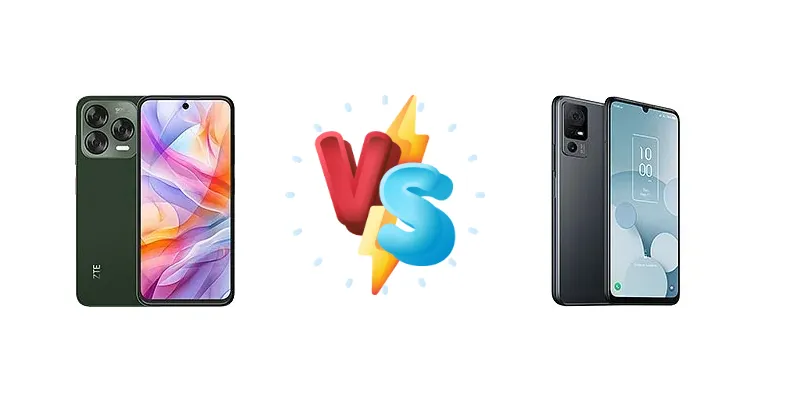
The ZTE Blade V70 Design and TCL 40 XL represent compelling options in the crowded budget smartphone market. While both aim to deliver essential features at an accessible price point, they take distinctly different approaches to performance and longevity. The ZTE prioritizes exceptional battery endurance, while the TCL focuses on a faster CPU, creating a clear trade-off for potential buyers.
🏆 Quick Verdict
For the average user prioritizing all-day (and then some) battery life, the ZTE Blade V70 Design is the clear winner. Its 40:47h endurance significantly outpaces what the TCL 40 XL can offer. However, users who frequently engage in more demanding tasks may find the TCL's faster CPU more appealing.
| Network |
|---|
| 2G bands | GSM 850 / 900 / 1800 / 1900 | GSM 850 / 900 / 1800 / 1900 |
| 3G bands | HSDPA 850 / 900 / 1900 / 2100 | HSDPA 850 / 1700(AWS) / 1900 - USA |
| 4G bands | 1, 3, 5, 7, 8, 20, 28, 38, 40, 41 | 2, 4, 5, 12, 13, 25, 26, 41, 66, 71 - USA |
| Speed | HSPA, LTE | HSPA, LTE |
| Technology | GSM / HSPA / LTE | GSM / HSPA / LTE |
| Launch |
|---|
| Announced | 2024, November 22 | 2023, February 26 |
| Status | Available. Released 2024, November 28 | Available. Released 2023, May |
| Body |
|---|
| Build | Glass front, plastic frame, glass back or silicone polymer (eco leather) back | Glass front, plastic frame, plastic back |
| Dimensions | 165.8 x 77.1 x 8.2 mm (6.53 x 3.04 x 0.32 in) | 167.9 x 76.5 x 8.8 mm (6.61 x 3.01 x 0.35 in) |
| SIM | Nano-SIM + Nano-SIM | · Nano-SIM + eSIM· Nano-SIM + Nano-SIM |
| Weight | 206 g (7.27 oz) | 195 g (6.88 oz) |
| Display |
|---|
| Protection | Mohs level 4 | - |
| Resolution | 720 x 1612 pixels, 20:9 ratio (~264 ppi density) | 720 x 1600 pixels, 20:9 ratio (~260 ppi density) |
| Size | 6.7 inches, 107.8 cm2 (~84.4% screen-to-body ratio) | 6.75 inches, 110.0 cm2 (~85.6% screen-to-body ratio) |
| Type | IPS LCD, 120Hz | IPS LCD, 90Hz |
| Platform |
|---|
| CPU | Octa-core (2x1.6 GHz Cortex-A75 & 6x1.6 GHz Cortex-A55) | Octa-core (4x2.3 GHz Cortex-A53 & 4x1.8 GHz Cortex-A53) |
| Chipset | Unisoc T606 (12 nm) | Mediatek MT6765 Helio G37 (12 nm) |
| GPU | Mali-G57 MP1 | PowerVR GE8320 |
| OS | Android 14 | Android 13, TCL UI |
| Memory |
|---|
| Card slot | microSDXC (uses shared SIM slot) | microSDXC |
| Internal | 256GB 4GB RAM, 256GB 8GB RAM | 128GB 4GB RAM, 256GB 6GB RAM |
| Main Camera |
|---|
| Dual | 50 MP, f/1.8, (wide), PDAF
Auxiliary lens | - |
| Features | LED flash, HDR, panorama | LED flash, HDR, panorama |
| Single | - | 8 MP, (wide) |
| Triple | - | 50 MP, (wide), PDAF
2 MP (macro)
Auxiliary lens |
| Video | 1080p@30fps | 1080p@30fps |
| Selfie camera |
|---|
| Single | 16 MP | 8 MP, (wide) |
| Video | 1080p@30fps | 1080p@30fps |
| Sound |
|---|
| 3.5mm jack | - | Yes |
| 35mm jack | Yes | Yes |
| Loudspeaker | Yes | Yes, with dual speakers |
| Comms |
|---|
| Bluetooth | 5.2, A2DP, LE | 5.1, A2DP, LE |
| NFC | Yes (market/region dependent) | No |
| Positioning | GPS, GALILEO, GLONASS | GPS |
| Radio | FM radio | FM radio |
| USB | USB Type-C 2.0 | USB Type-C 2.0 |
| WLAN | Wi-Fi 802.11 a/b/g/n/ac, dual-band | Wi-Fi 802.11 a/b/g/n/ac, dual-band, Wi-Fi Direct |
| Features |
|---|
| Sensors | Fingerprint (side-mounted), accelerometer, proximity, compass | Fingerprint (side-mounted), accelerometer, gyro, proximity, compass, barometer |
| Battery |
|---|
| Charging | 22.5W wired | 18W wired |
| Type | 5000 mAh | Li-Ion 5000 mAh |
| Misc |
|---|
| Colors | Stone gray, Rose pink, Citrus orange, Jade green | Dark Gray |
| Models | Z2458 | T608M |
| Price | £ 114.95 / € 89.00 | About 140 EUR |
| EU LABEL |
|---|
| Battery | 40:47h endurance, 800 cycles | - |
| Energy | Class C | - |
| Free fall | Class D (45 falls) | - |
| Repairability | Class B | - |
ZTE Blade V70 Design
- Exceptional battery life (40:47h endurance)
- Efficient Unisoc T606 chipset
- Potentially longer battery lifespan (800 cycles)
- CPU clock speeds are lower than the TCL 40 XL
- Camera performance likely average for the price range
TCL 40 XL
- Faster CPU clock speeds (2.3 GHz)
- Potentially improved ISP capabilities
- Slightly newer chipset
- Significantly shorter battery life
- Less efficient Helio G37 chipset
Display Comparison
Display specifications are not provided, so a direct comparison is limited. However, given the price bracket, both devices likely utilize LCD panels. The TCL 40 XL, being a slightly newer model, *may* benefit from improved color calibration or brightness, but this is speculative. Bezels are likely comparable, and neither phone is expected to feature high refresh rate displays.
Camera Comparison
Camera details are absent beyond the devices themselves. Given the market segment, both phones likely feature a primary camera alongside depth or macro sensors of limited utility. Without sensor size or aperture information, it’s difficult to assess image quality. However, the TCL 40 XL’s slightly newer chipset *might* offer marginally improved image signal processing (ISP) capabilities, potentially leading to better dynamic range or noise reduction. It's unlikely either phone will excel in low-light conditions.
Performance
The core difference lies in the chipsets. The ZTE Blade V70 Design utilizes the Unisoc T606, a 12nm chip with a focus on efficiency, featuring a dual-core Cortex-A75 setup alongside six Cortex-A55 cores clocked at 1.6 GHz. The TCL 40 XL employs the MediaTek Helio G37, also a 12nm chip, but with a different core configuration: four Cortex-A53 cores at 2.3 GHz and four more at 1.8 GHz. While the Helio G37 boasts higher clock speeds, the Cortex-A53 cores are less efficient than the A75 cores in the Unisoc chip. This suggests the TCL 40 XL will offer quicker response times for bursty tasks, but potentially at the cost of sustained performance and increased power consumption. The Unisoc T606’s architecture is better suited for balancing performance and battery life.
Battery Life
The ZTE Blade V70 Design truly shines in battery endurance, achieving a remarkable 40:47h of usage. This is significantly bolstered by the efficient Unisoc T606 chipset. The TCL 40 XL, with its more power-hungry Helio G37, will likely offer considerably less screen-on time. While the TCL supports 18W charging, and the ZTE 22.5W, the difference in charging speed is less critical given the ZTE’s superior battery life – users will simply need to charge less frequently. The ZTE’s claimed 800 charge cycles also suggest a longer lifespan for the battery itself.
Buying Guide
Buy the ZTE Blade V70 Design if you need a phone that can reliably last through a full day of moderate to heavy use, and potentially even two days with lighter usage. It’s ideal for travelers, commuters, or anyone who dislikes frequent charging. Buy the TCL 40 XL if you prioritize a snappier experience for everyday tasks like social media browsing and light gaming, and are willing to compromise on battery life to achieve that.
Frequently Asked Questions
❓ Will the TCL 40 XL struggle to last a full day with moderate use?
Given the Helio G37's power consumption and the lack of battery capacity information, it's highly likely the TCL 40 XL will require a charge before the end of a full day for users who frequently browse social media, stream videos, or play games. The ZTE Blade V70 Design is the better choice for all-day endurance.
❓ Is the Unisoc T606 in the ZTE Blade V70 Design powerful enough for casual gaming?
The Unisoc T606 is capable of handling casual games without significant issues. However, demanding titles may require lower graphics settings and could experience occasional frame drops. The TCL 40 XL's Helio G37 might offer a slightly smoother experience in some games, but the difference is unlikely to be substantial.
❓ Does the 22.5W charging on the ZTE Blade V70 Design translate to significantly faster charging times compared to the TCL 40 XL's 18W?
While 22.5W is faster than 18W, the ZTE's exceptional battery life means you'll simply need to charge it less often. The difference in 0-100% charging time will be noticeable, but less critical than the overall endurance advantage.