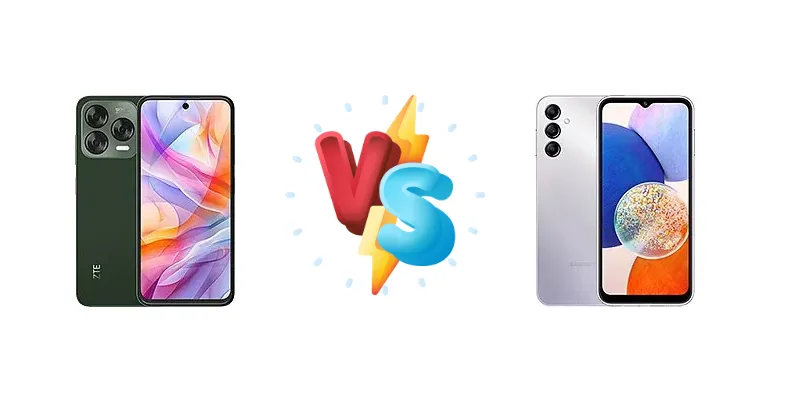
The ZTE Blade V70 Design and Samsung Galaxy A14 5G represent two distinct approaches to the budget 5G smartphone market. The ZTE prioritizes exceptional battery endurance, while the Samsung aims for a more balanced experience with a newer chipset and 5G connectivity. This comparison dissects their strengths and weaknesses to determine which device delivers the best value.
🏆 Quick Verdict
For users prioritizing all-day (and multi-day) battery life, the ZTE Blade V70 Design is the clear winner, offering a staggering 40:47h endurance. However, the Samsung Galaxy A14 5G provides a more responsive experience thanks to its Exynos 1330 chipset and faster 5G speeds, making it better suited for demanding users.
| Network |
|---|
| 2G bands | GSM 850 / 900 / 1800 / 1900 | GSM 850 / 900 / 1800 / 1900 |
| 3G bands | HSDPA 850 / 900 / 1900 / 2100 | HSDPA 850 / 900 / 1700(AWS) / 1900 / 2100 |
| 4G bands | 1, 3, 5, 7, 8, 20, 28, 38, 40, 41 | 1, 2, 3, 4, 5, 7, 8, 12, 17, 20, 26, 28, 38, 40, 41, 66 - International |
| 5G bands | - | 2, 5, 66, 77 Sub6/mmWave - USA |
| Speed | HSPA, LTE | HSPA, LTE, 5G |
| Technology | GSM / HSPA / LTE | GSM / HSPA / LTE / 5G |
| | - | 1, 3, 5, 7, 8, 20, 28, 40, 41, 78 SA/NSA/Sub6 - India |
| Launch |
|---|
| Announced | 2024, November 22 | 2023, January 04 |
| Status | Available. Released 2024, November 28 | Available. Released 2023, January 12 |
| Body |
|---|
| Build | Glass front, plastic frame, glass back or silicone polymer (eco leather) back | Glass front, plastic back, plastic frame |
| Dimensions | 165.8 x 77.1 x 8.2 mm (6.53 x 3.04 x 0.32 in) | 167.7 x 78 x 9.1 mm (6.60 x 3.07 x 0.36 in) |
| SIM | Nano-SIM + Nano-SIM | · Nano-SIM· Nano-SIM + Nano-SIM |
| Weight | 206 g (7.27 oz) | 202 g (7.13 oz) |
| Display |
|---|
| Protection | Mohs level 4 | - |
| Resolution | 720 x 1612 pixels, 20:9 ratio (~264 ppi density) | 1080 x 2408 pixels, 20:9 ratio (~400 ppi density) |
| Size | 6.7 inches, 107.8 cm2 (~84.4% screen-to-body ratio) | 6.6 inches, 104.9 cm2 (~80.2% screen-to-body ratio) |
| Type | IPS LCD, 120Hz | PLS LCD, 90Hz |
| Platform |
|---|
| CPU | Octa-core (2x1.6 GHz Cortex-A75 & 6x1.6 GHz Cortex-A55) | Octa-core (2x2.4 GHz Cortex-A78 & 6x2.0 GHz Cortex-A55) - SM-A146BOcta-core (2x2.2 GHz Cortex-A76 & 6x2.0 GHz Cortex-A55) - SM-A146P |
| Chipset | Unisoc T606 (12 nm) | Exynos 1330 (5 nm) - SM-A146BMediatek Dimensity 700 (7 nm) - SM-A146P |
| GPU | Mali-G57 MP1 | Mali-G68 MP2 - SM-A146BMali-G57 MC2 - SM-A146P |
| OS | Android 14 | Android 13, upgradable to Android 15, One UI Core 7 |
| Memory |
|---|
| Card slot | microSDXC (uses shared SIM slot) | microSDXC (uses shared SIM slot) - USA onlymicroSDXC (dedicated slot) - International |
| Internal | 256GB 4GB RAM, 256GB 8GB RAM | 64GB 4GB RAM, 128GB 4GB RAM, 128GB 6GB RAM, 128GB 8GB RAM |
| Main Camera |
|---|
| Dual | 50 MP, f/1.8, (wide), PDAF
Auxiliary lens | - |
| Features | LED flash, HDR, panorama | LED flash, panorama, HDR |
| Single | - | 13 MP, f/2.0, (wide) |
| Triple | - | 50 MP, f/1.8, 26mm (wide), 1/2.76", 0.64µm, PDAF
2 MP (macro)
Auxiliary lens |
| Video | 1080p@30fps | 1080p@30fps |
| Selfie camera |
|---|
| Single | 16 MP | 13 MP, f/2.0, 26mm (wide), 1.12µm |
| Video | 1080p@30fps | 1080p@30fps |
| Sound |
|---|
| 3.5mm jack | - | Yes |
| 35mm jack | Yes | Yes |
| Loudspeaker | Yes | Yes |
| Comms |
|---|
| Bluetooth | 5.2, A2DP, LE | 5.2, A2DP, LE |
| NFC | Yes (market/region dependent) | Yes |
| Positioning | GPS, GALILEO, GLONASS | GPS, GLONASS, GALILEO |
| Radio | FM radio | FM radio (Exynos 1330 chipset only), recording |
| USB | USB Type-C 2.0 | USB Type-C 2.0 |
| WLAN | Wi-Fi 802.11 a/b/g/n/ac, dual-band | Wi-Fi 802.11 a/b/g/n/ac, dual-band, Wi-Fi Direct |
| Features |
|---|
| Sensors | Fingerprint (side-mounted), accelerometer, proximity, compass | Fingerprint (side-mounted), accelerometer, gyro, proximity, compass, barometer (USA only) |
| Battery |
|---|
| Charging | 22.5W wired | 15W wired |
| Type | 5000 mAh | Li-Po 5000 mAh |
| Misc |
|---|
| Colors | Stone gray, Rose pink, Citrus orange, Jade green | Black, Light Green, Dark Red, Silver |
| Models | Z2458 | SM-A146B, SM-A146B/DS, SM-A146P, SM-A146P/DS, SM-A146U, SM-A146U1, SM-A146U1/DS, SM-A146W, SM-A146P/N, SM-A146P/DSN, SM-S146VL, SM-A146M |
| Price | £ 114.95 / € 89.00 | $ 77.63 / C$ 151.00 / £ 97.00 / € 159.79 / ₹ 14,990 |
| SAR | - | 1.00 W/kg (head) 1.00 W/kg (body) |
| SAR EU | - | 0.56 W/kg (head) 1.28 W/kg (body) |
| Tests |
|---|
| Battery life | - |
Endurance rating 130h
|
| Camera | - |
Photo / Video |
| Display | - |
Contrast ratio: 1334:1 (nominal) |
| Loudspeaker | - |
-26.8 LUFS (Good)
|
| Performance | - |
AnTuTu: 307886 (v9)
GeekBench: 1727 (v5.1)
GFXBench: 12fps (ES 3.1 onscreen) |
| EU LABEL |
|---|
| Battery | 40:47h endurance, 800 cycles | - |
| Energy | Class C | - |
| Free fall | Class D (45 falls) | - |
| Repairability | Class B | - |
ZTE Blade V70 Design
- Exceptional battery life (40:47h endurance)
- Long battery lifespan (800 cycles)
- More efficient chipset (Unisoc T606 12nm)
- Less powerful chipset (Unisoc T606)
- Slower 5G connectivity (or none)
- Limited camera capabilities
Samsung Galaxy A14 5G
- More powerful chipset (Exynos 1330 or Dimensity 700)
- Brighter display (519 nits)
- 5G connectivity for faster data speeds
- Significantly shorter battery life (130h endurance)
- Slower charging (15W)
- Potentially more thermal throttling
Display Comparison
Both devices feature a 1334:1 contrast ratio, suggesting similar image quality in terms of dynamic range. However, the Samsung Galaxy A14 5G boasts a significantly brighter display at 519 nits, compared to an unlisted value for the ZTE. This higher peak brightness will translate to better visibility outdoors under direct sunlight. While both displays share the same contrast ratio, the A14's brightness advantage is a tangible benefit for everyday use.
Camera Comparison
Both phones offer photo and video capabilities, but detailed camera specs are limited. Without sensor size or aperture information, it’s difficult to make a definitive judgment. However, the Samsung Galaxy A14 5G’s more modern image signal processor (ISP) within the Exynos 1330 or Dimensity 700 chipset likely provides superior image processing capabilities, potentially resulting in better dynamic range and low-light performance. The ZTE’s camera system is likely more basic, focusing on providing functional images rather than high-end photography.
Performance
The Samsung Galaxy A14 5G offers a more powerful chipset, with the Exynos 1330 (5nm) – or the Dimensity 700 (7nm) depending on the region – significantly outperforming the Unisoc T606 (12nm) found in the ZTE Blade V70 Design. The Exynos 1330’s Cortex-A78 cores, clocked at 2.4 GHz, provide a substantial performance uplift over the T606’s Cortex-A75 cores at 1.6 GHz. This translates to faster app loading times, smoother multitasking, and improved gaming performance. The 5nm process node of the Exynos also contributes to better thermal efficiency, potentially reducing throttling during sustained workloads. The A14's 5G capability is also a key advantage, offering significantly faster data speeds where available.
Battery Life
The ZTE Blade V70 Design truly shines in battery life, achieving an astounding 40:47h of endurance. This is dramatically higher than the Samsung Galaxy A14 5G’s 130h rating. While the A14 5G supports 5G connectivity which consumes more power, the ZTE’s efficiency is remarkable. The ZTE also boasts 800 battery cycles, suggesting a longer lifespan before significant capacity degradation. However, the Samsung counters with faster 15W charging, while the ZTE is limited to 22.5W. Despite the faster charging, the ZTE’s massive battery capacity still provides a significant advantage in overall usability.
Buying Guide
Buy the ZTE Blade V70 Design if you need a phone that can reliably last through two full days of moderate use, or if you frequently find yourself away from a charger. Buy the Samsung Galaxy A14 5G if you prioritize a smoother user experience, faster download speeds with 5G, and a more modern chipset for running current apps and games, even if it means more frequent charging.
Frequently Asked Questions
❓ Does the Exynos 1330 in the Samsung Galaxy A14 5G tend to overheat during prolonged gaming sessions?
While the Exynos 1330 is a capable chipset, it can experience some thermal throttling during extended gaming. The 5nm process helps mitigate this, but demanding titles may still lead to reduced performance after a while. The ZTE Blade V70 Design, with its less powerful Unisoc T606, is less likely to overheat but also offers a lower gaming experience overall.
❓ Is the 22.5W charging on the ZTE Blade V70 Design fast enough, considering its large battery?
While 22.5W isn't the fastest charging available, it's adequate for the ZTE Blade V70 Design's battery size. Given the exceptional battery life, you won't need to charge it as frequently as the Samsung A14 5G. A full charge will still take a considerable amount of time, but the long endurance minimizes the need for daily top-ups.
❓ How does the 5G performance of the Samsung Galaxy A14 5G compare to older 4G phones?
The Samsung Galaxy A14 5G offers significantly faster download and upload speeds compared to 4G phones when connected to a 5G network. This translates to quicker app downloads, smoother streaming, and more responsive online gaming. However, 5G availability varies by region and carrier, so the actual benefit will depend on your location and service plan.
❓ What kind of user would benefit most from the ZTE Blade V70 Design's long battery life?
The ZTE Blade V70 Design is ideal for users who travel frequently, work outdoors, or simply dislike the inconvenience of daily charging. It's also a great choice for those who rely heavily on their phone for essential tasks and need a reliable device that won't run out of power unexpectedly.