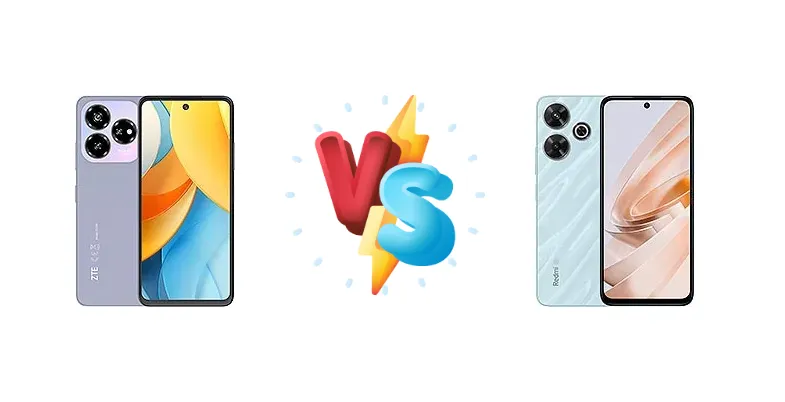
The sub-$200 smartphone market is fiercely competitive. The ZTE Blade V60 Design and Xiaomi Redmi Note 13R both aim to deliver essential features at an accessible price point, but they take drastically different approaches to achieving this. The Blade V60 Design relies on a Unisoc chipset, while the Redmi Note 13R boasts a newer Qualcomm Snapdragon processor. This comparison will dissect the key differences to help you determine which device offers the best value.
🏆 Quick Verdict
For most users, the Xiaomi Redmi Note 13R is the superior choice. Its Snapdragon 4+ Gen 2 chipset, built on a 4nm process, delivers noticeably faster performance and improved efficiency compared to the ZTE Blade V60 Design’s Unisoc T606. While the Blade V60 Design is more affordable, the performance gap justifies the price premium of the Redmi Note 13R.
| Network |
|---|
| 2G bands | GSM 850 / 900 / 1800 / 1900 | GSM 850 / 900 / 1800 / 1900 |
| 3G bands | HSDPA 850 / 900 / 1900 / 2100 | HSDPA 850 / 900 / 2100 |
| 4G bands | 1, 3, 5, 7, 8, 20, 28, 38, 40, 41 | 1, 3, 5, 8, 34, 38, 39, 40, 41 |
| 5G bands | - | 1, 5, 8, 28, 41, 78 SA/NSA |
| Speed | HSPA, LTE | HSPA, LTE, 5G |
| Technology | GSM / HSPA / LTE | GSM / CDMA / HSPA / EVDO / LTE / 5G |
| Launch |
|---|
| Announced | 2024, June 11 | 2024, May 17 |
| Status | Available. Released 2024, June | Available. Released 2024, May 17 |
| Body |
|---|
| Build | Glass front, glass back, plastic frame | Glass front, plastic frame, glass back |
| Dimensions | 164.2 x 75.3 x 8.6 mm (6.46 x 2.96 x 0.34 in) | 168.6 x 76.3 x 8.2 mm (6.64 x 3.00 x 0.32 in) |
| SIM | Nano-SIM + Nano-SIM | Nano-SIM + Nano-SIM |
| Weight | 198 g (6.98 oz) | 205 g (7.23 oz) |
| Display |
|---|
| Resolution | 720 x 1612 pixels, 20:9 ratio (~267 ppi density) | 1080 x 2460 pixels (~396 ppi density) |
| Size | 6.6 inches, 104.6 cm2 (~84.6% screen-to-body ratio) | 6.79 inches, 109.5 cm2 (~85.1% screen-to-body ratio) |
| Type | IPS LCD, 90Hz | IPS LCD, 120Hz, 550 nits |
| Platform |
|---|
| CPU | Octa-core (2x1.6 GHz Cortex-A75 & 6x1.6 GHz Cortex-A55) | Octa-core (2x2.3 GHz Cortex-A78 & 6x1.95 GHz Cortex-A55) |
| Chipset | Unisoc T606 (12 nm) | Qualcomm SM4450 Snapdragon 4+ Gen 2 (4 nm) |
| GPU | Mali-G57 MP1 | Adreno 613 |
| OS | Android 13 | Android 14, HyperOS |
| Memory |
|---|
| Card slot | microSDXC (uses shared SIM slot) | No |
| Internal | 256GB 4GB RAM, 256GB 6GB RAM | 128GB 6GB RAM, 128GB 8GB RAM, 256GB 8GB RAM, 256GB 12GB RAM, 512GB 12GB RAM |
| Main Camera |
|---|
| Dual | 50 MP, f/1.8, (wide), PDAF
Auxiliary lens | 50 MP, f/1.8, (wide), 1/2.76", 0.64µm, PDAF
2 MP (macro) |
| Features | LED flash, HDR, panorama | LED flash, HDR |
| Video | 1080p@30fps | 1080p@30fps |
| Selfie camera |
|---|
| Single | 8 MP, f/2.0, (wide) | 8 MP, (wide), 1/4.0", 1.12µm |
| Video | Yes | 1080p@30fps |
| Sound |
|---|
| 35mm jack | Yes | Yes |
| Loudspeaker | Yes | Yes |
| Comms |
|---|
| Bluetooth | 5.2, A2DP, LE | 5.3, A2DP, LE |
| Infrared port | - | Yes |
| NFC | Yes (market/region dependent) | Yes |
| Positioning | GPS, GLONASS, GALILEO | GPS, GLONASS, GALILEO, BDS |
| Radio | FM radio | No |
| USB | USB Type-C 2.0 | USB Type-C |
| WLAN | Wi-Fi 802.11 a/b/g/n/ac, dual-band | Wi-Fi 802.11 a/b/g/n/ac, dual-band |
| Features |
|---|
| Sensors | Fingerprint (side-mounted), accelerometer, proximity, compass | Fingerprint (side-mounted), accelerometer, compass |
| Battery |
|---|
| Charging | 22.5W wired | 33W wired |
| Type | 5000 mAh | 5030 mAh |
| Misc |
|---|
| Colors | Dark Blue, Champagne Gold, Sunrise Violet | Black, Blue, Silver |
| Models | Z2350 | 2406ERN9CC |
| Price | About 110 EUR | About 180 EUR |
ZTE Blade V60 Design
- Lower price point makes it highly accessible.
- Sufficient for basic smartphone tasks.
- Acceptable battery life for light users.
- Unisoc T606 chipset offers limited performance.
- Slower charging speed (22.5W).
- Likely to struggle with demanding apps and games.
Xiaomi Redmi Note 13R
- Significantly faster performance with Snapdragon 4+ Gen 2.
- Faster charging (33W) reduces downtime.
- Improved power efficiency for longer battery life.
- Higher price compared to the ZTE Blade V60 Design.
- May still not be ideal for graphically intensive gaming.
- Potentially larger physical size.
Display Comparison
Neither device boasts a standout display. While specific panel details (like peak brightness or color gamut coverage) are unavailable, the core difference lies in the processing power driving them. Both likely utilize LCD panels given the price bracket. The focus here isn't display quality, but rather how efficiently each chipset can render content on the screen. The Redmi Note 13R’s more powerful GPU will translate to smoother animations and faster app loading times, even if the raw resolution is similar.
Camera Comparison
Without detailed camera specs beyond the main chipsets, a direct comparison is limited. However, the Redmi Note 13R’s superior image signal processor (ISP) within the Snapdragon 4+ Gen 2 will likely deliver better image processing, even with similar sensor configurations. The ISP handles noise reduction, dynamic range, and color accuracy. While both phones likely feature basic camera setups, the Redmi Note 13R will likely produce more detailed and visually appealing photos, particularly in challenging lighting conditions. Expect both to include a standard macro lens, which are generally of limited utility.
Performance
The performance disparity is the defining factor in this comparison. The Xiaomi Redmi Note 13R’s Qualcomm Snapdragon 4+ Gen 2 (4nm) is a significant upgrade over the ZTE Blade V60 Design’s Unisoc T606 (12nm). The 4nm fabrication process inherently offers better power efficiency and thermal management, meaning the Redmi Note 13R will likely sustain peak performance for longer periods without throttling. Furthermore, the Snapdragon utilizes Cortex-A78 cores in its CPU configuration, which are architecturally superior to the Cortex-A75 cores found in the Unisoc T606, resulting in faster single-core performance. This translates to snappier app launches and a more responsive user experience. The Redmi Note 13R’s CPU clock speeds (2x2.3 GHz) also exceed those of the Blade V60 Design (2x1.6 GHz).
Battery Life
The Xiaomi Redmi Note 13R’s 33W wired charging is a clear advantage over the ZTE Blade V60 Design’s 22.5W charging. This translates to significantly faster charging times – potentially reducing a full charge from over two hours on the Blade V60 Design to around an hour on the Redmi Note 13R. While battery capacity isn’t specified, the Snapdragon 4+ Gen 2’s improved power efficiency will likely offset any potential capacity differences, resulting in comparable real-world battery life despite the faster charging speed.
Buying Guide
Buy the ZTE Blade V60 Design if you prioritize absolute affordability and basic smartphone functionality – calls, texts, and light social media use. It’s a suitable option for first-time smartphone users or those on a very tight budget. Buy the Xiaomi Redmi Note 13R if you value smoother multitasking, better gaming performance, and faster charging. It’s ideal for users who want a responsive experience without breaking the bank.
Frequently Asked Questions
❓ Will the Redmi Note 13R handle popular games like PUBG Mobile or Call of Duty Mobile?
The Redmi Note 13R, with its Snapdragon 4+ Gen 2, will be capable of running PUBG Mobile and Call of Duty Mobile at medium settings with acceptable frame rates. However, don't expect a flagship-level gaming experience. The Unisoc T606 in the Blade V60 Design will likely struggle with these titles, even at lower settings.
❓ How much faster is the charging on the Redmi Note 13R compared to the Blade V60 Design?
The Redmi Note 13R’s 33W charging is considerably faster than the Blade V60 Design’s 22.5W charging. While exact times depend on battery capacity, expect the Redmi Note 13R to charge from 0-100% in approximately 60-90 minutes, while the Blade V60 Design could take over two hours.
❓ Is the difference in chipset performance noticeable in everyday tasks like browsing and social media?
Yes, the difference is noticeable. The Snapdragon 4+ Gen 2 in the Redmi Note 13R will result in snappier app launches, smoother scrolling, and faster webpage loading times compared to the Unisoc T606 in the Blade V60 Design. This is particularly evident when multitasking.