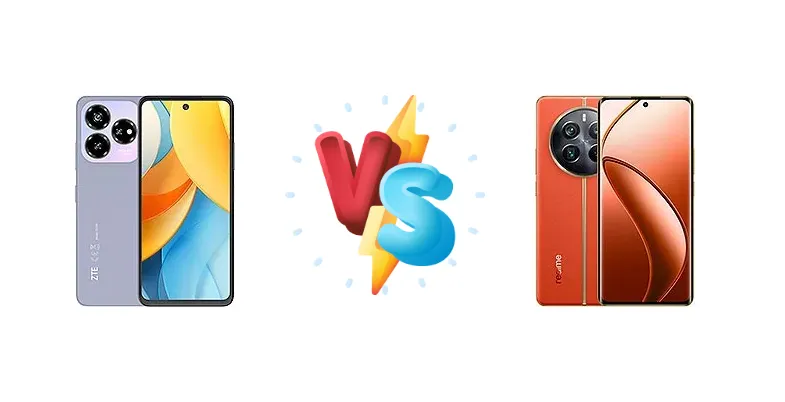
The smartphone market is segmented, and these two devices exemplify that. The ZTE Blade V60 Design aims for extreme affordability, while the Realme 12 Pro+ targets users seeking a balance of features and performance without a flagship price tag. This comparison dissects their core differences, focusing on where each phone excels and who will benefit most.
🏆 Quick Verdict
For the average user prioritizing responsiveness and future-proofing, the Realme 12 Pro+ is the clear winner. Its Snapdragon 7s Gen 2 chipset and 67W charging significantly outperform the ZTE Blade V60 Design’s Unisoc T606 and 22.5W charging. However, the Blade V60 Design remains a viable option for those on a very tight budget.
| Network |
|---|
| 2G bands | GSM 850 / 900 / 1800 / 1900 | GSM 850 / 900 / 1800 / 1900 |
| 3G bands | HSDPA 850 / 900 / 1900 / 2100 | HSDPA 850 / 900 / 2100 |
| 4G bands | 1, 3, 5, 7, 8, 20, 28, 38, 40, 41 | 1, 3, 5, 8, 28, 40, 41 |
| 5G bands | - | 1, 3, 5, 8, 28, 40, 41, 77, 78 SA/NSA |
| Speed | HSPA, LTE | HSPA, LTE, 5G |
| Technology | GSM / HSPA / LTE | GSM / HSPA / LTE / 5G |
| Launch |
|---|
| Announced | 2024, June 11 | 2024, January 29 |
| Status | Available. Released 2024, June | Available. Released 2024, January 29 |
| Body |
|---|
| Build | Glass front, glass back, plastic frame | - |
| Dimensions | 164.2 x 75.3 x 8.6 mm (6.46 x 2.96 x 0.34 in) | 161.5 x 74 x 8.8 mm (6.36 x 2.91 x 0.35 in) |
| SIM | Nano-SIM + Nano-SIM | Nano-SIM + Nano-SIM |
| Weight | 198 g (6.98 oz) | 196 g (6.91 oz) |
| Display |
|---|
| Resolution | 720 x 1612 pixels, 20:9 ratio (~267 ppi density) | 1080 x 2412 pixels, 20:9 ratio (~394 ppi density) |
| Size | 6.6 inches, 104.6 cm2 (~84.6% screen-to-body ratio) | 6.7 inches, 108.0 cm2 (~90.4% screen-to-body ratio) |
| Type | IPS LCD, 90Hz | AMOLED, 1B colors, 120Hz, 800 nits (HBM), 950 nits (peak) |
| Platform |
|---|
| CPU | Octa-core (2x1.6 GHz Cortex-A75 & 6x1.6 GHz Cortex-A55) | Octa-core (4x2.40 GHz Cortex-A78 & 4x1.95 GHz Cortex-A55) |
| Chipset | Unisoc T606 (12 nm) | Qualcomm SM7435-AB Snapdragon 7s Gen 2 (4 nm) |
| GPU | Mali-G57 MP1 | Adreno 710 |
| OS | Android 13 | Android 14, Realme UI 5.0 |
| Memory |
|---|
| Card slot | microSDXC (uses shared SIM slot) | No |
| Internal | 256GB 4GB RAM, 256GB 6GB RAM | 128GB 8GB RAM, 256GB 8GB RAM, 256GB 12GB RAM, 512GB 12GB RAM |
| Main Camera |
|---|
| Dual | 50 MP, f/1.8, (wide), PDAF
Auxiliary lens | - |
| Features | LED flash, HDR, panorama | LED flash, HDR, panorama |
| Triple | - | 50 MP, f/1.8, 24mm (wide), 1/1.56", 1.0µm, multi-directional PDAF, OIS
64 MP, f/2.8, 71mm, (periscope telephoto), 1/2.0", 0.7µm, PDAF, OIS, 3x optical zoom
8 MP, f/2.2, 16mm, 112˚ (ultrawide), 1/4.0", 1.12µm |
| Video | 1080p@30fps | 4K@30fps, 1080p@30/60/120fps, gyro-EIS |
| Selfie camera |
|---|
| Single | 8 MP, f/2.0, (wide) | 32 MP, f/2.4, 22mm (wide) |
| Video | Yes | 1080p@30fps |
| Sound |
|---|
| 35mm jack | Yes | No |
| Loudspeaker | Yes | Yes, with stereo speakers |
| Comms |
|---|
| Bluetooth | 5.2, A2DP, LE | 5.2, A2DP, LE |
| NFC | Yes (market/region dependent) | Yes (market/region dependent) |
| Positioning | GPS, GLONASS, GALILEO | GPS, GLONASS, GALILEO, BDS, QZSS |
| Radio | FM radio | No |
| USB | USB Type-C 2.0 | USB Type-C 2.0 |
| WLAN | Wi-Fi 802.11 a/b/g/n/ac, dual-band | Wi-Fi 802.11 a/b/g/n/ac/6, dual-band |
| Features |
|---|
| Sensors | Fingerprint (side-mounted), accelerometer, proximity, compass | Fingerprint (under display, optical), accelerometer, gyro, proximity, compass |
| Battery |
|---|
| Charging | 22.5W wired | 67W wired, 50% in 19 min |
| Type | 5000 mAh | 5000 mAh |
| Misc |
|---|
| Colors | Dark Blue, Champagne Gold, Sunrise Violet | Submarine Blue, Navigator Beige, Explorer Red |
| Models | Z2350 | RMX3840, RMX3841 |
| Price | About 110 EUR | $ 465.00 / £ 299.00 / € 344.26 / ₹ 28,400 |
ZTE Blade V60 Design
- Extremely affordable price point
- Functional for basic smartphone tasks
- Acceptable battery life for light users
- Slow charging speed (22.5W)
- Outdated Unisoc T606 chipset
- Likely lower display quality
Realme 12 Pro+
- Fast 67W charging
- Powerful Snapdragon 7s Gen 2 chipset
- Bright and likely accurate display (802 nits)
- Excellent battery life (13:24h active use)
- Higher price than the ZTE Blade V60 Design
- May be overkill for very basic users
Display Comparison
The Realme 12 Pro+ boasts a significantly brighter display, reaching a measured 802 nits. While the ZTE Blade V60 Design’s display specifications are not provided, it’s likely to be considerably dimmer, impacting outdoor visibility. The Realme’s panel likely benefits from better color accuracy and viewing angles due to its more advanced manufacturing process. The lack of detailed display specs for the ZTE suggests a cost-cutting approach, potentially impacting the overall viewing experience.
Camera Comparison
Without detailed camera specifications for the ZTE Blade V60 Design, a direct comparison is limited. However, the Realme 12 Pro+ is expected to have a more sophisticated camera system, likely featuring a larger sensor and more advanced image processing capabilities. The Realme’s focus on camera features, common in their Pro+ line, suggests a greater emphasis on image quality and versatility. While the ZTE may offer acceptable photos in good lighting, the Realme is likely to excel in low-light conditions and offer more detailed images.
Performance
The core difference lies in the chipsets. The Realme 12 Pro+ utilizes the Qualcomm SM7435-AB Snapdragon 7s Gen 2, built on a power-efficient 4nm process, featuring an octa-core CPU with 4x2.40 GHz Cortex-A78 cores. This contrasts sharply with the ZTE Blade V60 Design’s Unisoc T606 (12nm), which uses older Cortex-A75 cores clocked at 1.6 GHz. The Snapdragon 7s Gen 2 offers a substantial performance uplift in both CPU and GPU tasks, translating to faster app launches, smoother multitasking, and a more enjoyable gaming experience. The 4nm process also contributes to better thermal management, reducing throttling during sustained workloads.
Battery Life
The Realme 12 Pro+ shines with its 67W wired charging, capable of reaching 50% charge in just 19 minutes. This is a significant advantage over the ZTE Blade V60 Design’s slower 22.5W charging. While the Realme 12 Pro+'s battery capacity isn't specified, its active use score of 13:24h demonstrates excellent battery life. The faster charging speed mitigates any potential concerns about battery capacity, allowing for quick top-ups throughout the day. The ZTE, with its slower charging, will require considerably more time to fully recharge.
Buying Guide
Buy the ZTE Blade V60 Design if you need a functional smartphone for basic tasks like calls, messaging, and light social media, and your budget is the absolute primary concern. Buy the Realme 12 Pro+ if you prefer a smoother user experience, faster app loading times, more responsive gaming, and significantly quicker charging – all without the cost of a premium flagship.
Frequently Asked Questions
❓ Is the Unisoc T606 in the ZTE Blade V60 Design sufficient for playing games like PUBG Mobile?
While the Unisoc T606 can run PUBG Mobile, expect to play at lower graphics settings and potentially experience frame drops during intense moments. The chipset lacks the graphical horsepower of the Snapdragon 7s Gen 2 in the Realme 12 Pro+, which will provide a much smoother and more consistent gaming experience.
❓ How much faster is the charging on the Realme 12 Pro+ compared to the ZTE Blade V60 Design in a typical use case?
The Realme 12 Pro+'s 67W charging is dramatically faster. A 19-minute charge to 50% is achievable, whereas the ZTE Blade V60 Design’s 22.5W charging will take considerably longer – likely over an hour to reach the same level. This difference is crucial for users who need quick top-ups throughout the day.
❓ Will the Realme 12 Pro+ overheat during prolonged use, like video recording or gaming?
The Snapdragon 7s Gen 2’s 4nm process is designed for improved thermal efficiency. While some heat generation is inevitable during demanding tasks, the Realme 12 Pro+ is less likely to experience significant throttling compared to the ZTE Blade V60 Design’s 12nm Unisoc T606, which is more prone to overheating.