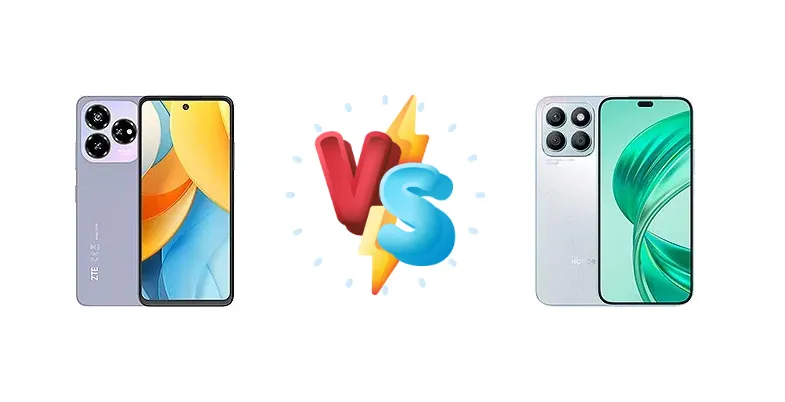
The budget smartphone market is fiercely competitive, and the ZTE Blade V60 Design and Honor X8b represent compelling options for users seeking affordability. However, beneath the similar price points lie significant differences in their core components, particularly the chipsets. This comparison dissects these differences, focusing on performance, charging, and the implications for everyday use.
🏆 Quick Verdict
For the average user prioritizing responsiveness and future-proofing, the Honor X8b emerges as the better choice. Its Qualcomm Snapdragon 680, built on a 6nm process, delivers superior performance and efficiency compared to the ZTE Blade V60 Design’s Unisoc T606. The faster 35W charging further sweetens the deal, minimizing downtime.
| Network |
|---|
| 2G bands | GSM 850 / 900 / 1800 / 1900 | GSM 850 / 900 / 1800 / 1900 |
| 3G bands | HSDPA 850 / 900 / 1900 / 2100 | HSDPA 850 / 900 / 1900 / 2100 |
| 4G bands | 1, 3, 5, 7, 8, 20, 28, 38, 40, 41 | LTE |
| Speed | HSPA, LTE | HSPA, LTE |
| Technology | GSM / HSPA / LTE | GSM / HSPA / LTE |
| Launch |
|---|
| Announced | 2024, June 11 | 2023, December 14 |
| Status | Available. Released 2024, June | Available. Released 2023, December 22 |
| Body |
|---|
| Build | Glass front, glass back, plastic frame | - |
| Dimensions | 164.2 x 75.3 x 8.6 mm (6.46 x 2.96 x 0.34 in) | 161.1 x 74.6 x 6.8 mm (6.34 x 2.94 x 0.27 in) |
| SIM | Nano-SIM + Nano-SIM | Nano-SIM + Nano-SIM |
| Weight | 198 g (6.98 oz) | 166 g (5.86 oz) |
| Display |
|---|
| Resolution | 720 x 1612 pixels, 20:9 ratio (~267 ppi density) | 1080 x 2412 pixels, 20:9 ratio (~394 ppi density) |
| Size | 6.6 inches, 104.6 cm2 (~84.6% screen-to-body ratio) | 6.7 inches, 108.0 cm2 (~89.9% screen-to-body ratio) |
| Type | IPS LCD, 90Hz | AMOLED, 90Hz, 1200 nits (HBM), 2000 nits (peak) |
| Platform |
|---|
| CPU | Octa-core (2x1.6 GHz Cortex-A75 & 6x1.6 GHz Cortex-A55) | Octa-core (4x2.4 GHz Kryo 265 Gold & 4x1.9 GHz Kryo 265 Silver) |
| Chipset | Unisoc T606 (12 nm) | Qualcomm SM6225 Snapdragon 680 4G (6 nm) |
| GPU | Mali-G57 MP1 | Adreno 610 |
| OS | Android 13 | Android 13, MagicOS 7.2 |
| Memory |
|---|
| Card slot | microSDXC (uses shared SIM slot) | No |
| Internal | 256GB 4GB RAM, 256GB 6GB RAM | 128GB 8GB RAM, 256GB 6GB RAM, 256GB 8GB RAM, 512GB 8GB RAM |
| Main Camera |
|---|
| Dual | 50 MP, f/1.8, (wide), PDAF
Auxiliary lens | - |
| Features | LED flash, HDR, panorama | LED flash, HDR, panorama |
| Triple | - | 108 MP, f/1.8, 24mm (wide), 1/1.67", PDAF
5 MP, f/2.2, (ultrawide)
2 MP (macro) |
| Video | 1080p@30fps | 1080p@30fps |
| Selfie camera |
|---|
| Features | - | LED flash |
| Single | 8 MP, f/2.0, (wide) | 50 MP, f/2.1, (wide) |
| Video | Yes | 1080p@30fps |
| Sound |
|---|
| 35mm jack | Yes | No |
| Loudspeaker | Yes | Yes |
| Comms |
|---|
| Bluetooth | 5.2, A2DP, LE | 5.0, A2DP, LE |
| NFC | Yes (market/region dependent) | No |
| Positioning | GPS, GLONASS, GALILEO | GPS, GLONASS, GALILEO, BDS |
| Radio | FM radio | No |
| USB | USB Type-C 2.0 | USB Type-C 2.0, OTG |
| WLAN | Wi-Fi 802.11 a/b/g/n/ac, dual-band | Wi-Fi 802.11 a/b/g/n/ac, dual-band, Wi-Fi Direct |
| Features |
|---|
| Sensors | Fingerprint (side-mounted), accelerometer, proximity, compass | Fingerprint (side-mounted), accelerometer, compass |
| Battery |
|---|
| Charging | 22.5W wired | 35W wired |
| Type | 5000 mAh | Li-Po 4500 mAh |
| Misc |
|---|
| Colors | Dark Blue, Champagne Gold, Sunrise Violet | Glamorous Green, Titanium Silver, Midnight Black, Blue |
| Models | Z2350 | LLY-LX1, LLY-LX2, LLY-LX3 |
| Price | About 110 EUR | $ 369.00 / € 219.99 |
ZTE Blade V60 Design
- Potentially lower price point
- Acceptable performance for basic tasks
- Functional for everyday communication
- Less efficient Unisoc T606 chipset
- Slower 22.5W charging
- Likely less responsive user experience
Honor X8b
- More efficient Snapdragon 680 chipset
- Faster 35W charging
- Smoother multitasking and app performance
- Potentially better camera image processing
- Slightly higher price point
- May not be a significant upgrade for very basic users
- 4G only connectivity
Display Comparison
Neither device's display specifications are provided, so a direct comparison is limited. However, given the target market, both likely utilize LCD panels. The Honor X8b, benefiting from a more modern chipset, *may* have access to more advanced display controllers, potentially leading to slightly better color accuracy or viewing angles. Bezels are likely comparable, focusing on maximizing screen real estate within the budget constraints.
Camera Comparison
Without detailed camera specifications, a comprehensive comparison is impossible. However, it’s reasonable to assume both devices will feature a multi-camera setup geared towards social media sharing. The Snapdragon 680’s image signal processor (ISP) is generally more advanced than Unisoc’s offerings, potentially resulting in better image processing, dynamic range, and low-light performance on the Honor X8b. The absence of information regarding sensor sizes and apertures prevents a more definitive assessment.
Performance
The core difference lies in the chipsets. The Honor X8b’s Qualcomm Snapdragon 680 (6nm) boasts a significant advantage over the ZTE Blade V60 Design’s Unisoc T606 (12nm). The 6nm process inherently offers better power efficiency, translating to less heat generation and potentially sustained performance during prolonged use. The Snapdragon 680’s CPU configuration – 4x2.4 GHz Kryo 265 Gold & 4x1.9 GHz Kryo 265 Silver – also provides a performance edge over the Unisoc T606’s 2x1.6 GHz Cortex-A75 & 6x1.6 GHz Cortex-A55. This means faster app loading times, smoother multitasking, and a more responsive overall experience on the Honor X8b. While both are octa-core, the architectural differences and fabrication process are key.
Battery Life
Battery capacity isn't specified for either device. However, the Honor X8b’s 35W wired charging is a clear advantage over the ZTE Blade V60 Design’s 22.5W charging. This translates to significantly faster charging times, reducing downtime and increasing convenience. Even with a similar battery capacity, the Snapdragon 680’s superior power efficiency could result in longer battery life for the Honor X8b during typical usage.
Buying Guide
Buy the ZTE Blade V60 Design if you prioritize a potentially lower upfront cost and are primarily focused on basic smartphone tasks like calling, texting, and light social media browsing. Buy the Honor X8b if you value smoother multitasking, a more responsive user experience, and faster charging, even if it means a slightly higher initial investment. The X8b is better suited for users who occasionally play mobile games or use demanding applications.
Frequently Asked Questions
❓ Will the Unisoc T606 in the ZTE Blade V60 Design struggle with demanding apps like video editing or resource-intensive games?
Yes, the Unisoc T606 is a budget-focused chipset. While it can handle basic tasks, it will likely exhibit noticeable lag and slowdowns when running demanding applications. The Honor X8b’s Snapdragon 680 is better equipped to handle these workloads, offering a smoother experience.
❓ How long will it take to fully charge the Honor X8b with the 35W charger compared to the ZTE Blade V60 Design?
While exact charge times depend on battery capacity (which isn't specified), the Honor X8b’s 35W charging will be significantly faster. Expect a full charge in approximately 60-90 minutes, whereas the ZTE Blade V60 Design’s 22.5W charging could take upwards of 2-3 hours.
❓ Does the Snapdragon 680 in the Honor X8b support 5G connectivity?
No, the Snapdragon 680 is a 4G-only chipset. Both the Honor X8b and ZTE Blade V60 Design are limited to 4G network speeds.
❓ Is the difference in chipset performance noticeable for everyday tasks like browsing and social media?
Yes, even for everyday tasks, the Snapdragon 680 in the Honor X8b will provide a more fluid and responsive experience. App loading times will be quicker, scrolling will be smoother, and multitasking will be less prone to lag compared to the ZTE Blade V60 Design.