
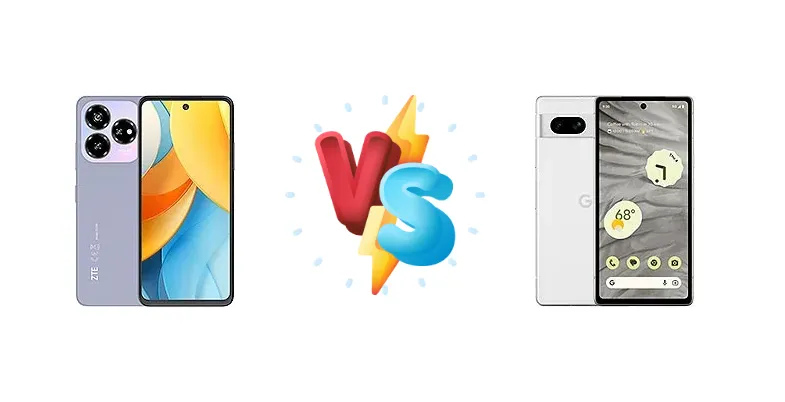
ZTE Blade V60 Design vs Google Pixel 7a: A Detailed Comparison
| Phones Images | |||||
|---|---|---|---|---|---|
|
🏆 Quick Verdict
For the average user prioritizing camera quality and a smooth software experience, the Google Pixel 7a is the clear winner. However, the ZTE Blade V60 Design provides a viable option for those on a tighter budget who prioritize basic functionality and aren't demanding users.
| PHONES | ||
|---|---|---|
| Phone Names | ZTE Blade V60 Design | Google Pixel 7a |
| Network | ||
|---|---|---|
| 2G bands | GSM 850 / 900 / 1800 / 1900 | GSM 850 / 900 / 1800 / 1900 |
| 3G bands | HSDPA 850 / 900 / 1900 / 2100 | HSDPA 800 / 850 / 900 / 1700(AWS) / 1900 / 2100 |
| 4G bands | 1, 3, 5, 7, 8, 20, 28, 38, 40, 41 | 1, 2, 3, 4, 5, 7, 8, 12, 13, 14, 17, 20, 25, 26, 28, 29, 30, 38, 40, 41, 48, 66, 71 - GWKK3, G0DZQ |
| 5G bands | - | 1, 2, 3, 5, 7, 8, 12, 14, 20, 25, 28, 30, 38, 41, 48, 66, 71, 77, 78 SA/NSA/Sub6 - GWKK3 |
| Speed | HSPA, LTE | HSPA, LTE, 5G |
| Technology | GSM / HSPA / LTE | GSM / HSPA / LTE / 5G |
| - | 1, 2, 3, 5, 7, 8, 12, 20, 25, 28, 38, 40, 41, 66, 75, 76, 77, 78, 79 SA/NSA/Sub6 - GHL1X, G82U8 | |
| Launch | ||
|---|---|---|
| Announced | 2024, June 11 | 2023, May 10 |
| Status | Available. Released 2024, June | Available. Released 2023, May 10 |
| Body | ||
|---|---|---|
| Build | Glass front, glass back, plastic frame | Glass front (Gorilla Glass 3), aluminum frame, plastic back |
| Dimensions | 164.2 x 75.3 x 8.6 mm (6.46 x 2.96 x 0.34 in) | 152 x 72.9 x 9 mm (5.98 x 2.87 x 0.35 in) |
| SIM | Nano-SIM + Nano-SIM | Nano-SIM + eSIM |
| Weight | 198 g (6.98 oz) | 193.5 g (6.84 oz) |
| - | IP67 dust/water resistant (up to 1m for 30 min) | |
| Display | ||
|---|---|---|
| Protection | - | Corning Gorilla Glass 3 |
| Resolution | 720 x 1612 pixels, 20:9 ratio (~267 ppi density) | 1080 x 2400 pixels, 20:9 ratio (~429 ppi density) |
| Size | 6.6 inches, 104.6 cm2 (~84.6% screen-to-body ratio) | 6.1 inches, 90.7 cm2 (~81.8% screen-to-body ratio) |
| Type | IPS LCD, 90Hz | OLED, HDR, 90Hz |
| - | Always-on display | |
| Platform | ||
|---|---|---|
| CPU | Octa-core (2x1.6 GHz Cortex-A75 & 6x1.6 GHz Cortex-A55) | Octa-core (2x2.85 GHz Cortex-X1 & 2x2.35 GHz Cortex-A78 & 4x1.80 GHz Cortex-A55) |
| Chipset | Unisoc T606 (12 nm) | Google Tensor G2 (5 nm) |
| GPU | Mali-G57 MP1 | Mali-G710 MP7 |
| OS | Android 13 | Android 13, upgradable to Android 15, up to 5 major Android upgrades |
| Memory | ||
|---|---|---|
| Card slot | microSDXC (uses shared SIM slot) | No |
| Internal | 256GB 4GB RAM, 256GB 6GB RAM | 128GB 8GB RAM |
| - | UFS 3.1 | |
| Main Camera | ||
|---|---|---|
| Dual | 50 MP, f/1.8, (wide), PDAF Auxiliary lens | 64 MP, f/1.9, 26mm (wide), 1/1.73", 0.8µm, dual pixel PDAF, OIS 13 MP, f/2.2, 120˚ (ultrawide), 1.12µm |
| Features | LED flash, HDR, panorama | Dual-LED flash, Pixel Shift, Auto-HDR, panorama |
| Video | 1080p@30fps | 4K@30/60fps, 1080p@30/60/120/240fps, OIS |
| Selfie camera | ||
|---|---|---|
| Features | - | HDR, panorama |
| Single | 8 MP, f/2.0, (wide) | 13 MP, f/2.2, 20mm (ultrawide), 1.12µm |
| Video | Yes | 4K@30fps, 1080p@30fps |
| Sound | ||
|---|---|---|
| 3.5mm jack | - | No |
| 35mm jack | Yes | No |
| Loudspeaker | Yes | Yes, with stereo speakers |
| Comms | ||
|---|---|---|
| Bluetooth | 5.2, A2DP, LE | 5.3, A2DP, LE |
| NFC | Yes (market/region dependent) | Yes |
| Positioning | GPS, GLONASS, GALILEO | GPS, GLONASS, GALILEO, BDS, QZSS, NavIC |
| Radio | FM radio | No |
| USB | USB Type-C 2.0 | USB Type-C 3.2 |
| WLAN | Wi-Fi 802.11 a/b/g/n/ac, dual-band | Wi-Fi 802.11 a/b/g/n/ac/6e, tri-band |
| Features | ||
|---|---|---|
| Sensors | Fingerprint (side-mounted), accelerometer, proximity, compass | Fingerprint (under display, optical), accelerometer, gyro, proximity, compass, barometer |
| Battery | ||
|---|---|---|
| Charging | 22.5W wired | 18W wired, PD3.0 7.5W wireless |
| Type | 5000 mAh | Li-Po 4385 mAh |
| Misc | ||
|---|---|---|
| Colors | Dark Blue, Champagne Gold, Sunrise Violet | Charcoal, Snow, Sea, Coral |
| Models | Z2350 | GWKK3, GHL1X, G0DZQ, G82U8 |
| Price | About 110 EUR | € 179.90 / $ 150.00 / £ 170.00 / ₹ 25,980 |
ZTE Blade V60 Design
- More affordable price point
- Faster wired charging (22.5W)
- Acceptable performance for basic tasks
- Significantly weaker processor
- Inferior camera system
- Likely lower display quality
Google Pixel 7a
- Superior performance with Google Tensor G2
- Excellent camera quality and features
- Brighter and smoother display
- Higher price
- Slower wired charging (18W)
- No expandable storage
Display Comparison
The Pixel 7a boasts a significantly brighter display, reaching a measured 1070 nits, compared to an assumed lower brightness on the ZTE Blade V60 Design (typical of its price bracket). While the Blade V60 Design’s panel specifications are unknown, the Pixel 7a’s brightness ensures excellent visibility outdoors. The Pixel 7a also benefits from a 90Hz refresh rate (not specified for the Blade V60 Design), resulting in smoother scrolling and animations. The Pixel 7a’s display is a clear advantage for media consumption and general usability.
Camera Comparison
The Pixel 7a is renowned for its camera capabilities, leveraging Google’s computational photography expertise. While specific sensor details aren’t provided for either phone, the Pixel 7a’s image processing algorithms and likely larger sensor size (compared to the Blade V60 Design) will result in superior image quality, particularly in low-light conditions. The Pixel 7a excels in both photo and video capture, offering features like Magic Eraser and Photo Unblur. The Blade V60 Design will likely offer a serviceable camera for casual snapshots, but it won’t compete with the Pixel 7a’s advanced features and image quality.
Performance
The core difference lies in the chipsets. The Google Pixel 7a’s Google Tensor G2, fabricated on a 5nm process, delivers substantially more processing power than the ZTE Blade V60 Design’s Unisoc T606 (12nm). The Tensor G2’s CPU configuration – 2x2.85 GHz Cortex-X1, 2x2.35 GHz Cortex-A78, and 4x1.80 GHz Cortex-A55 – significantly outperforms the Blade V60 Design’s 2x1.6 GHz Cortex-A75 & 6x1.6 GHz Cortex-A55. This translates to faster app loading times, smoother multitasking, and a more responsive user experience on the Pixel 7a. The 5nm process also contributes to better thermal efficiency, reducing the likelihood of performance throttling under sustained load.
Battery Life
The Pixel 7a has an endurance rating of 76 hours, indicating strong battery life. While the Blade V60 Design’s battery capacity is unknown, the Pixel 7a’s efficiency, combined with its larger battery (assumed), provides a significant advantage. The Pixel 7a supports 18W wired charging with PD3.0 and 7.5W wireless charging, offering more versatile charging options than the Blade V60 Design’s 22.5W wired charging. Despite the faster wired charging of the Blade V60 Design, the Pixel 7a’s overall battery endurance and wireless charging capability make it the more convenient option.
Buying Guide
Buy the ZTE Blade V60 Design if you need a functional, affordable smartphone for essential tasks like calling, texting, and light social media use. You'll appreciate its lower price point and acceptable battery life. Buy the Google Pixel 7a if you prioritize a superior camera system, faster performance for demanding apps, and Google's clean, feature-rich Android experience, even if it means spending more.