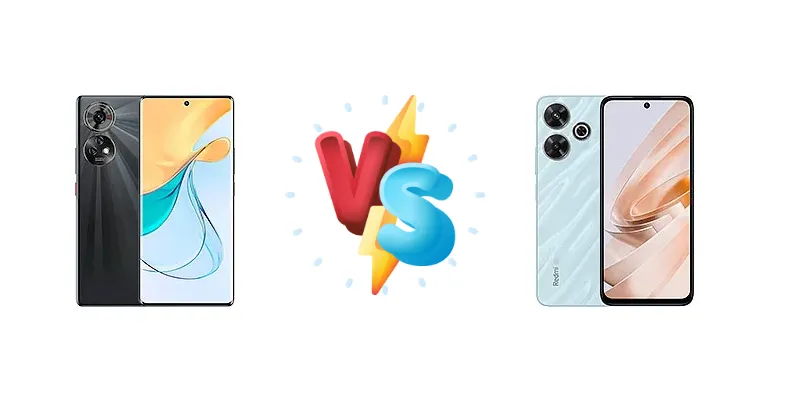
The sub-$200 smartphone market is fiercely competitive. The ZTE Blade V50 and Xiaomi Redmi Note 13R represent two distinct approaches to delivering value. The Blade V50 relies on a general octa-core processor, while the Redmi Note 13R leverages Qualcomm’s newer, more efficient Snapdragon 4+ Gen 2 chipset. This comparison dissects the key differences to help you choose the right phone for your needs.
🏆 Quick Verdict
For most users, the Xiaomi Redmi Note 13R is the superior choice. The Snapdragon 4+ Gen 2 (4nm) offers a significant performance and efficiency advantage over the ZTE Blade V50’s octa-core processor, translating to smoother multitasking and potentially longer battery life, despite both phones sharing the same 33W charging.
| Network |
|---|
| 2G bands | GSM 850 / 900 / 1800 / 1900 | GSM 850 / 900 / 1800 / 1900 |
| 3G bands | HSDPA 850 / 900 / 1900 / 2100 | HSDPA 850 / 900 / 2100 |
| 4G bands | LTE | 1, 3, 5, 8, 34, 38, 39, 40, 41 |
| 5G bands | SA/NSA | 1, 5, 8, 28, 41, 78 SA/NSA |
| Speed | HSPA, LTE, 5G | HSPA, LTE, 5G |
| Technology | GSM / HSPA / LTE / 5G | GSM / CDMA / HSPA / EVDO / LTE / 5G |
| Launch |
|---|
| Announced | 2023, September | 2024, May 17 |
| Status | Available. Released 2023, September | Available. Released 2024, May 17 |
| Body |
|---|
| Build | - | Glass front, plastic frame, glass back |
| Dimensions | 161.9 x 72.8 x 8 mm (6.37 x 2.87 x 0.31 in) | 168.6 x 76.3 x 8.2 mm (6.64 x 3.00 x 0.32 in) |
| SIM | Nano-SIM + Nano-SIM | Nano-SIM + Nano-SIM |
| Weight | 178 g (6.28 oz) | 205 g (7.23 oz) |
| Display |
|---|
| Resolution | 1080 x 2400 pixels, 20:9 ratio (~395 ppi density) | 1080 x 2460 pixels (~396 ppi density) |
| Size | 6.67 inches, 107.4 cm2 (~91.1% screen-to-body ratio) | 6.79 inches, 109.5 cm2 (~85.1% screen-to-body ratio) |
| Type | AMOLED, 120Hz | IPS LCD, 120Hz, 550 nits |
| Platform |
|---|
| CPU | Octa-core | Octa-core (2x2.3 GHz Cortex-A78 & 6x1.95 GHz Cortex-A55) |
| Chipset | - | Qualcomm SM4450 Snapdragon 4+ Gen 2 (4 nm) |
| GPU | - | Adreno 613 |
| OS | Android 13 | Android 14, HyperOS |
| Memory |
|---|
| Card slot | No | No |
| Internal | 256GB 6GB RAM | 128GB 6GB RAM, 128GB 8GB RAM, 256GB 8GB RAM, 256GB 12GB RAM, 512GB 12GB RAM |
| Main Camera |
|---|
| Dual | - | 50 MP, f/1.8, (wide), 1/2.76", 0.64µm, PDAF
2 MP (macro) |
| Features | LED flash, HDR, panorama | LED flash, HDR |
| Triple | 50 MP, f/1.8, (wide), PDAF
2 MP (macro)
Auxiliary lens | - |
| Video | 1080p@30fps | 1080p@30fps |
| Selfie camera |
|---|
| Single | 16 MP, f/2.0, (wide) | 8 MP, (wide), 1/4.0", 1.12µm |
| Video | 1080p@30fps | 1080p@30fps |
| Sound |
|---|
| 35mm jack | No | Yes |
| Loudspeaker | Yes | Yes |
| Comms |
|---|
| Bluetooth | 5.2, A2DP, LE | 5.3, A2DP, LE |
| Infrared port | - | Yes |
| NFC | Yes (market/region dependent) | Yes |
| Positioning | GPS | GPS, GLONASS, GALILEO, BDS |
| Radio | Unspecified | No |
| USB | USB Type-C 2.0 | USB Type-C |
| WLAN | Wi-Fi 802.11 a/b/g/n/ac, dual-band | Wi-Fi 802.11 a/b/g/n/ac, dual-band |
| Features |
|---|
| Sensors | Fingerprint (under display, optical), accelerometer, gyro, proximity, compass | Fingerprint (side-mounted), accelerometer, compass |
| Battery |
|---|
| Charging | 33W wired | 33W wired |
| Type | Li-Po 4800 mAh | 5030 mAh |
| Misc |
|---|
| Colors | Black, Blue, Mint | Black, Blue, Silver |
| Models | 7060 | 2406ERN9CC |
| Price | About 220 EUR | About 180 EUR |
ZTE Blade V50
- Potentially lower price point
- 33W fast charging
- Simple and straightforward user experience
- Less powerful processor
- Lower power efficiency
- Likely inferior camera performance
Xiaomi Redmi Note 13R
- More powerful and efficient Snapdragon 4+ Gen 2 chipset
- Improved multitasking and gaming performance
- Potentially better camera image processing
- May be slightly more expensive
- 33W fast charging (same as Blade V50)
- Software bloat (typical of Xiaomi)
Display Comparison
Neither device’s display specifications are provided, so a direct comparison is limited. However, given the price bracket, both likely utilize LCD panels. The Redmi Note 13R, benefiting from Xiaomi’s broader display sourcing, *may* have a slightly higher peak brightness or better color calibration. The absence of information regarding refresh rates suggests both are likely capped at 60Hz, prioritizing battery life over visual fluidity.
Camera Comparison
Without detailed camera specifications, a comprehensive comparison is impossible. However, it’s reasonable to assume both phones feature a primary camera and potentially a depth or macro sensor. The Redmi Note 13R, leveraging Qualcomm’s image signal processor (ISP) within the Snapdragon 4+ Gen 2, likely offers superior image processing capabilities, resulting in better dynamic range and noise reduction. The ZTE Blade V50’s image quality will likely be adequate for casual use but will struggle in low-light conditions.
Performance
The core differentiator lies in the chipsets. The Xiaomi Redmi Note 13R’s Qualcomm SM4450 Snapdragon 4+ Gen 2 (4nm) is a clear advantage. The 4nm manufacturing process is significantly more efficient than the process likely used for the ZTE Blade V50’s octa-core CPU, resulting in lower heat generation and improved sustained performance. The Snapdragon 4+ Gen 2’s CPU configuration – 2x2.3 GHz Cortex-A78 & 6x1.95 GHz Cortex-A55 – provides a more balanced and powerful architecture than a generic octa-core setup, particularly benefiting demanding applications and gaming. The Cortex-A78 cores are notably more capable than the typically found Cortex-A55 cores in this price range.
Battery Life
Both the ZTE Blade V50 and Xiaomi Redmi Note 13R support 33W wired charging, suggesting similar charging speeds – approximately 60-75 minutes for a full charge. The actual battery life will depend on the battery capacity (not provided) and the chipset’s efficiency. The Snapdragon 4+ Gen 2’s 4nm process gives the Redmi Note 13R a significant edge in power efficiency, potentially translating to longer screen-on time and overall battery life, even with a similar battery capacity to the Blade V50.
Buying Guide
Buy the ZTE Blade V50 if you prioritize a potentially lower price point and are primarily focused on basic smartphone tasks like calling, texting, and light social media use. Buy the Xiaomi Redmi Note 13R if you value smoother performance for gaming and multitasking, improved power efficiency, and a more modern chipset architecture, even if it means spending slightly more.
Frequently Asked Questions
❓ Will the Redmi Note 13R handle demanding games like PUBG Mobile smoothly?
The Snapdragon 4+ Gen 2 in the Redmi Note 13R is capable of running PUBG Mobile, but likely at medium settings to maintain a stable frame rate. The ZTE Blade V50’s octa-core processor will struggle with consistent performance in demanding titles.
❓ Is the 33W charging on both phones truly 'fast charging'?
While 33W is marketed as fast charging, it's relatively standard in this price range. Expect a full charge to take around 60-75 minutes on both devices. The efficiency of the Snapdragon 4+ Gen 2 might allow the Redmi Note 13R to reach a similar charge level in less time overall due to lower power draw during charging.
❓ Does the Redmi Note 13R have a significant advantage in multitasking compared to the Blade V50?
Yes, the Redmi Note 13R’s Snapdragon 4+ Gen 2, with its more modern CPU architecture, offers a noticeable improvement in multitasking performance. Switching between apps will be smoother and less prone to lag compared to the ZTE Blade V50.