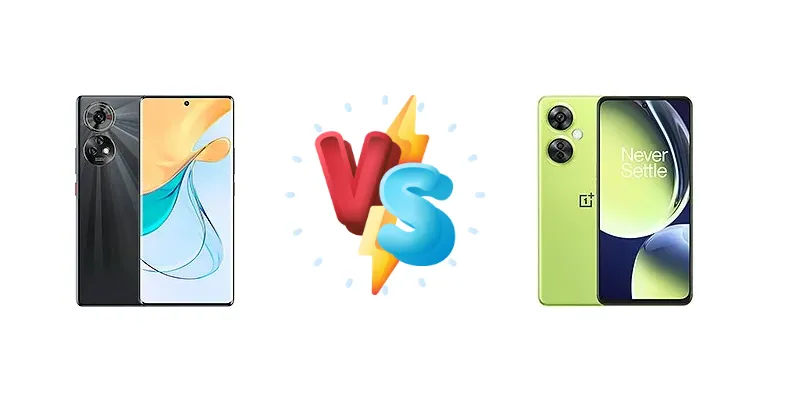
The ZTE Blade V50 and OnePlus Nord CE 3 Lite both target the competitive budget and mid-range smartphone market, but approach it with different philosophies. The Blade V50 aims for affordability, while the Nord CE 3 Lite prioritizes faster charging and a more established chipset. This comparison dissects their key differences to determine which device offers the best overall value.
🏆 Quick Verdict
For most users, the OnePlus Nord CE 3 Lite emerges as the stronger choice. Its Snapdragon 695 5G chipset provides a noticeable performance advantage, and the 67W SuperVOOC charging significantly reduces downtime. While the Blade V50 offers a lower entry price, the Nord CE 3 Lite’s superior speed and convenience justify the price difference.
| Network |
|---|
| 2G bands | GSM 850 / 900 / 1800 / 1900 | GSM 850 / 900 / 1800 / 1900 |
| 3G bands | HSDPA 850 / 900 / 1900 / 2100 | HSDPA 800 / 850 / 900 / 1700(AWS) / 1900 / 2100 - International |
| 4G bands | LTE | 1, 2, 3, 4, 5, 7, 8, 12, 13, 17, 18, 19, 20, 26, 28, 32, 38, 39, 40, 41, 66 - International |
| 5G bands | SA/NSA | 1, 3, 5, 7, 8, 20, 28, 38, 40, 41, 66, 77, 78 SA/NSA - International |
| Speed | HSPA, LTE, 5G | HSPA, LTE, 5G |
| Technology | GSM / HSPA / LTE / 5G | GSM / HSPA / LTE / 5G |
| | - | 1, 3, 5, 8, 28, 40, 41, 77, 78 SA/NSA - India |
| Launch |
|---|
| Announced | 2023, September | 2023, April 04 |
| Status | Available. Released 2023, September | Available. Released 2023, April 11 |
| Body |
|---|
| Build | - | Glass front, plastic frame, plastic back |
| Dimensions | 161.9 x 72.8 x 8 mm (6.37 x 2.87 x 0.31 in) | 165.5 x 76 x 8.3 mm (6.52 x 2.99 x 0.33 in) |
| SIM | Nano-SIM + Nano-SIM | Nano-SIM + Nano-SIM |
| Weight | 178 g (6.28 oz) | 195 g (6.88 oz) |
| Display |
|---|
| Protection | - | Corning Gorilla Glass |
| Resolution | 1080 x 2400 pixels, 20:9 ratio (~395 ppi density) | 1080 x 2400 pixels, 20:9 ratio (~391 ppi density) |
| Size | 6.67 inches, 107.4 cm2 (~91.1% screen-to-body ratio) | 6.72 inches, 109.6 cm2 (~87.1% screen-to-body ratio) |
| Type | AMOLED, 120Hz | IPS LCD, 120Hz, 550 nits (typ), 680 nits (peak) |
| Platform |
|---|
| CPU | Octa-core | Octa-core (2x2.2 GHz Kryo 660 Gold & 6x1.7 GHz Kryo 660 Silver) |
| Chipset | - | Qualcomm SM6375 Snapdragon 695 5G (6 nm) |
| GPU | - | Adreno 619 |
| OS | Android 13 | Android 13, OxygenOS 13.1 |
| Memory |
|---|
| Card slot | No | microSDXC (uses shared SIM slot) |
| Internal | 256GB 6GB RAM | 128GB 8GB RAM, 256GB 8GB RAM |
| | - | UFS 2.2 |
| Main Camera |
|---|
| Features | LED flash, HDR, panorama | LED flash, HDR, panorama |
| Triple | 50 MP, f/1.8, (wide), PDAF
2 MP (macro)
Auxiliary lens | 108 MP, f/1.8, (wide), 1/1.67", 0.64µm, PDAF
2 MP (macro)
Auxiliary lens |
| Video | 1080p@30fps | 1080p@30fps |
| Selfie camera |
|---|
| Features | - | HDR, panorama |
| Single | 16 MP, f/2.0, (wide) | 16 MP, f/2.4, (wide), 1.0µm |
| Video | 1080p@30fps | 1080p@30fps |
| Sound |
|---|
| 3.5mm jack | - | Yes |
| 35mm jack | No | Yes |
| Loudspeaker | Yes | Yes, with stereo speakers |
| Comms |
|---|
| Bluetooth | 5.2, A2DP, LE | 5.1, A2DP, LE, aptX HD |
| NFC | Yes (market/region dependent) | Yes (market/region dependent) |
| Positioning | GPS | GPS, GALILEO, GLONASS, BDS, QZSS |
| Radio | Unspecified | No |
| USB | USB Type-C 2.0 | USB Type-C 2.0, OTG |
| WLAN | Wi-Fi 802.11 a/b/g/n/ac, dual-band | Wi-Fi 802.11 a/b/g/n/ac, dual-band |
| Features |
|---|
| Sensors | Fingerprint (under display, optical), accelerometer, gyro, proximity, compass | Fingerprint (side-mounted), accelerometer, gyro, proximity, compass |
| Battery |
|---|
| Charging | 33W wired | 67W wired, 80% in 30 min |
| Type | Li-Po 4800 mAh | Li-Po 5000 mAh |
| Misc |
|---|
| Colors | Black, Blue, Mint | Pastel Lime, Chromatic Gray |
| Models | 7060 | CPH2467, CPH2465 |
| Price | About 220 EUR | £ 169.98 / € 209.99 |
| SAR | - | 1.17 W/kg (head) 0.70 W/kg (body) |
| Tests |
|---|
| Performance | - |
AnTuTu: 412006 (v9)
GeekBench: 2052 (v5)
GFXBench: 17fps (ES 3.1 onscreen) |
ZTE Blade V50
- Potentially lower price point
- Acceptable for basic smartphone tasks
- 33W charging is still reasonably fast
- Inferior processor performance
- Likely less efficient power consumption
- Camera quality may be limited
OnePlus Nord CE 3 Lite
- Faster Snapdragon 695 5G chipset
- 67W SuperVOOC charging for rapid top-ups
- Potentially better camera image processing
- Slightly higher price
- May not be a significant upgrade for very basic users
- Software bloat (typical of OnePlus)
Display Comparison
Neither device’s display specifications are provided, so a direct comparison is limited. However, given the price points, both likely utilize LCD panels. The OnePlus Nord CE 3 Lite, benefiting from OnePlus’s display tuning experience, likely offers slightly better color accuracy and viewing angles. Bezels are expected to be comparable, with both aiming for maximizing screen real estate within their respective budgets. Without knowing refresh rates, it's difficult to assess smoothness.
Camera Comparison
Without detailed camera specifications, a comprehensive comparison is challenging. However, the OnePlus Nord CE 3 Lite is likely to offer a more refined camera experience due to Qualcomm’s image signal processor (ISP) integration within the Snapdragon 695. While both phones may feature multiple rear cameras, the quality of the main sensor and image processing algorithms will be crucial. The Blade V50’s camera system likely focuses on affordability, potentially sacrificing image quality in low-light conditions. The Nord CE 3 Lite’s ISP should provide better dynamic range and noise reduction.
Performance
The OnePlus Nord CE 3 Lite’s Qualcomm Snapdragon 695 5G (6nm) chipset represents a clear advantage over the ZTE Blade V50’s unspecified octa-core processor. The Snapdragon 695, with its Kryo 660 Gold and Silver cores clocked at 2.2 GHz and 1.7 GHz respectively, delivers significantly improved CPU and GPU performance. The 6nm fabrication process also contributes to better power efficiency and thermal management, potentially leading to less throttling during sustained workloads. The Blade V50’s octa-core CPU, lacking specific details, likely relies on less efficient core designs and a larger manufacturing process, resulting in lower overall performance.
Battery Life
The OnePlus Nord CE 3 Lite’s 67W wired charging is a standout feature, capable of reaching 80% charge in just 30 minutes. This dramatically reduces downtime compared to the ZTE Blade V50’s 33W charging. While battery capacity isn’t specified for either device, the faster charging speed of the Nord CE 3 Lite effectively mitigates any potential disadvantage from a slightly smaller battery. Users who frequently find themselves needing to quickly top up their phone will greatly benefit from the Nord CE 3 Lite’s charging capabilities.
Buying Guide
Buy the ZTE Blade V50 if you prioritize absolute affordability and are willing to compromise on performance and charging speed. It’s a suitable option for basic smartphone tasks like calling, texting, and light social media use. Buy the OnePlus Nord CE 3 Lite if you value faster performance for gaming and multitasking, and appreciate the convenience of incredibly rapid 67W charging. This phone is ideal for users who demand more from their device without breaking the bank.
Frequently Asked Questions
❓ Is the Snapdragon 695 in the OnePlus Nord CE 3 Lite powerful enough for demanding games like PUBG or Call of Duty?
The Snapdragon 695 is capable of running PUBG and Call of Duty, but you’ll likely need to lower graphics settings to achieve consistently smooth frame rates. It’s not a flagship-level gaming chip, but it provides a playable experience for casual gamers. The ZTE Blade V50’s processor will struggle more with these titles.
❓ How much faster is the 67W charging on the OnePlus Nord CE 3 Lite compared to the 33W charging on the ZTE Blade V50 in real-world use?
The 67W charging on the Nord CE 3 Lite can take a phone from 0% to 80% in approximately 30 minutes, while the 33W charging on the Blade V50 will take considerably longer – likely over an hour to reach the same level. This difference is significant for users who need a quick power boost before leaving the house.
❓ Does the OnePlus Nord CE 3 Lite support 5G connectivity, and will I see a noticeable speed improvement over 4G?
Yes, the OnePlus Nord CE 3 Lite features a Snapdragon 695 5G chipset, which supports 5G connectivity. If you have 5G coverage in your area and a 5G data plan, you’ll experience significantly faster download and upload speeds compared to 4G, resulting in quicker app downloads, smoother streaming, and more responsive online gaming.