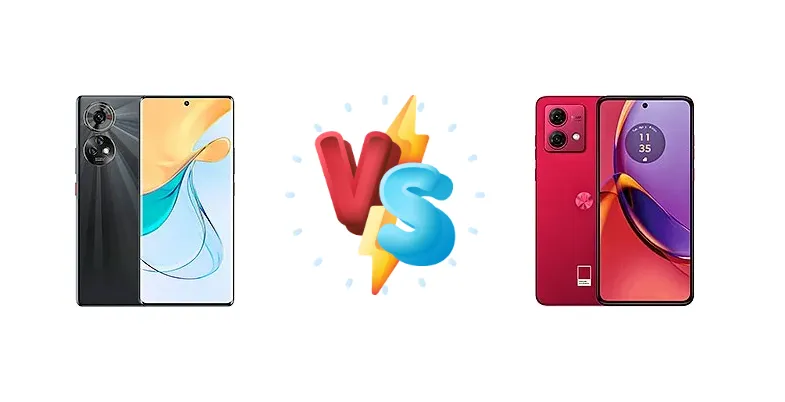
The ZTE Blade V50 and Motorola Moto G84 represent compelling options in the increasingly competitive sub-$250 smartphone market. While both offer 5G connectivity, they take different approaches to achieving affordability. The Moto G84 prioritizes a more refined user experience with a brighter display and a known chipset, while the Blade V50 aims for value with a focus on core functionality. This comparison will dissect their strengths and weaknesses to determine which device delivers the best bang for your buck.
🏆 Quick Verdict
For the average user prioritizing a brighter, more vibrant display and a proven chipset, the Motorola Moto G84 is the better choice. Its Snapdragon 695 offers a smoother experience than the Blade V50’s unspecified chipset, and the 996 nits peak brightness makes it far more usable outdoors. However, the Blade V50 may appeal to those on the tightest budgets.
| Network |
|---|
| 2G bands | GSM 850 / 900 / 1800 / 1900 | GSM 850 / 900 / 1800 / 1900 |
| 3G bands | HSDPA 850 / 900 / 1900 / 2100 | HSDPA 850 / 900 / 1700(AWS) / 1900 / 2100 - LATAM |
| 4G bands | LTE | 1, 2, 3, 4, 5, 7, 8, 12, 13, 17, 25, 26, 28, 38, 40, 41, 42, 66 - LATAM |
| 5G bands | SA/NSA | 1, 2, 3, 5, 7, 26, 28, 40, 66, 78 SA/NSA/Sub6 - LATAM |
| Speed | HSPA, LTE, 5G | HSPA, LTE, 5G |
| Technology | GSM / HSPA / LTE / 5G | GSM / HSPA / LTE / 5G |
| Launch |
|---|
| Announced | 2023, September | 2023, August 24 |
| Status | Available. Released 2023, September | Available. Released 2023, September 08 |
| Body |
|---|
| Build | - | Glass front, plastic frame, plastic back or eco leather back |
| Dimensions | 161.9 x 72.8 x 8 mm (6.37 x 2.87 x 0.31 in) | 160 x 74.4 x 7.6 mm (6.30 x 2.93 x 0.30 in) |
| SIM | Nano-SIM + Nano-SIM | Nano-SIM + Nano-SIM |
| Weight | 178 g (6.28 oz) | 166.8 g (5.86 oz) |
| Display |
|---|
| Resolution | 1080 x 2400 pixels, 20:9 ratio (~395 ppi density) | 1080 x 2400 pixels, 20:9 ratio (~405 ppi density) |
| Size | 6.67 inches, 107.4 cm2 (~91.1% screen-to-body ratio) | 6.5 inches, 102.0 cm2 (~85.7% screen-to-body ratio) |
| Type | AMOLED, 120Hz | P-OLED, 1B colors, 120Hz, 1300 nits (peak) |
| Platform |
|---|
| CPU | Octa-core | Octa-core (2x2.2 GHz Kryo 660 Gold & 6x1.7 GHz Kryo 660 Silver) |
| Chipset | - | Qualcomm SM6375 Snapdragon 695 5G (6 nm) |
| GPU | - | Adreno 619 |
| OS | Android 13 | Android 13, upgradable to Android 15 |
| Memory |
|---|
| Card slot | No | microSDXC (uses shared SIM slot) |
| Internal | 256GB 6GB RAM | 256GB 8GB RAM, 256GB 12GB RAM |
| Main Camera |
|---|
| Dual | - | 50 MP, f/1.9 (wide), 1/1.5", 1.0µm, PDAF, OIS
8 MP, f/2.2, 120˚ (ultrawide), 1/4.0", 1.12µm, AF |
| Features | LED flash, HDR, panorama | LED flash, HDR, panorama |
| Triple | 50 MP, f/1.8, (wide), PDAF
2 MP (macro)
Auxiliary lens | - |
| Video | 1080p@30fps | 1080p@30/60fps |
| Selfie camera |
|---|
| Single | 16 MP, f/2.0, (wide) | 16 MP, f/2.5, (wide), 1.0µm |
| Video | 1080p@30fps | 1080p@30fps |
| Sound |
|---|
| 35mm jack | No | Yes |
| Loudspeaker | Yes | Yes, with stereo speakers |
| Comms |
|---|
| Bluetooth | 5.2, A2DP, LE | 5.1, A2DP, LE |
| NFC | Yes (market/region dependent) | Yes (market/region dependent) |
| Positioning | GPS | GPS, GLONASS, GALILEO |
| Radio | Unspecified | FM radio (market/region dependent) |
| USB | USB Type-C 2.0 | USB Type-C 2.0 |
| WLAN | Wi-Fi 802.11 a/b/g/n/ac, dual-band | Wi-Fi 802.11 a/b/g/n/ac, dual-band, Wi-Fi Direct |
| Features |
|---|
| Sensors | Fingerprint (under display, optical), accelerometer, gyro, proximity, compass | Fingerprint (under display, optical), accelerometer, gyro, proximity, compass |
| Battery |
|---|
| Charging | 33W wired | 30W wired |
| Type | Li-Po 4800 mAh | Li-Po 5000 mAh |
| Misc |
|---|
| Colors | Black, Blue, Mint | Marshmallow Blue, Midnight Blue, Viva Magenta |
| Models | 7060 | XT2347, XT2347-1, XT2347-2 |
| Price | About 220 EUR | $ 399.00 / £ 189.99 / € 169.00 |
ZTE Blade V50
- Potentially lower price point
- 33W fast charging
- 5G connectivity
- Unspecified chipset performance
- Likely lower display brightness
- Limited camera details
Motorola Moto G84
- Snapdragon 695 5G chipset
- 996 nits peak display brightness
- Excellent battery life (12:31h active use)
- 30W charging (slightly slower than Blade V50)
- Potentially higher price
- Camera details are limited
Display Comparison
The Motorola Moto G84 boasts a significant advantage in display quality, achieving a measured peak brightness of 996 nits. This is crucial for outdoor visibility, a common pain point in this price bracket. The ZTE Blade V50’s display specifications are currently unknown, but given its price positioning, it’s likely to offer considerably lower brightness and potentially inferior color accuracy. The Moto G84’s panel likely benefits users who frequently consume media outdoors or in brightly lit environments.
Camera Comparison
Both devices feature camera systems, but details are limited for the ZTE Blade V50. The Motorola Moto G84 offers a photo/video capable camera, but specific sensor details are missing. Without knowing the sensor size, aperture, or image processing capabilities of the Blade V50, it’s difficult to make a direct comparison. However, Motorola’s image processing generally prioritizes natural-looking images, while ZTE often leans towards more saturated colors. Users prioritizing image quality should await detailed camera reviews of both devices.
Performance
The Motorola Moto G84 is powered by the Qualcomm Snapdragon 695 5G (6nm), an octa-core processor with a Kryo 660 Gold/Silver configuration (2x2.2 GHz & 6x1.7 GHz). This chipset provides a solid foundation for everyday tasks and light gaming. The ZTE Blade V50 utilizes an unspecified octa-core CPU. While both are octa-core, the Snapdragon 695’s 6nm process node offers better power efficiency and thermal management, potentially leading to less throttling during sustained workloads. Users who engage in mobile gaming or multitasking will likely experience smoother performance on the Moto G84.
Battery Life
The Motorola Moto G84 demonstrates strong battery performance, achieving an active use score of 12 hours and 31 minutes and an endurance rating of 117 hours. This suggests excellent longevity for all-day use. The ZTE Blade V50 offers 33W wired charging, while the Moto G84 supports 30W wired charging. While the Blade V50’s charging is slightly faster on paper, the Moto G84’s larger battery and more efficient chipset likely offset this difference, providing comparable or even better real-world battery life. Users who prioritize long-lasting battery life will likely favor the Moto G84.
Buying Guide
Buy the ZTE Blade V50 if you need a functional 5G smartphone at the absolute lowest possible price point and aren't concerned with demanding tasks or a premium display experience. Buy the Motorola Moto G84 if you prefer a more polished experience with a brighter screen, a more efficient chipset (Snapdragon 695), and a longer-lasting battery, even if it means spending a bit more.
Frequently Asked Questions
❓ Does the Snapdragon 695 in the Moto G84 struggle with demanding games like PUBG or Call of Duty?
The Snapdragon 695 is capable of running PUBG and Call of Duty, but you'll likely need to lower the graphics settings to medium or low to achieve a consistently smooth frame rate. It's not a gaming powerhouse, but it provides a playable experience for casual gamers.
❓ How does the Moto G84's battery life hold up with heavy social media and video streaming use?
The Moto G84's 12:31h active use score suggests it can comfortably handle a full day of heavy social media browsing and video streaming. The efficient Snapdragon 695 chipset contributes to excellent power management, minimizing battery drain during these activities.
❓ Is the 30W charging on the Moto G84 slow compared to other phones?
While 30W isn't the fastest charging available, it's still reasonably quick and should fully charge the Moto G84 in around 1.5 to 2 hours. The Moto G84's battery efficiency means you won't necessarily need to top it up as frequently as phones with faster charging but smaller batteries.