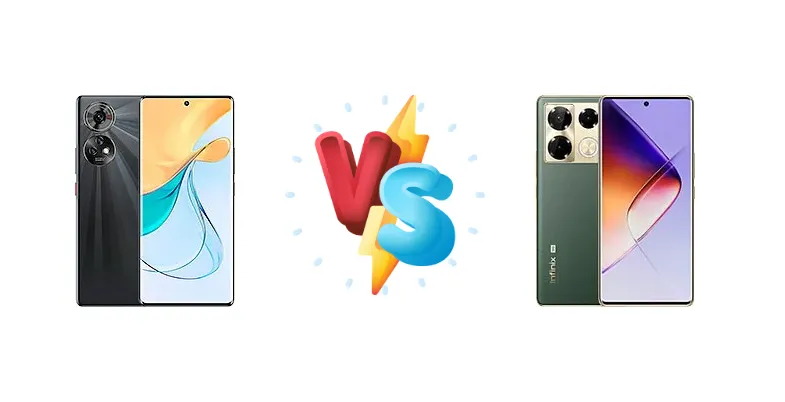
The ZTE Blade V50 and Infinix Note 40 Pro represent distinct approaches to the budget and mid-range smartphone market. The Blade V50 aims for affordability, while the Note 40 Pro attempts to pack in premium features like fast charging and a more powerful chipset. This comparison dissects their key differences to help you determine which device best suits your needs.
🏆 Quick Verdict
For the average user prioritizing performance and convenience, the Infinix Note 40 Pro is the clear winner. Its Mediatek Dimensity 7020 chipset and 45W charging significantly outperform the ZTE Blade V50’s basic specifications, justifying the likely price difference. However, the Blade V50 remains a viable option for those on the tightest of budgets.
| Network |
|---|
| 2G bands | GSM 850 / 900 / 1800 / 1900 | GSM 850 / 900 / 1800 / 1900 |
| 3G bands | HSDPA 850 / 900 / 1900 / 2100 | HSDPA 850 / 900 / 1700(AWS) / 1900 / 2100 |
| 4G bands | LTE | 1, 2, 3, 4, 5, 7, 8, 12, 17, 20, 28, 38, 40, 41, 42, 66 |
| 5G bands | SA/NSA | 1, 3, 5, 7, 8, 12, 20, 28, 38, 40, 41, 66, 77, 78 SA/NSA |
| Speed | HSPA, LTE, 5G | HSPA, LTE, 5G |
| Technology | GSM / HSPA / LTE / 5G | GSM / HSPA / LTE / 5G |
| Launch |
|---|
| Announced | 2023, September | 2024, March 18 |
| Status | Available. Released 2023, September | Available. Released 2024, March 19 |
| Body |
|---|
| Dimensions | 161.9 x 72.8 x 8 mm (6.37 x 2.87 x 0.31 in) | 164.3 x 74.5 x 8.1 mm (6.47 x 2.93 x 0.32 in) |
| SIM | Nano-SIM + Nano-SIM | Nano-SIM + Nano-SIM |
| Weight | 178 g (6.28 oz) | 190 g or 196 g (6.70 oz) |
| Display |
|---|
| Protection | - | Corning Gorilla Glass |
| Resolution | 1080 x 2400 pixels, 20:9 ratio (~395 ppi density) | 1080 x 2436 pixels (~393 ppi density) |
| Size | 6.67 inches, 107.4 cm2 (~91.1% screen-to-body ratio) | 6.78 inches, 109.9 cm2 (~89.8% screen-to-body ratio) |
| Type | AMOLED, 120Hz | AMOLED, 1B colors, 120Hz, 2160Hz PWM, 1300 nits (peak) |
| Platform |
|---|
| CPU | Octa-core | Octa-core (2x2.2 GHz Cortex-A78 & 6x2.0 GHz Cortex-A55) |
| Chipset | - | Mediatek Dimensity 7020 (6 nm) |
| GPU | - | IMG BXM-8-256 |
| OS | Android 13 | Android 14, XOS 14 |
| Memory |
|---|
| Card slot | No | Unspecified |
| Internal | 256GB 6GB RAM | 256GB 8GB RAM |
| Main Camera |
|---|
| Features | LED flash, HDR, panorama | Dual-LED flash, HDR, panorama |
| Triple | 50 MP, f/1.8, (wide), PDAF
2 MP (macro)
Auxiliary lens | 108 MP, f/1.8, (wide), PDAF, OIS
2 MP, f/2.4
2 MP, f/2.4 |
| Video | 1080p@30fps | 1440p@30fps, 1080p@30/60fps |
| Selfie camera |
|---|
| Features | - | Dual-LED flash |
| Single | 16 MP, f/2.0, (wide) | 32 MP, f/2.2, (wide), 1/3.1" |
| Video | 1080p@30fps | 1080p@30fps |
| Sound |
|---|
| 35mm jack | No | No |
| Loudspeaker | Yes | Yes, with stereo speakers |
| Comms |
|---|
| Bluetooth | 5.2, A2DP, LE | Yes |
| Infrared port | - | Yes |
| NFC | Yes (market/region dependent) | Yes (market/region dependent) |
| Positioning | GPS | GPS |
| Radio | Unspecified | FM radio |
| USB | USB Type-C 2.0 | USB Type-C 2.0, OTG |
| WLAN | Wi-Fi 802.11 a/b/g/n/ac, dual-band | Wi-Fi 802.11 a/b/g/n/ac, dual-band |
| Features |
|---|
| Sensors | Fingerprint (under display, optical), accelerometer, gyro, proximity, compass | Fingerprint (under display, optical), accelerometer, gyro, proximity, compass |
| Battery |
|---|
| Charging | 33W wired | 45W wired, 50% in 26 min
20W wireless MagCharge
Reverse wired
Reverse wireless |
| Type | Li-Po 4800 mAh | 5000 mAh |
| Misc |
|---|
| Colors | Black, Blue, Mint | Vintage Green, Titan Gold, Racing Edition |
| Models | 7060 | X6851 |
| Price | About 220 EUR | About 280 EUR |
ZTE Blade V50
- Likely more affordable price point
- Functional for basic smartphone tasks
- Simple and straightforward user experience
- Significantly weaker performance
- Slower charging speeds
- Likely lower quality display
Infinix Note 40 Pro
- Powerful Mediatek Dimensity 7020 chipset
- 45W fast charging with 50% in 26 minutes
- 20W wireless MagCharge and reverse charging
- Likely superior display quality
- Higher price compared to the ZTE Blade V50
- May be overkill for basic users
- Potential for software bloat (typical of Infinix)
Display Comparison
Neither device’s display specifications are detailed in the provided data. However, given the Blade V50’s positioning, it likely features a standard 60Hz LCD panel. The Note 40 Pro, aiming higher, likely incorporates a higher refresh rate (potentially 90Hz or 120Hz) AMOLED display, offering superior color accuracy and viewing angles. The absence of LTPO technology in either is expected at this price point, meaning refresh rate adjustments will be less dynamic for power saving.
Camera Comparison
Without detailed camera specifications, a direct comparison is limited. However, the Infinix Note 40 Pro’s positioning suggests a more sophisticated camera system. While both phones likely feature a main camera, the Note 40 Pro is more likely to include features like Optical Image Stabilization (OIS) and larger sensor sizes, resulting in better low-light performance and image quality. The Blade V50 likely relies on software processing to compensate for hardware limitations. The presence of a 2MP macro camera on either device is largely a marketing tactic, offering minimal practical benefit.
Performance
The Infinix Note 40 Pro’s Mediatek Dimensity 7020 (6nm) represents a substantial leap in performance over the ZTE Blade V50’s unspecified octa-core CPU. The Dimensity 7020’s architecture – featuring 2x2.2 GHz Cortex-A78 and 6x2.0 GHz Cortex-A55 cores – provides significantly better multi-core and single-core performance, translating to smoother app launches, faster multitasking, and improved gaming experiences. The 6nm process node also contributes to better thermal efficiency, reducing the likelihood of throttling during sustained workloads. The Blade V50’s CPU, while octa-core, likely utilizes less powerful cores and a less efficient manufacturing process.
Battery Life
The Infinix Note 40 Pro’s 45W wired charging, capable of delivering 50% charge in 26 minutes, is a significant advantage over the ZTE Blade V50’s 33W charging. This faster charging speed drastically reduces downtime. Furthermore, the Note 40 Pro’s inclusion of 20W wireless MagCharge, reverse wired charging, and reverse wireless charging adds considerable versatility, allowing it to charge other devices. While battery capacity isn’t specified for either, the charging speed differential makes the Note 40 Pro more convenient for users who frequently need to top up their battery.
Buying Guide
Buy the ZTE Blade V50 if you need a functional smartphone for basic tasks like calls, texts, and light social media, and your budget is extremely limited. Buy the Infinix Note 40 Pro if you prioritize faster performance for gaming and multitasking, appreciate the convenience of rapid charging (including wireless MagCharge), and want a more future-proof device.
Frequently Asked Questions
❓ Is the Mediatek Dimensity 7020 in the Infinix Note 40 Pro capable of handling demanding games like Genshin Impact?
Yes, the Dimensity 7020 is a capable chipset for gaming. While it won't deliver flagship-level performance, it can run Genshin Impact at medium settings with playable frame rates. The 6nm process node also helps to mitigate thermal throttling during extended gaming sessions.
❓ How practical is the MagCharge wireless charging on the Infinix Note 40 Pro?
MagCharge offers a convenient and secure wireless charging experience. The magnetic attachment ensures proper alignment and efficient power transfer. While 20W isn't the fastest wireless charging available, it's a useful feature for topping up the battery throughout the day, especially when combined with the reverse wireless charging capabilities.
❓ Does the ZTE Blade V50 support software updates beyond the initial Android version?
Given ZTE’s track record with budget devices, long-term software support for the Blade V50 is unlikely. Expect limited security updates and potentially no major Android version upgrades. The Infinix Note 40 Pro, while not guaranteed, typically receives more consistent software updates.
❓ Is the difference in charging speed between 33W and 45W really noticeable in everyday use?
Absolutely. The 45W charging on the Infinix Note 40 Pro significantly reduces charging time. While 33W is adequate, 45W can add a substantial amount of battery life in just a short period, making it ideal for users who are always on the go. The 50% in 26 minutes claim is a tangible benefit.