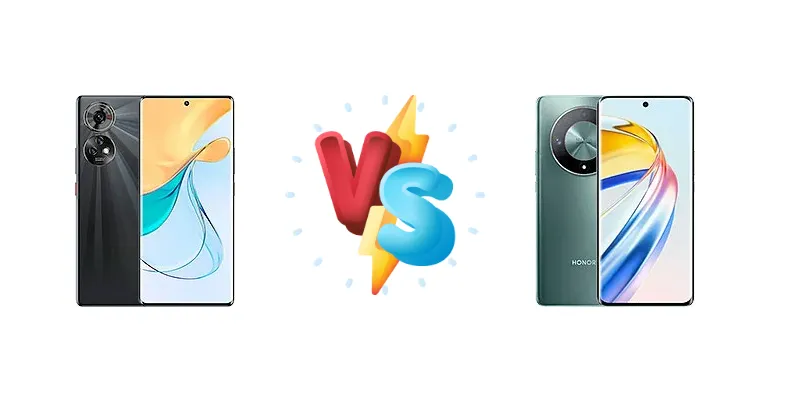
The sub-$200 smartphone market is fiercely competitive. The ZTE Blade V50 and Honor X9b represent compelling options, but cater to slightly different priorities. The Blade V50 aims for affordability, while the X9b leverages Qualcomm's Snapdragon 6 Gen 1 for a performance edge. This comparison dissects their key differences to determine which device delivers the best value.
🏆 Quick Verdict
For most users, the Honor X9b emerges as the superior choice. Its Snapdragon 6 Gen 1 chipset provides a noticeable performance boost over the ZTE Blade V50’s unspecified octa-core processor, translating to smoother multitasking and gaming. While both offer 33-35W charging, the X9b’s reverse wired charging adds a convenient feature.
| Network |
|---|
| 2G bands | GSM 850 / 900 / 1800 / 1900 | GSM 850 / 900 / 1800 / 1900 |
| 3G bands | HSDPA 850 / 900 / 1900 / 2100 | HSDPA 850 / 900 / 1900 / 2100 |
| 4G bands | LTE | 1, 2, 3, 4, 5, 7, 8, 20, 28, 32, 38, 40, 41 |
| 5G bands | SA/NSA | 1, 3, 7, 8, 20, 28, 38, 40, 41, 77, 78 SA/NSA |
| Speed | HSPA, LTE, 5G | HSPA, LTE, 5G |
| Technology | GSM / HSPA / LTE / 5G | GSM / HSPA / LTE / 5G |
| Launch |
|---|
| Announced | 2023, September | 2023, October 18 |
| Status | Available. Released 2023, September | Available. Released 2023, October |
| Body |
|---|
| Dimensions | 161.9 x 72.8 x 8 mm (6.37 x 2.87 x 0.31 in) | 163.6 x 75.5 x 8 mm (6.44 x 2.97 x 0.31 in) |
| SIM | Nano-SIM + Nano-SIM | Nano-SIM + Nano-SIM |
| Weight | 178 g (6.28 oz) | 185 g (6.53 oz) |
| Display |
|---|
| Resolution | 1080 x 2400 pixels, 20:9 ratio (~395 ppi density) | 1220 x 2652 pixels, 19.5:9 ratio (~431 ppi density) |
| Size | 6.67 inches, 107.4 cm2 (~91.1% screen-to-body ratio) | 6.78 inches, 112.6 cm2 (~91.2% screen-to-body ratio) |
| Type | AMOLED, 120Hz | AMOLED, 1B colors, 120Hz, 1200 nits (peak) |
| Platform |
|---|
| CPU | Octa-core | Octa-core (4x2.2 GHz Cortex-A78 & 4x1.8 GHz Cortex-A55) |
| Chipset | - | Qualcomm SM6450 Snapdragon 6 Gen 1 (4 nm) |
| GPU | - | Adreno 710 |
| OS | Android 13 | Android 13, Magic OS 7.2 |
| Memory |
|---|
| Card slot | No | No |
| Internal | 256GB 6GB RAM | 256GB 8GB RAM, 256GB 12GB RAM, 512GB 8GB RAM, 512GB 12GB RAM |
| Main Camera |
|---|
| Features | LED flash, HDR, panorama | LED flash, panorama, HDR |
| Triple | 50 MP, f/1.8, (wide), PDAF
2 MP (macro)
Auxiliary lens | 108 MP, f/1.8, (wide), 1/1.67", PDAF
5 MP, f/2.2, (ultrawide)
2 MP (macro) |
| Video | 1080p@30fps | 4K@30fps, 1080p@30fps |
| Selfie camera |
|---|
| Single | 16 MP, f/2.0, (wide) | 16 MP, f/2.5, (wide) |
| Video | 1080p@30fps | 1080p@30fps |
| Sound |
|---|
| 35mm jack | No | No |
| Loudspeaker | Yes | Yes |
| Comms |
|---|
| Bluetooth | 5.2, A2DP, LE | 5.1, A2DP, LE |
| Infrared port | - | Yes |
| NFC | Yes (market/region dependent) | Yes (market/region dependent) |
| Positioning | GPS | GPS, GLONASS, GALILEO, BDS |
| Radio | Unspecified | No |
| USB | USB Type-C 2.0 | USB Type-C 2.0, OTG |
| WLAN | Wi-Fi 802.11 a/b/g/n/ac, dual-band | Wi-Fi 802.11 a/b/g/n/ac, dual-band, Wi-Fi Direct |
| Features |
|---|
| Sensors | Fingerprint (under display, optical), accelerometer, gyro, proximity, compass | Fingerprint (under display, optical), accelerometer, gyro, proximity, compass |
| Battery |
|---|
| Charging | 33W wired | 35W wired
Reverse wired |
| Type | Li-Po 4800 mAh | Li-Po 5800 mAh |
| Misc |
|---|
| Colors | Black, Blue, Mint | Sunrise Orange, Midnight Black, Emerald Green |
| Models | 7060 | ALI-NX1 |
| Price | About 220 EUR | About 970 EUR |
ZTE Blade V50
- Potentially lower price point
- Simple and straightforward user experience
- Acceptable for basic smartphone tasks
- Inferior processor performance
- Likely less efficient battery life
- Missing features like reverse charging
Honor X9b
- Superior Snapdragon 6 Gen 1 performance
- More efficient 4nm process
- Reverse wired charging capability
- Potentially higher price
- May not offer significant camera improvements
- Still a budget-focused device with inherent limitations
Display Comparison
Neither device’s display specifications are provided, so a direct comparison is limited. However, given the price points, we can anticipate both utilizing LCD panels. The Honor X9b, being the slightly more premium offering, may benefit from a higher peak brightness and potentially better color calibration. The absence of details like refresh rate or resolution suggests both prioritize cost-effectiveness over display extravagance.
Camera Comparison
Without detailed camera specifications, a precise comparison is difficult. However, the Honor X9b’s association with a more established brand suggests a potentially more refined image processing pipeline. The ZTE Blade V50 likely relies on software optimizations to compensate for potentially lower-quality sensors. The absence of information regarding sensor size or optical image stabilization (OIS) suggests both phones will struggle in low-light conditions. We anticipate both will include a standard macro lens, which often delivers limited real-world benefit.
Performance
The Honor X9b’s Qualcomm Snapdragon 6 Gen 1 (4nm) chipset is the clear performance leader. The 4nm process node is significantly more efficient than the likely larger node used in the ZTE Blade V50’s octa-core processor, resulting in better thermal management and sustained performance. The Snapdragon 6 Gen 1’s CPU configuration – 4x2.2 GHz Cortex-A78 & 4x1.8 GHz Cortex-A55 – provides a substantial uplift in single-core and multi-core performance compared to a generic octa-core setup. This translates to faster app loading times, smoother scrolling, and a more enjoyable gaming experience for X9b users.
Battery Life
Both devices feature fast charging capabilities, with the Honor X9b offering 35W wired charging and the ZTE Blade V50 at 33W. While the difference is marginal, the X9b’s inclusion of reverse wired charging is a significant advantage, allowing it to charge other devices. Battery capacity is not specified for either device, but given the focus on affordability, we can expect capacities in the 4000-5000 mAh range. The Snapdragon 6 Gen 1’s efficiency should give the X9b a slight edge in battery life despite potentially similar capacities.
Buying Guide
Buy the ZTE Blade V50 if you prioritize absolute affordability and basic smartphone functionality. It’s a suitable option for users who primarily need a phone for calls, texts, and light social media use. Buy the Honor X9b if you value a more responsive user experience, improved gaming capabilities, and the added convenience of reverse wireless charging. It’s ideal for users who multitask frequently or enjoy mobile gaming.
Frequently Asked Questions
❓ Is the Snapdragon 6 Gen 1 in the Honor X9b powerful enough for demanding games like PUBG Mobile?
The Snapdragon 6 Gen 1 is capable of running PUBG Mobile at medium settings with stable frame rates. While it won't deliver a flagship gaming experience, it provides a significantly smoother experience than the ZTE Blade V50’s processor, especially during prolonged gaming sessions due to its superior thermal efficiency.
❓ Does the ZTE Blade V50 support 5G connectivity?
While not explicitly stated, given the Blade V50's positioning, 5G support is likely, but not guaranteed. The Honor X9b, with its more modern chipset, almost certainly supports 5G, offering faster data speeds where available.
❓ How long will it take to fully charge the Honor X9b with the 35W charger?
Estimating a full charge time requires knowing the battery capacity, but with 35W charging, we anticipate a full charge from 0-100% in approximately 60-90 minutes. The ZTE Blade V50’s 33W charging will likely take slightly longer.
❓ Is the reverse wired charging feature on the Honor X9b useful for everyday use?
Yes, reverse wired charging is a surprisingly useful feature. It allows you to top up accessories like wireless earbuds or smartwatches, or even provide a small emergency charge to a friend’s phone, offering added convenience.