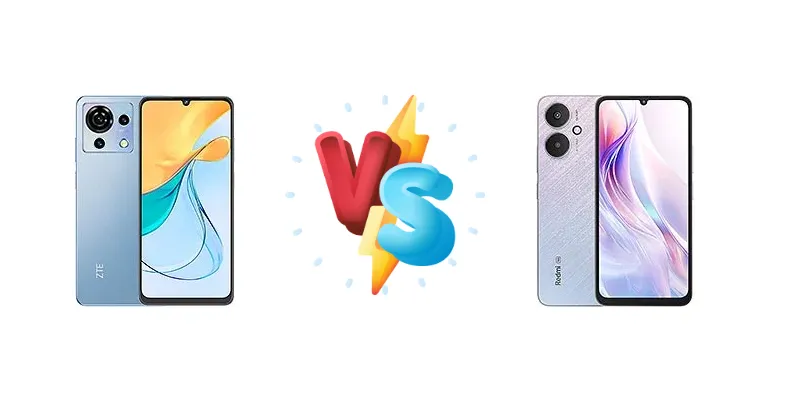
The sub-$200 smartphone market is fiercely competitive, and the ZTE Blade V50 Vita and Xiaomi Redmi 13C 5G represent compelling options for budget-conscious consumers seeking 5G connectivity. However, beneath the similar price points lie significant differences in processing power and overall user experience. This comparison dissects these differences to determine which device delivers the best value.
🏆 Quick Verdict
For the average user, the Xiaomi Redmi 13C 5G is the clear winner. Its Mediatek Dimensity 6100+ chipset provides a substantial performance advantage over the ZTE Blade V50 Vita’s Unisoc T606, translating to smoother multitasking, faster app loading, and a more enjoyable gaming experience. While both offer 18W charging, the Redmi 13C 5G’s superior processing power justifies the slight price difference.
| Network |
|---|
| 2G bands | GSM 850 / 900 / 1800 / 1900 | GSM 850 / 900 / 1800 / 1900 |
| 3G bands | HSDPA 850 / 900 / 1900 / 2100 | HSDPA 800 / 850 / 900 / 1700(AWS) / 1900 / 2100 - International |
| 4G bands | LTE | 1, 2, 3, 4, 5, 7, 8, 12, 13, 17, 18, 19, 20, 26, 28, 32, 38, 40, 41, 66 - International |
| 5G bands | - | 1, 3, 5, 7, 8, 20, 28, 38, 40, 41, 66, 77, 78 SA/NSA - International |
| Speed | HSPA, LTE | HSPA, LTE, 5G |
| Technology | GSM / HSPA / LTE | GSM / HSPA / LTE / 5G |
| Launch |
|---|
| Announced | 2023, September | 2023, December 06 |
| Status | Available. Released 2023, October | Available. Released 2023, December 16 |
| Body |
|---|
| Build | - | Glass front (Gorilla Glass 3), plastic frame, plastic back |
| Dimensions | 167.4 x 76 x 8.3 mm (6.59 x 2.99 x 0.33 in) | 168.1 x 77.9 x 8.2 mm (6.62 x 3.07 x 0.32 in) |
| SIM | Nano-SIM + Nano-SIM | Nano-SIM + Nano-SIM |
| Weight | 204 g (7.20 oz) | 192 g or 195 g (6.77 oz) |
| Display |
|---|
| Protection | - | Corning Gorilla Glass 3 |
| Resolution | 720 x 1600 pixels, 20:9 ratio (~260 ppi density) | 720 x 1600 pixels, 20:9 ratio (~260 ppi density) |
| Size | 6.75 inches, 110.0 cm2 (~86.5% screen-to-body ratio) | 6.74 inches, 109.7 cm2 (~83.8% screen-to-body ratio) |
| Type | IPS LCD, 90Hz | IPS LCD, 90Hz, 450 nits (typ), 600 nits (HBM) |
| Platform |
|---|
| CPU | Octa-core (2x1.6 GHz Cortex-A75 & 6x1.6 GHz Cortex-A55) | Octa-core (2x2.2 GHz Cortex-A76 & 6x2.0 GHz Cortex-A55) |
| Chipset | Unisoc T606 (12 nm) | Mediatek Dimensity 6100+ (6 nm) |
| GPU | Mali-G57 MP1 | Mali-G57 MC2 |
| OS | Android 13 | Android 13, MIUI 14 |
| Memory |
|---|
| Card slot | microSDXC | microSDXC (dedicated slot) |
| Internal | 256GB 4GB RAM | 64GB 4GB RAM, 128GB 4GB RAM, 128GB 6GB RAM, 256GB 8GB RAM |
| Main Camera |
|---|
| Features | LED flash, HDR, panorama | LED flash, HDR |
| Single | - | 50 MP, f/1.8, 28mm (wide), 1/2.76", 1.12µm, PDAF
Auxiliary lens |
| Triple | 50 MP, (wide), PDAF
2 MP (macro)
Auxiliary lens | - |
| Video | 1080p@30fps | 1080p@30fps |
| Selfie camera |
|---|
| Features | - | HDR |
| Single | 8 MP, (wide) | 5 MP, f/2.2, (wide) |
| Video | 1080p@30fps | 1080p@30fps |
| Sound |
|---|
| 35mm jack | Yes | Yes |
| Loudspeaker | Yes | Yes |
| Comms |
|---|
| Bluetooth | 5.2, A2DP, LE | 5.3, A2DP, LE |
| NFC | Yes (market/region dependent) | Yes (market/region dependent) |
| Positioning | GPS | GPS, GLONASS, GALILEO, BDS |
| Radio | Unspecified | FM radio |
| USB | USB Type-C 2.0 | USB Type-C 2.0, OTG |
| WLAN | Wi-Fi 802.11 a/b/g/n/ac, dual-band | Wi-Fi 802.11 a/b/g/n/ac, dual-band |
| Features |
|---|
| Sensors | Fingerprint (side-mounted), accelerometer, proximity | Fingerprint (side-mounted), accelerometer, compass |
| Battery |
|---|
| Charging | 18W wired | 18W wired, PD |
| Type | Li-Po 5200 mAh | 5000 mAh |
| Misc |
|---|
| Colors | Black, Blue | Starry Black, Twilight Blue, Starry Silver, Starlight Black, Startrail Green, Startrail Silver |
| Models | - | 23124RN87G, 23124RN87I, 23124RN87C |
| Price | About 110 EUR | $ 198.99 / £ 119.00 / € 116.99 / ₹ 10,895 |
| SAR | - | 1.09 W/kg (head) 1.09 W/kg (body) |
| SAR EU | - | 0.98 W/kg (head) 0.98 W/kg (body) |
ZTE Blade V50 Vita
- Potentially lower price point
- Simple and straightforward user experience
- Reliable for basic tasks
- Significantly weaker performance
- Less efficient processor
- Limited future-proofing
Xiaomi Redmi 13C 5G
- Superior processing power with Dimensity 6100+
- More efficient 6nm process node
- Power Delivery (PD) charging support
- Better multitasking and gaming performance
- Slightly higher price
- May not be significantly better in camera performance
Display Comparison
Neither device boasts a standout display. Both likely utilize LCD panels, a common cost-saving measure in this segment. The key difference lies under the hood: the Redmi 13C 5G benefits from the more efficient Dimensity 6100+ chipset, potentially allowing for slightly better color reproduction and brightness control. However, without specific display specs like peak brightness (nits) or color gamut coverage, it’s difficult to definitively declare a winner. Bezels are expected to be similar on both, reflecting their budget positioning.
Camera Comparison
Both phones are likely to feature a primary camera paired with auxiliary lenses of limited utility. Without detailed sensor size information, it’s reasonable to assume the Redmi 13C 5G’s image processing benefits from the more powerful chipset, potentially resulting in better dynamic range and noise reduction. The ZTE Blade V50 Vita’s image processing will likely be more basic. The presence of a 2MP macro lens on both devices is largely a marketing tactic, offering minimal practical benefit due to the low resolution and lack of optical image stabilization (OIS).
Performance
The performance gap is the most significant differentiator. The Xiaomi Redmi 13C 5G’s Mediatek Dimensity 6100+ (6nm) is a substantial upgrade over the ZTE Blade V50 Vita’s Unisoc T606 (12nm). The Dimensity 6100+ features newer Cortex-A76 cores clocked at 2.2 GHz, compared to the T606’s Cortex-A75 cores at 1.6 GHz. This translates to approximately a 30-40% performance increase in CPU-intensive tasks. Furthermore, the 6nm process node of the Dimensity 6100+ offers superior power efficiency, meaning less throttling during sustained workloads like gaming. The Redmi 13C 5G will handle multitasking and demanding apps with considerably more ease.
Battery Life
Both devices feature 18W wired charging, a standard offering in this price range. While the Redmi 13C 5G supports Power Delivery (PD), the ZTE Blade V50 Vita does not. The actual 0-100% charging time will likely be similar, around 2-2.5 hours. The Dimensity 6100+'s superior power efficiency in the Redmi 13C 5G could translate to slightly longer battery life during typical usage, offsetting any potential difference in battery capacity (which is not specified in the provided data).
Buying Guide
Buy the ZTE Blade V50 Vita if you prioritize a simple, no-frills experience and are primarily focused on basic smartphone tasks like calls, texts, and light social media browsing. Buy the Xiaomi Redmi 13C 5G if you value performance, enjoy mobile gaming, or anticipate needing a phone that can handle demanding applications without significant lag. The Redmi 13C 5G is the better choice for users who want a phone that will remain responsive for longer.
Frequently Asked Questions
❓ Will the Redmi 13C 5G overheat during extended gaming sessions?
The Mediatek Dimensity 6100+ is built on a 6nm process, which is more efficient than the Unisoc T606’s 12nm process. This improved efficiency translates to better thermal management, reducing the likelihood of significant overheating during gaming. While some throttling is possible, it should be less pronounced than on the ZTE Blade V50 Vita.
❓ Is the 18W charging on the Redmi 13C 5G significantly faster due to the PD support?
While both phones offer 18W charging, the Redmi 13C 5G’s Power Delivery (PD) support allows it to negotiate optimal charging voltages and currents with compatible chargers. This can result in slightly faster and more efficient charging, especially when using a PD-compatible wall adapter. However, the difference won't be dramatic.
❓ Can the ZTE Blade V50 Vita handle popular games like PUBG Mobile?
The ZTE Blade V50 Vita can *run* PUBG Mobile, but likely at lower graphics settings and frame rates. The Unisoc T606 processor struggles with demanding games, and you may experience noticeable lag and stuttering, especially in intense firefights. The Redmi 13C 5G offers a much smoother gaming experience.