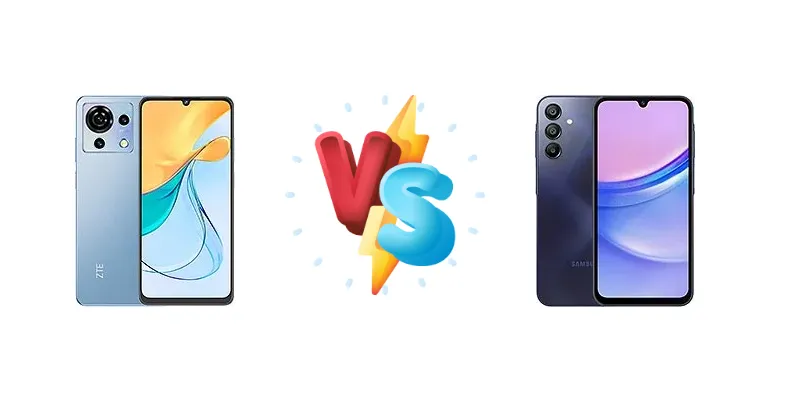
The sub-$200 smartphone market is fiercely competitive. The ZTE Blade V50 Vita and Samsung Galaxy A15 both aim to deliver essential smartphone functionality at an accessible price point. However, they take different approaches – ZTE focuses on a lower entry cost, while Samsung prioritizes a more refined user experience and longer battery life. This comparison dissects their key specifications to determine which device offers the best overall value.
🏆 Quick Verdict
For the average user prioritizing battery life and a brighter, more usable display, the Samsung Galaxy A15 is the clear winner. Its Mediatek Helio G99 chipset and 15:28h active use battery score significantly outperform the ZTE Blade V50 Vita, despite the latter’s lower price.
| Network |
|---|
| 2G bands | GSM 850 / 900 / 1800 / 1900 | GSM 850 / 900 / 1800 / 1900 |
| 3G bands | HSDPA 850 / 900 / 1900 / 2100 | HSDPA 850 / 900 / 2100 |
| 4G bands | LTE | 1, 3, 5, 7, 8, 20, 28, 38, 40, 41 |
| Speed | HSPA, LTE | HSPA, LTE |
| Technology | GSM / HSPA / LTE | GSM / HSPA / LTE |
| Launch |
|---|
| Announced | 2023, September | 2023, December 11 |
| Status | Available. Released 2023, October | Available. Released 2023, December 16 |
| Body |
|---|
| Build | - | Glass front, plastic back, plastic frame |
| Dimensions | 167.4 x 76 x 8.3 mm (6.59 x 2.99 x 0.33 in) | 160.1 x 76.8 x 8.4 mm (6.30 x 3.02 x 0.33 in) |
| SIM | Nano-SIM + Nano-SIM | · Nano-SIM· Nano-SIM + Nano-SIM |
| Weight | 204 g (7.20 oz) | 200 g (7.05 oz) |
| Display |
|---|
| Resolution | 720 x 1600 pixels, 20:9 ratio (~260 ppi density) | 1080 x 2340 pixels, 19.5:9 ratio (~396 ppi density) |
| Size | 6.75 inches, 110.0 cm2 (~86.5% screen-to-body ratio) | 6.5 inches, 103.7 cm2 (~84.3% screen-to-body ratio) |
| Type | IPS LCD, 90Hz | Super AMOLED, 90Hz, 800 nits (HBM) |
| Platform |
|---|
| CPU | Octa-core (2x1.6 GHz Cortex-A75 & 6x1.6 GHz Cortex-A55) | Octa-core (2x2.2 GHz Cortex-A76 & 6x2.0 GHz Cortex-A55) |
| Chipset | Unisoc T606 (12 nm) | Mediatek Helio G99 (6 nm) |
| GPU | Mali-G57 MP1 | Mali-G57 MC2 |
| OS | Android 13 | Android 14, up to 4 major Android upgrades, One UI 7 |
| Memory |
|---|
| Card slot | microSDXC | microSDXC (uses shared SIM slot) |
| Internal | 256GB 4GB RAM | 128GB 4GB RAM, 128GB 6GB RAM, 128GB 8GB RAM, 256GB 6GB RAM, 256GB 8GB RAM |
| Main Camera |
|---|
| Features | LED flash, HDR, panorama | LED flash, panorama, HDR |
| Triple | 50 MP, (wide), PDAF
2 MP (macro)
Auxiliary lens | 50 MP, f/1.8, 26mm (wide), 1/2.8", 0.64µm, PDAF
5 MP, f/2.2, 17mm (ultrawide), 1/5.0", 1.12µm
2 MP (macro) |
| Video | 1080p@30fps | 1080p@30fps |
| Selfie camera |
|---|
| Single | 8 MP, (wide) | 13 MP, f/2.0, 26mm (wide), 1/3.06", 1.12µm |
| Video | 1080p@30fps | 1080p@30fps |
| Sound |
|---|
| 35mm jack | Yes | Yes |
| Loudspeaker | Yes | Yes |
| Comms |
|---|
| Bluetooth | 5.2, A2DP, LE | 5.3, A2DP, LE |
| NFC | Yes (market/region dependent) | Yes (market/region dependent) |
| Positioning | GPS | GPS, GALILEO, GLONASS, BDS, QZSS |
| Radio | Unspecified | FM radio (market/region dependent) |
| USB | USB Type-C 2.0 | USB Type-C 2.0 |
| WLAN | Wi-Fi 802.11 a/b/g/n/ac, dual-band | Wi-Fi 802.11 a/b/g/n/ac, dual-band, Wi-Fi Direct |
| Features |
|---|
| Sensors | Fingerprint (side-mounted), accelerometer, proximity | Fingerprint (side-mounted), accelerometer, compass |
| Battery |
|---|
| Charging | 18W wired | 25W wired |
| Type | Li-Po 5200 mAh | 5000 mAh |
| Misc |
|---|
| Colors | Black, Blue | Brave Black, Optimistic Blue, Magical Blue, Personality Yellow |
| Models | - | SM-A155F, SM-A155F/DSN, SM-A155M, SM-A155M/DS, SM-A155P, SM-A155R |
| Price | About 110 EUR | € 168.99 / $ 125.00 / £ 113.00 |
| SAR EU | - | 0.42 W/kg (head) 1.29 W/kg (body) |
ZTE Blade V50 Vita
- Lowest possible price point
- Functional for basic smartphone tasks
- Acceptable for light usage
- Inferior performance compared to the A15
- Likely lower display quality
- Shorter battery life
Samsung Galaxy A15
- Significantly better performance with Helio G99
- Brighter and more vibrant display (808 nits)
- Excellent battery life (15:28h active use)
- Faster 25W charging
- Higher price than the ZTE Blade V50 Vita
- May still lack advanced features found in higher-end phones
- Software updates may be slower than flagship Samsung devices
Display Comparison
The Samsung Galaxy A15 boasts a substantial advantage in display quality, achieving a measured peak brightness of 808 nits. This is crucial for outdoor visibility, a common pain point in this price segment. While the ZTE Blade V50 Vita’s display specifications are not provided, it’s reasonable to assume it falls significantly below this level given its price point. The A15’s higher brightness translates to a more comfortable viewing experience in direct sunlight. We can infer that the A15 likely uses a more advanced panel technology, offering better color accuracy and viewing angles.
Camera Comparison
Without detailed camera specifications for the ZTE Blade V50 Vita, a direct comparison is limited. However, given the price bracket, it’s likely the A15 offers a more refined camera experience. Samsung typically invests in image processing algorithms that enhance photo quality, even with modest hardware. The A15’s main sensor size and aperture are critical factors, but without that data, we can only assume it’s superior to the ZTE’s offering. It’s safe to ignore the presence of 2MP macro cameras on either device, as their image quality is generally poor.
Performance
The Mediatek Helio G99 in the Samsung Galaxy A15, fabricated on a 6nm process, represents a significant leap in efficiency and performance compared to the Unisoc T606 (12nm) found in the ZTE Blade V50 Vita. The Helio G99’s Cortex-A76 cores, clocked at 2.2 GHz, offer a noticeable performance boost over the A75 cores in the ZTE device, especially in demanding applications and multitasking. The 6nm process also contributes to better thermal management, reducing the likelihood of performance throttling during extended use. While both are octa-core CPUs, the architectural differences and fabrication process give the A15 a clear edge.
Battery Life
The Samsung Galaxy A15’s 15:28h active use battery score is a standout feature. This demonstrates a significant advantage in real-world endurance compared to what we’d expect from the ZTE Blade V50 Vita. While the ZTE offers 18W wired charging, the A15’s 25W charging provides a faster top-up, reducing downtime. The combination of a more efficient chipset (Helio G99) and optimized software likely contributes to the A15’s superior battery performance, making it ideal for users who rely heavily on their smartphones throughout the day.
Buying Guide
Buy the ZTE Blade V50 Vita if you absolutely need the lowest possible upfront cost and are willing to compromise on performance and display quality. It’s a functional device for basic tasks. Buy the Samsung Galaxy A15 if you prioritize a smoother user experience, a brighter and more vibrant display, and significantly longer battery life, even if it means spending a bit more.
Frequently Asked Questions
❓ Does the Mediatek Helio G99 in the Galaxy A15 get noticeably warm during prolonged gaming sessions?
The Helio G99’s 6nm process and Samsung’s thermal management are generally effective. While some warmth is expected during intensive gaming, it’s unlikely to reach throttling temperatures, providing a consistently smooth experience for most mobile games. The Unisoc T606 in the ZTE Blade V50 Vita is more prone to throttling due to its less efficient 12nm process.
❓ Is the 25W charging on the Galaxy A15 a significant improvement over the 18W charging on the ZTE Blade V50 Vita?
Yes, the 25W charging on the Galaxy A15 will noticeably reduce charging times. While exact 0-100% times aren’t provided, the higher wattage translates to a faster top-up, minimizing downtime and keeping you connected for longer. The 18W charging on the ZTE Blade V50 Vita will take considerably longer to fully charge the device.
❓ How does the software experience differ between the ZTE Blade V50 Vita and the Samsung Galaxy A15?
Samsung’s One UI offers a more polished and feature-rich software experience compared to the typically more basic software found on ZTE devices. Samsung also generally provides more consistent software updates and security patches, ensuring a more secure and up-to-date device.