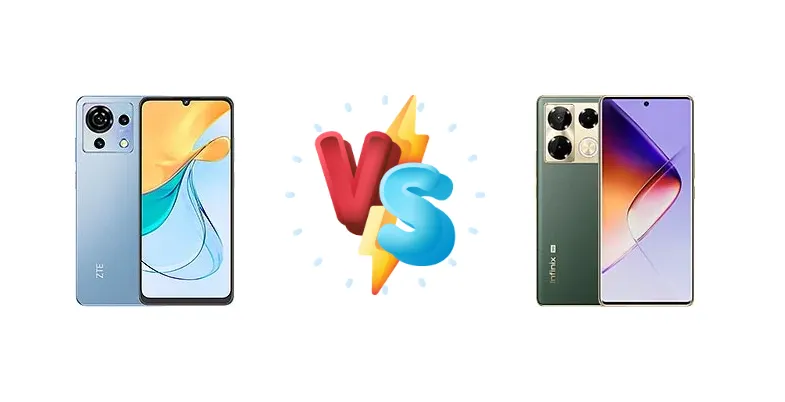
The sub-$200 smartphone market is fiercely competitive. The ZTE Blade V50 Vita and Infinix Note 40 Pro both aim to deliver a compelling experience without breaking the bank, but they take drastically different approaches. The ZTE focuses on affordability, while the Infinix pushes the boundaries of charging technology and processing power within this price bracket. This comparison dissects their key differences to help you choose the right device.
🏆 Quick Verdict
For most users, the Infinix Note 40 Pro is the superior choice. Its Mediatek Dimensity 7020 chipset offers significantly better performance than the Unisoc T606 in the ZTE Blade V50 Vita, and the inclusion of 45W wired and 20W wireless charging, including MagCharge, provides a level of convenience the ZTE simply can't match. While the ZTE is cheaper, the performance gap justifies the price difference.
| Network |
|---|
| 2G bands | GSM 850 / 900 / 1800 / 1900 | GSM 850 / 900 / 1800 / 1900 |
| 3G bands | HSDPA 850 / 900 / 1900 / 2100 | HSDPA 850 / 900 / 1700(AWS) / 1900 / 2100 |
| 4G bands | LTE | 1, 2, 3, 4, 5, 7, 8, 12, 17, 20, 28, 38, 40, 41, 42, 66 |
| 5G bands | - | 1, 3, 5, 7, 8, 12, 20, 28, 38, 40, 41, 66, 77, 78 SA/NSA |
| Speed | HSPA, LTE | HSPA, LTE, 5G |
| Technology | GSM / HSPA / LTE | GSM / HSPA / LTE / 5G |
| Launch |
|---|
| Announced | 2023, September | 2024, March 18 |
| Status | Available. Released 2023, October | Available. Released 2024, March 19 |
| Body |
|---|
| Dimensions | 167.4 x 76 x 8.3 mm (6.59 x 2.99 x 0.33 in) | 164.3 x 74.5 x 8.1 mm (6.47 x 2.93 x 0.32 in) |
| SIM | Nano-SIM + Nano-SIM | Nano-SIM + Nano-SIM |
| Weight | 204 g (7.20 oz) | 190 g or 196 g (6.70 oz) |
| Display |
|---|
| Protection | - | Corning Gorilla Glass |
| Resolution | 720 x 1600 pixels, 20:9 ratio (~260 ppi density) | 1080 x 2436 pixels (~393 ppi density) |
| Size | 6.75 inches, 110.0 cm2 (~86.5% screen-to-body ratio) | 6.78 inches, 109.9 cm2 (~89.8% screen-to-body ratio) |
| Type | IPS LCD, 90Hz | AMOLED, 1B colors, 120Hz, 2160Hz PWM, 1300 nits (peak) |
| Platform |
|---|
| CPU | Octa-core (2x1.6 GHz Cortex-A75 & 6x1.6 GHz Cortex-A55) | Octa-core (2x2.2 GHz Cortex-A78 & 6x2.0 GHz Cortex-A55) |
| Chipset | Unisoc T606 (12 nm) | Mediatek Dimensity 7020 (6 nm) |
| GPU | Mali-G57 MP1 | IMG BXM-8-256 |
| OS | Android 13 | Android 14, XOS 14 |
| Memory |
|---|
| Card slot | microSDXC | Unspecified |
| Internal | 256GB 4GB RAM | 256GB 8GB RAM |
| Main Camera |
|---|
| Features | LED flash, HDR, panorama | Dual-LED flash, HDR, panorama |
| Triple | 50 MP, (wide), PDAF
2 MP (macro)
Auxiliary lens | 108 MP, f/1.8, (wide), PDAF, OIS
2 MP, f/2.4
2 MP, f/2.4 |
| Video | 1080p@30fps | 1440p@30fps, 1080p@30/60fps |
| Selfie camera |
|---|
| Features | - | Dual-LED flash |
| Single | 8 MP, (wide) | 32 MP, f/2.2, (wide), 1/3.1" |
| Video | 1080p@30fps | 1080p@30fps |
| Sound |
|---|
| 35mm jack | Yes | No |
| Loudspeaker | Yes | Yes, with stereo speakers |
| Comms |
|---|
| Bluetooth | 5.2, A2DP, LE | Yes |
| Infrared port | - | Yes |
| NFC | Yes (market/region dependent) | Yes (market/region dependent) |
| Positioning | GPS | GPS |
| Radio | Unspecified | FM radio |
| USB | USB Type-C 2.0 | USB Type-C 2.0, OTG |
| WLAN | Wi-Fi 802.11 a/b/g/n/ac, dual-band | Wi-Fi 802.11 a/b/g/n/ac, dual-band |
| Features |
|---|
| Sensors | Fingerprint (side-mounted), accelerometer, proximity | Fingerprint (under display, optical), accelerometer, gyro, proximity, compass |
| Battery |
|---|
| Charging | 18W wired | 45W wired, 50% in 26 min
20W wireless MagCharge
Reverse wired
Reverse wireless |
| Type | Li-Po 5200 mAh | 5000 mAh |
| Misc |
|---|
| Colors | Black, Blue | Vintage Green, Titan Gold, Racing Edition |
| Models | - | X6851 |
| Price | About 110 EUR | About 280 EUR |
ZTE Blade V50 Vita
- Most affordable option
- Simple and straightforward user experience
- Acceptable for basic tasks
- Significantly weaker performance
- Slow charging speed
- Likely lower quality display
Infinix Note 40 Pro
- Superior performance with Dimensity 7020
- 45W fast wired charging and 20W wireless MagCharge
- More future-proof and capable
- Higher price point
- May still lack some premium features
- Software experience can be inconsistent
Display Comparison
Neither device boasts a flagship-level display. However, the lack of detailed display specs for the ZTE Blade V50 Vita suggests a standard LCD panel. The Infinix Note 40 Pro, while also likely LCD, benefits from the more powerful Dimensity 7020’s image signal processor, potentially leading to better color reproduction and image clarity. The absence of high refresh rates on either device is expected at this price point, but the Infinix’s processing power could allow for smoother animations overall.
Camera Comparison
Without detailed camera specifications for either device, a direct comparison is difficult. However, the Infinix Note 40 Pro’s more powerful chipset allows for more sophisticated image processing algorithms. This means better noise reduction, dynamic range, and overall image quality, even with similar sensor sizes. The ZTE Blade V50 Vita will likely rely on software optimizations to compensate for its weaker processing power, but it will struggle to match the Infinix’s capabilities in challenging lighting conditions. The prevalence of 2MP macro lenses on both devices suggests they are largely marketing features and offer limited practical benefit.
Performance
The performance disparity is the most significant difference. The Infinix Note 40 Pro’s Mediatek Dimensity 7020, built on a 6nm process, is a substantial upgrade over the ZTE Blade V50 Vita’s Unisoc T606 (12nm). The Dimensity 7020 utilizes two Cortex-A78 cores clocked at 2.2 GHz, offering a significant performance boost over the ZTE’s Cortex-A75 cores at 1.6 GHz. This translates to faster app loading times, smoother multitasking, and a more enjoyable gaming experience on the Infinix. The 6nm node also contributes to better thermal efficiency, reducing the likelihood of throttling during sustained workloads.
Battery Life
The Infinix Note 40 Pro’s charging capabilities are a standout feature. 45W wired charging can replenish the battery to 50% in just 26 minutes, a significant advantage over the ZTE Blade V50 Vita’s 18W charging. Furthermore, the inclusion of 20W wireless MagCharge adds a layer of convenience, allowing for cable-free charging. While battery capacity isn’t specified, the Dimensity 7020’s improved power efficiency could offset any potential capacity difference, resulting in comparable real-world battery life despite the faster charging speeds.
Buying Guide
Buy the ZTE Blade V50 Vita if you prioritize absolute affordability and only need a phone for basic tasks like calls, messaging, and light social media. It's a suitable option for first-time smartphone users or those on a very tight budget. Buy the Infinix Note 40 Pro if you value performance for gaming and multitasking, appreciate fast charging capabilities (wired and wireless), and want a more future-proof device that can handle demanding applications.
Frequently Asked Questions
❓ Does the Mediatek Dimensity 7020 in the Infinix Note 40 Pro get hot during extended gaming sessions?
The Dimensity 7020 is built on a 6nm process, which is more efficient than the 12nm Unisoc T606 in the ZTE Blade V50 Vita. This means it generates less heat under load. While some warming is expected during prolonged gaming, the Infinix Note 40 Pro is less likely to experience significant throttling compared to the ZTE, providing a more consistent gaming experience.
❓ Is the MagCharge feature on the Infinix Note 40 Pro compatible with all magnetic wireless chargers?
The Infinix Note 40 Pro utilizes the MagCharge standard, which is based on the Qi wireless charging protocol but with magnetic alignment. While it's designed to work seamlessly with Infinix's own MagCharge accessories, compatibility with third-party magnetic wireless chargers can vary. It's best to check the charger's specifications to ensure it supports MagSafe or MagCharge compatibility for optimal alignment and charging speeds.
❓ How does the Unisoc T606 handle multitasking compared to the Dimensity 7020?
The Unisoc T606, with its older architecture and lower clock speeds, will struggle with demanding multitasking scenarios. Switching between apps will be noticeably slower, and running multiple apps simultaneously may lead to lag. The Dimensity 7020, with its more powerful cores and efficient design, handles multitasking with ease, allowing for a smoother and more responsive user experience.