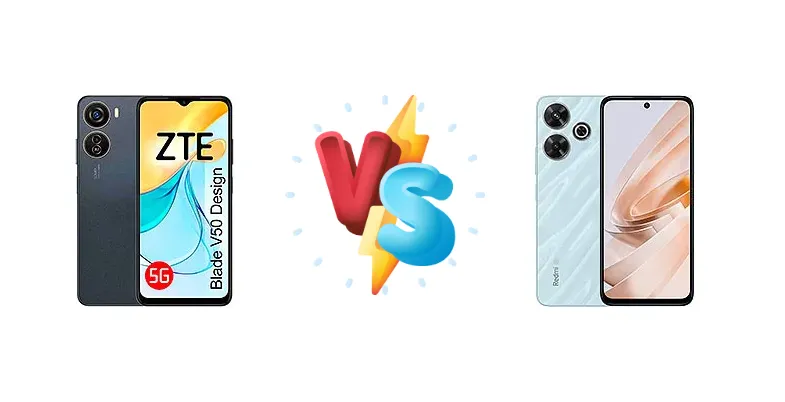
The sub-$200 smartphone market is fiercely competitive. The ZTE Blade V50 Design and Xiaomi Redmi Note 13R both aim to deliver essential features at an accessible price point, but they take different approaches to achieving this. The ZTE focuses on a potentially lower entry price, while the Redmi Note 13R leverages Qualcomm's latest entry-level silicon for a performance boost. This comparison dissects the key differences to help you choose the right device.
🏆 Quick Verdict
For most users, the Xiaomi Redmi Note 13R is the better choice. Its Snapdragon 4+ Gen 2 chipset, built on a more efficient 4nm process, provides a noticeable performance advantage over the ZTE Blade V50 Design’s Unisoc T760. The faster 33W charging is also a significant benefit, offsetting the slightly smaller potential battery capacity.
| Network |
|---|
| 2G bands | GSM 850 / 900 / 1800 / 1900 | GSM 850 / 900 / 1800 / 1900 |
| 3G bands | HSDPA 850 / 900 / 1900 / 2100 | HSDPA 850 / 900 / 2100 |
| 4G bands | LTE | 1, 3, 5, 8, 34, 38, 39, 40, 41 |
| 5G bands | SA/NSA | 1, 5, 8, 28, 41, 78 SA/NSA |
| Speed | HSPA, LTE, 5G | HSPA, LTE, 5G |
| Technology | GSM / HSPA / LTE / 5G | GSM / CDMA / HSPA / EVDO / LTE / 5G |
| Launch |
|---|
| Announced | 2023, July 20 | 2024, May 17 |
| Status | Available. Released 2023, August | Available. Released 2024, May 17 |
| Body |
|---|
| Build | - | Glass front, plastic frame, glass back |
| Dimensions | 8.0 mm thickness | 168.6 x 76.3 x 8.2 mm (6.64 x 3.00 x 0.32 in) |
| SIM | Nano-SIM + Nano-SIM | Nano-SIM + Nano-SIM |
| Weight | - | 205 g (7.23 oz) |
| Display |
|---|
| Resolution | 1080 x 2408 pixels, 20:9 ratio (~400 ppi density) | 1080 x 2460 pixels (~396 ppi density) |
| Size | 6.6 inches, 104.9 cm2 | 6.79 inches, 109.5 cm2 (~85.1% screen-to-body ratio) |
| Type | IPS LCD, 90Hz | IPS LCD, 120Hz, 550 nits |
| Platform |
|---|
| CPU | Octa-core (1x2.2 GHz Cortex-A76 & 3x Cortex-A76 & 4x Cortex-A55) | Octa-core (2x2.3 GHz Cortex-A78 & 6x1.95 GHz Cortex-A55) |
| Chipset | Unisoc T760 (6 nm) | Qualcomm SM4450 Snapdragon 4+ Gen 2 (4 nm) |
| GPU | Mali-G57 | Adreno 613 |
| OS | Android 13 | Android 14, HyperOS |
| Memory |
|---|
| Card slot | No | No |
| Internal | 128GB 4GB RAM | 128GB 6GB RAM, 128GB 8GB RAM, 256GB 8GB RAM, 256GB 12GB RAM, 512GB 12GB RAM |
| Main Camera |
|---|
| Dual | 50 MP, f/1.8, (wide), PDAF
Auxiliary lens | 50 MP, f/1.8, (wide), 1/2.76", 0.64µm, PDAF
2 MP (macro) |
| Features | LED flash, HDR, panorama | LED flash, HDR |
| Video | 1080p@30fps | 1080p@30fps |
| Selfie camera |
|---|
| Single | 8 MP, (wide) | 8 MP, (wide), 1/4.0", 1.12µm |
| Video | 1080p@30fps | 1080p@30fps |
| Sound |
|---|
| 35mm jack | Yes | Yes |
| Loudspeaker | Yes | Yes |
| Comms |
|---|
| Bluetooth | Yes | 5.3, A2DP, LE |
| Infrared port | - | Yes |
| NFC | Yes | Yes |
| Positioning | GPS | GPS, GLONASS, GALILEO, BDS |
| Radio | Unspecified | No |
| USB | USB Type-C 2.0 | USB Type-C |
| WLAN | Yes | Wi-Fi 802.11 a/b/g/n/ac, dual-band |
| Features |
|---|
| Sensors | Fingerprint (side-mounted), accelerometer, proximity | Fingerprint (side-mounted), accelerometer, compass |
| Battery |
|---|
| Charging | 22.5W wired | 33W wired |
| Type | Li-Po 4500 mAh | 5030 mAh |
| Misc |
|---|
| Colors | Sky Blue, Starry Gray, Gray Matt | Black, Blue, Silver |
| Models | - | 2406ERN9CC |
| Price | About 200 EUR | About 180 EUR |
ZTE Blade V50 Design
- Potentially lower price point
- Acceptable performance for basic tasks
- Decent battery life for light users
- Less powerful Unisoc T760 chipset
- Slower 22.5W charging
- Likely inferior camera performance
Xiaomi Redmi Note 13R
- More powerful Snapdragon 4+ Gen 2 chipset
- Faster 33W charging
- Improved power efficiency
- Slightly higher price
- May not have a significantly larger battery
- Still a budget device with inherent limitations
Display Comparison
Neither device boasts a standout display. While specific panel details (like peak brightness or color gamut coverage) are unavailable, the focus here is on core functionality. Both will likely feature LCD panels typical of this price bracket. The absence of high refresh rates is expected. The real difference will likely come down to color calibration and viewing angles, areas where Xiaomi generally performs slightly better due to its more mature display tuning processes.
Camera Comparison
Without detailed camera specs, a direct comparison is difficult. However, both phones will likely feature a primary camera and potentially a depth or macro sensor. Given Xiaomi’s history, the Redmi Note 13R is likely to have more sophisticated image processing algorithms, resulting in better dynamic range and detail in photos. The Unisoc T760’s ISP capabilities are less well-documented, suggesting the ZTE Blade V50 Design may struggle in low-light conditions. Expect both to offer acceptable results for casual photography, but the Redmi Note 13R is the likely winner.
Performance
The core differentiator lies in the chipsets. The Xiaomi Redmi Note 13R’s Qualcomm Snapdragon 4+ Gen 2 (4nm) is a clear upgrade over the ZTE Blade V50 Design’s Unisoc T760 (6nm). The 4nm process node translates to improved power efficiency and thermal management, meaning the Redmi Note 13R is less likely to throttle under sustained load. The Snapdragon’s CPU configuration – 2x2.3 GHz Cortex-A78 & 6x1.95 GHz Cortex-A55 – also offers a more potent combination of performance and efficiency compared to the Unisoc’s Octa-core setup (1x2.2 GHz Cortex-A76 & 3x Cortex-A76 & 4x Cortex-A55). This will be most noticeable in app loading times, multitasking, and light gaming. The Redmi Note 13R will likely handle more demanding titles with greater stability.
Battery Life
The ZTE Blade V50 Design supports 22.5W wired charging, while the Xiaomi Redmi Note 13R steps up to 33W. This faster charging speed will significantly reduce the time it takes to replenish the battery. While battery capacity isn’t specified, the Snapdragon 4+ Gen 2’s efficiency means the Redmi Note 13R can likely achieve comparable or even better battery life with a slightly smaller battery. The 33W charging on the Redmi Note 13R translates to a more convenient user experience, especially for those who frequently top up their phones throughout the day.
Buying Guide
Buy the ZTE Blade V50 Design if your primary concern is minimizing upfront cost and you primarily use your phone for basic tasks like calls, messaging, and light social media. Buy the Xiaomi Redmi Note 13R if you prioritize smoother multitasking, occasional gaming, and faster charging, even if it means spending a little more.
Frequently Asked Questions
❓ Will the Unisoc T760 in the ZTE Blade V50 Design struggle with multitasking?
The Unisoc T760 is capable of handling basic multitasking, but it will likely show signs of slowdown with numerous apps open simultaneously. The Redmi Note 13R’s Snapdragon 4+ Gen 2 offers significantly better multitasking performance due to its more efficient architecture and higher clock speeds.
❓ How long will it take to fully charge the Xiaomi Redmi Note 13R with the 33W charger?
While a precise time requires testing, the Redmi Note 13R’s 33W charging should fully charge the battery in approximately 60-75 minutes, depending on the battery capacity. This is considerably faster than the ZTE Blade V50 Design’s 22.5W charging.
❓ Is the Snapdragon 4+ Gen 2 in the Redmi Note 13R capable of playing popular mobile games?
The Snapdragon 4+ Gen 2 can handle many popular mobile games at medium settings. While it won't deliver a flagship gaming experience, it provides a playable experience for titles like PUBG Mobile and Call of Duty Mobile, with better stability than the Unisoc T760.