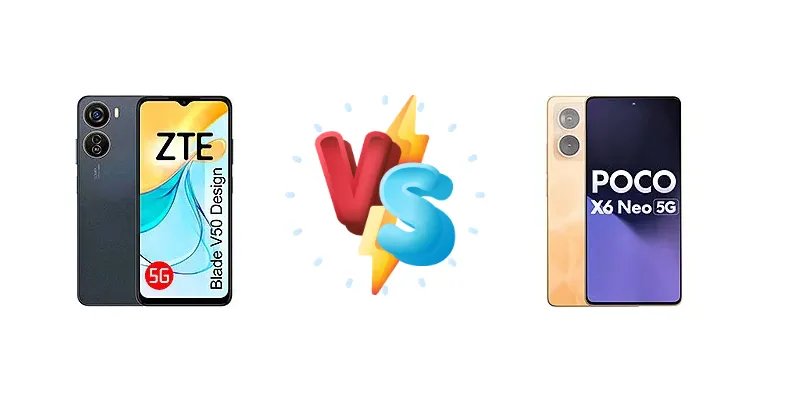
The sub-$200 smartphone market is fiercely competitive. The ZTE Blade V50 Design and Xiaomi Poco X6 Neo both aim to deliver essential features at an accessible price point, but they take different approaches. The Poco X6 Neo prioritizes processing power and charging speed, while the ZTE Blade V50 Design focuses on a balanced, if less flashy, experience. This comparison dissects their key differences to help you choose the right device.
🏆 Quick Verdict
For most users, the Xiaomi Poco X6 Neo is the better buy. Its Mediatek Dimensity 6080 chipset provides a noticeable performance uplift over the ZTE Blade V50 Design’s Unisoc T760, and the 33W charging significantly reduces downtime. While the ZTE offers a respectable experience, the Poco’s extra power justifies the potentially slight price premium.
| Network |
|---|
| 2G bands | GSM 850 / 900 / 1800 / 1900 | GSM 850 / 900 / 1800 / 1900 |
| 3G bands | HSDPA 850 / 900 / 1900 / 2100 | HSDPA 850 / 900 / 2100 |
| 4G bands | LTE | 1, 3, 5, 8, 28, 40, 41 |
| 5G bands | SA/NSA | 1, 3, 5, 8, 28, 40, 78 SA/NSA |
| Speed | HSPA, LTE, 5G | HSPA, LTE, 5G |
| Technology | GSM / HSPA / LTE / 5G | GSM / HSPA / LTE / 5G |
| Launch |
|---|
| Announced | 2023, July 20 | 2024, March 13 |
| Status | Available. Released 2023, August | Available. Released 2024, March 13 |
| Body |
|---|
| Build | - | Glass front (Gorilla Glass 5), plastic frame, plastic back |
| Dimensions | 8.0 mm thickness | 161.1 x 75 x 7.7 mm (6.34 x 2.95 x 0.30 in) |
| SIM | Nano-SIM + Nano-SIM | Nano-SIM + Nano-SIM |
| Weight | - | 175 g (6.17 oz) |
| Display |
|---|
| Protection | - | Corning Gorilla Glass 5 |
| Resolution | 1080 x 2408 pixels, 20:9 ratio (~400 ppi density) | 1080 x 2400 pixels, 20:9 ratio (~395 ppi density) |
| Size | 6.6 inches, 104.9 cm2 | 6.67 inches, 107.4 cm2 (~88.9% screen-to-body ratio) |
| Type | IPS LCD, 90Hz | AMOLED, 1B colors, 120Hz, 1000 nits (peak) |
| Platform |
|---|
| CPU | Octa-core (1x2.2 GHz Cortex-A76 & 3x Cortex-A76 & 4x Cortex-A55) | Octa-core (2x2.4 GHz Cortex-A76 & 6x2.0 GHz Cortex-A55) |
| Chipset | Unisoc T760 (6 nm) | Mediatek Dimensity 6080 (6 nm) |
| GPU | Mali-G57 | Mali-G57 MC2 |
| OS | Android 13 | Android 13 |
| Memory |
|---|
| Card slot | No | microSDXC (uses shared SIM slot) |
| Internal | 128GB 4GB RAM | 128GB 8GB RAM, 256GB 12GB RAM |
| Main Camera |
|---|
| Dual | 50 MP, f/1.8, (wide), PDAF
Auxiliary lens | 108 MP, f/1.8, (wide), 0.64µm, PDAF
Auxiliary lens |
| Features | LED flash, HDR, panorama | LED flash, HDR, panorama |
| Video | 1080p@30fps | 1080p@30fps |
| Selfie camera |
|---|
| Features | - | HDR |
| Single | 8 MP, (wide) | 16 MP, (wide) |
| Video | 1080p@30fps | 1080p@30fps |
| Sound |
|---|
| 35mm jack | Yes | Yes |
| Loudspeaker | Yes | Yes |
| Comms |
|---|
| Bluetooth | Yes | 5.3, A2DP, LE |
| Infrared port | - | Yes |
| NFC | Yes | No |
| Positioning | GPS | GPS, GLONASS, GALILEO, BDS |
| Radio | Unspecified | FM radio |
| USB | USB Type-C 2.0 | USB Type-C 2.0, OTG |
| WLAN | Yes | Wi-Fi 802.11 a/b/g/n/ac, dual-band |
| Features |
|---|
| Sensors | Fingerprint (side-mounted), accelerometer, proximity | Fingerprint (side-mounted), accelerometer, gyro, proximity, compass |
| Battery |
|---|
| Charging | 22.5W wired | 33W wired |
| Type | Li-Po 4500 mAh | Li-Po 5000 mAh |
| Misc |
|---|
| Colors | Sky Blue, Starry Gray, Gray Matt | Astral Black, Horizon Blue, Martian Orange |
| Models | - | MZB0GGWIN, 2312FRAFDI |
| Price | About 200 EUR | ₹ 18,990 |
| SAR | - | 0.85 W/kg (head) 0.71 W/kg (body) |
ZTE Blade V50 Design
- Potentially more affordable price point
- Stable performance for basic tasks
- Efficient 6nm Unisoc T760 chipset
- Slower charging speed (22.5W)
- Less powerful processor for gaming and multitasking
Xiaomi Poco X6 Neo
- Faster charging (33W)
- More powerful Mediatek Dimensity 6080 processor
- Improved gaming and multitasking performance
- May be slightly more expensive
- Potentially slightly less battery life due to higher performance
Display Comparison
Neither device boasts a standout display. Both utilize 6nm chipsets, suggesting a similar focus on efficiency over pushing display boundaries. While specific display specs (resolution, panel type) are missing, the focus here is on processing power. Bezels are likely comparable given the price bracket, and color accuracy will be standard for this segment – adequate but not color-critical.
Camera Comparison
Without detailed camera specifications, a direct comparison is difficult. However, given the price point, both phones likely feature a primary camera supplemented by basic depth or macro sensors. The absence of OIS on either device suggests image stabilization will rely heavily on software processing. The Poco X6 Neo, benefiting from its more powerful chipset, likely has an edge in image processing speed and quality, potentially delivering sharper images and better low-light performance. The ZTE Blade V50 Design will likely offer acceptable results in good lighting conditions, but may struggle in challenging scenarios.
Performance
The Xiaomi Poco X6 Neo’s Mediatek Dimensity 6080 is the clear performance winner. Its octa-core configuration with 2x2.4 GHz Cortex-A76 cores provides a significant advantage over the ZTE Blade V50 Design’s Unisoc T760, which features 1x2.2 GHz Cortex-A76 and 3x Cortex-A76 cores. The Dimensity 6080’s higher clock speeds translate to faster app loading, smoother multitasking, and improved gaming performance. The Unisoc T760, while capable, will likely exhibit more noticeable slowdowns under heavy load. The 6nm process node is shared, meaning thermal efficiency should be similar, but the Dimensity 6080’s superior architecture will still deliver more sustained performance.
Battery Life
The Xiaomi Poco X6 Neo’s 33W wired charging is a significant advantage over the ZTE Blade V50 Design’s 22.5W charging. This translates to a substantially faster 0-100% charge time, minimizing downtime. While battery capacity isn’t specified, the faster charging speed of the Poco X6 Neo effectively mitigates any potential disadvantage from a slightly smaller battery. Users who frequently find themselves needing to top up their phone will greatly benefit from the Poco’s faster charging capabilities.
Buying Guide
Buy the ZTE Blade V50 Design if you prioritize a consistently stable experience for basic tasks like calling, texting, and light social media use, and are less concerned with demanding games or rapid charging. Buy the Xiaomi Poco X6 Neo if you want a phone capable of handling moderate gaming, streaming, and multitasking, and value the convenience of faster charging for a more dynamic lifestyle.
Frequently Asked Questions
❓ Will the Poco X6 Neo handle demanding games like Genshin Impact or Call of Duty Mobile?
The Mediatek Dimensity 6080 in the Poco X6 Neo is capable of running these games, but you’ll likely need to lower graphics settings to achieve a consistently smooth frame rate. The Unisoc T760 in the ZTE Blade V50 Design will struggle with these titles, requiring significant compromises in visual fidelity.
❓ How long will it take to fully charge each phone?
With 33W charging, the Poco X6 Neo should reach 100% in approximately 60-75 minutes. The ZTE Blade V50 Design, with its 22.5W charging, will likely take around 90-120 minutes for a full charge.
❓ Is the difference in CPU performance noticeable for everyday tasks?
For basic tasks like browsing, social media, and messaging, the difference may not be immediately apparent. However, when multitasking, opening multiple apps, or performing more demanding operations, the Poco X6 Neo’s Dimensity 6080 will feel noticeably snappier and more responsive.