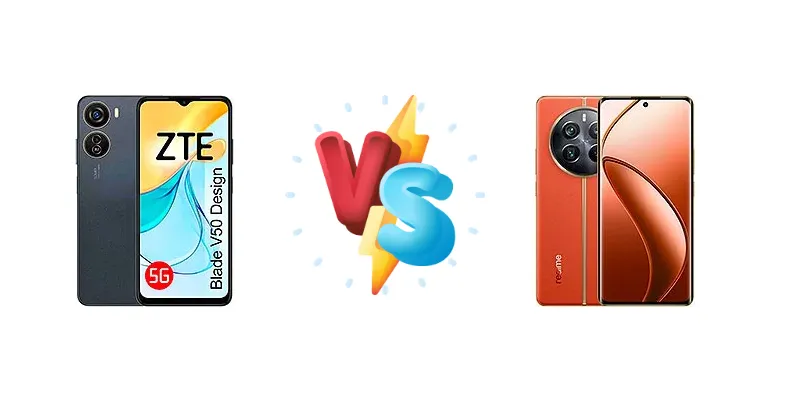
The smartphone market is flooded with options, but finding the right balance between price and performance can be challenging. We pit the Realme 12 Pro+ – a device focused on rapid charging and a capable processor – against the ZTE Blade V50 Design, a more budget-conscious offering, to determine which phone delivers the best value for your money.
🏆 Quick Verdict
For most users, the Realme 12 Pro+ is the superior choice. Its Snapdragon 7s Gen 2 chipset provides a noticeable performance boost over the Unisoc T760 in the ZTE Blade V50 Design, and the 67W charging is a game-changer. However, the ZTE Blade V50 Design remains a viable option for those prioritizing affordability above all else.
| Network |
|---|
| 2G bands | GSM 850 / 900 / 1800 / 1900 | GSM 850 / 900 / 1800 / 1900 |
| 3G bands | HSDPA 850 / 900 / 1900 / 2100 | HSDPA 850 / 900 / 2100 |
| 4G bands | LTE | 1, 3, 5, 8, 28, 40, 41 |
| 5G bands | SA/NSA | 1, 3, 5, 8, 28, 40, 41, 77, 78 SA/NSA |
| Speed | HSPA, LTE, 5G | HSPA, LTE, 5G |
| Technology | GSM / HSPA / LTE / 5G | GSM / HSPA / LTE / 5G |
| Launch |
|---|
| Announced | 2023, July 20 | 2024, January 29 |
| Status | Available. Released 2023, August | Available. Released 2024, January 29 |
| Body |
|---|
| Dimensions | 8.0 mm thickness | 161.5 x 74 x 8.8 mm (6.36 x 2.91 x 0.35 in) |
| SIM | Nano-SIM + Nano-SIM | Nano-SIM + Nano-SIM |
| Weight | - | 196 g (6.91 oz) |
| Display |
|---|
| Resolution | 1080 x 2408 pixels, 20:9 ratio (~400 ppi density) | 1080 x 2412 pixels, 20:9 ratio (~394 ppi density) |
| Size | 6.6 inches, 104.9 cm2 | 6.7 inches, 108.0 cm2 (~90.4% screen-to-body ratio) |
| Type | IPS LCD, 90Hz | AMOLED, 1B colors, 120Hz, 800 nits (HBM), 950 nits (peak) |
| Platform |
|---|
| CPU | Octa-core (1x2.2 GHz Cortex-A76 & 3x Cortex-A76 & 4x Cortex-A55) | Octa-core (4x2.40 GHz Cortex-A78 & 4x1.95 GHz Cortex-A55) |
| Chipset | Unisoc T760 (6 nm) | Qualcomm SM7435-AB Snapdragon 7s Gen 2 (4 nm) |
| GPU | Mali-G57 | Adreno 710 |
| OS | Android 13 | Android 14, Realme UI 5.0 |
| Memory |
|---|
| Card slot | No | No |
| Internal | 128GB 4GB RAM | 128GB 8GB RAM, 256GB 8GB RAM, 256GB 12GB RAM, 512GB 12GB RAM |
| Main Camera |
|---|
| Dual | 50 MP, f/1.8, (wide), PDAF
Auxiliary lens | - |
| Features | LED flash, HDR, panorama | LED flash, HDR, panorama |
| Triple | - | 50 MP, f/1.8, 24mm (wide), 1/1.56", 1.0µm, multi-directional PDAF, OIS
64 MP, f/2.8, 71mm, (periscope telephoto), 1/2.0", 0.7µm, PDAF, OIS, 3x optical zoom
8 MP, f/2.2, 16mm, 112˚ (ultrawide), 1/4.0", 1.12µm |
| Video | 1080p@30fps | 4K@30fps, 1080p@30/60/120fps, gyro-EIS |
| Selfie camera |
|---|
| Single | 8 MP, (wide) | 32 MP, f/2.4, 22mm (wide) |
| Video | 1080p@30fps | 1080p@30fps |
| Sound |
|---|
| 35mm jack | Yes | No |
| Loudspeaker | Yes | Yes, with stereo speakers |
| Comms |
|---|
| Bluetooth | Yes | 5.2, A2DP, LE |
| NFC | Yes | Yes (market/region dependent) |
| Positioning | GPS | GPS, GLONASS, GALILEO, BDS, QZSS |
| Radio | Unspecified | No |
| USB | USB Type-C 2.0 | USB Type-C 2.0 |
| WLAN | Yes | Wi-Fi 802.11 a/b/g/n/ac/6, dual-band |
| Features |
|---|
| Sensors | Fingerprint (side-mounted), accelerometer, proximity | Fingerprint (under display, optical), accelerometer, gyro, proximity, compass |
| Battery |
|---|
| Charging | 22.5W wired | 67W wired, 50% in 19 min |
| Type | Li-Po 4500 mAh | 5000 mAh |
| Misc |
|---|
| Colors | Sky Blue, Starry Gray, Gray Matt | Submarine Blue, Navigator Beige, Explorer Red |
| Models | - | RMX3840, RMX3841 |
| Price | About 200 EUR | $ 465.00 / £ 299.00 / € 344.26 / ₹ 28,400 |
ZTE Blade V50 Design
- Highly affordable price point
- Functional for basic smartphone tasks
- Acceptable performance for everyday use
- Slower processor compared to the Realme 12 Pro+
- Slower charging speeds
- Likely lower display quality
Realme 12 Pro+
- Faster and more efficient Snapdragon 7s Gen 2 chipset
- Significantly faster 67W charging
- Brighter display for better outdoor visibility
- Higher price compared to the ZTE Blade V50 Design
- May be overkill for basic smartphone users
- Battery capacity not specified
Display Comparison
The Realme 12 Pro+ boasts a significantly brighter display, reaching a measured peak of 802 nits. This is crucial for outdoor visibility, a clear advantage over the ZTE Blade V50 Design, whose display brightness is not specified but is likely lower given its price point. While both likely utilize LCD panels, the Realme’s higher brightness and potentially better color calibration will result in a more enjoyable viewing experience. The absence of refresh rate data for the ZTE Blade V50 Design suggests a standard 60Hz panel, while the Realme 12 Pro+ is likely to offer a smoother 120Hz experience, though this is not confirmed in the provided data.
Camera Comparison
Without detailed camera specifications for either device, a direct comparison is limited. However, Realme typically focuses on camera performance in its Pro+ series, suggesting a more sophisticated camera system than the ZTE Blade V50 Design. The Realme 12 Pro+ likely features a larger main sensor and more advanced image processing algorithms. The ZTE Blade V50 Design will likely rely on software enhancements to compensate for a less capable sensor. The absence of information regarding OIS (Optical Image Stabilization) on either device suggests it may not be present, or is a lower priority feature.
Performance
The Realme 12 Pro+’s Qualcomm Snapdragon 7s Gen 2 (4nm) represents a substantial leap in processing power and efficiency compared to the ZTE Blade V50 Design’s Unisoc T760 (6nm). The Snapdragon’s Cortex-A78 cores, clocked at 2.40 GHz, outperform the Cortex-A76 cores in the Unisoc chip, leading to faster app loading times and smoother multitasking. The 4nm fabrication process of the Snapdragon also translates to better thermal management, reducing the likelihood of performance throttling during extended gaming sessions. The Unisoc T760 is adequate for everyday tasks, but will struggle with demanding applications.
Battery Life
The Realme 12 Pro+ shines in the charging department with its 67W wired charging, capable of reaching 50% charge in just 19 minutes. This is a significant advantage over the ZTE Blade V50 Design’s slower 22.5W charging. While the Realme 12 Pro+’s battery capacity isn’t specified, its active use score of 13:24h indicates excellent battery life, likely achieved through the efficiency of the Snapdragon 7s Gen 2 chipset. The ZTE Blade V50 Design’s battery capacity is also unknown, but its less efficient chipset may necessitate more frequent charging.
Buying Guide
Buy the ZTE Blade V50 Design if you need a functional smartphone for basic tasks like calling, texting, and light social media use, and your budget is extremely limited. Buy the Realme 12 Pro+ if you prioritize faster performance for gaming and multitasking, demand significantly quicker charging speeds, and appreciate a brighter, more vibrant display for media consumption.
Frequently Asked Questions
❓ Is the Unisoc T760 in the ZTE Blade V50 Design capable of running demanding games like PUBG or Genshin Impact?
While the Unisoc T760 can *run* these games, expect to make significant compromises in graphics settings and frame rates. The chipset lacks the raw power of the Snapdragon 7s Gen 2, and may experience noticeable lag or stuttering during intense gameplay. The Realme 12 Pro+ will provide a much smoother and more enjoyable gaming experience.
❓ How much faster is the 67W charging on the Realme 12 Pro+ compared to the 22.5W charging on the ZTE Blade V50 Design in real-world use?
The 67W charging on the Realme 12 Pro+ is dramatically faster. It can add a substantial amount of battery life in a short period – 50% in just 19 minutes. The ZTE Blade V50 Design’s 22.5W charging will take considerably longer to reach a similar charge level, potentially over an hour to fully charge from empty.
❓ Does the Realme 12 Pro+ get hot during prolonged use, such as gaming or video recording?
The Snapdragon 7s Gen 2’s 4nm process is designed for improved thermal efficiency. While some heat generation is inevitable during demanding tasks, the Realme 12 Pro+ is less likely to experience significant throttling compared to devices with less efficient chipsets. However, sustained heavy use will still result in some warming.