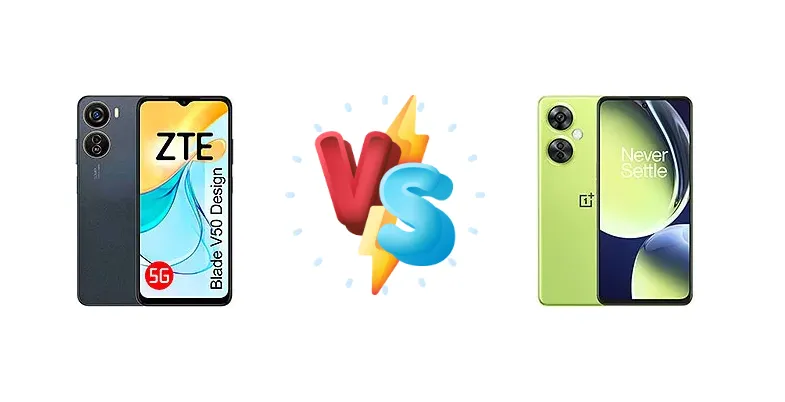
The sub-$300 smartphone market is fiercely competitive. The ZTE Blade V50 Design and OnePlus Nord CE 3 Lite both aim to deliver 5G connectivity and essential features at an accessible price. However, they take different approaches to achieving this, with the ZTE relying on a Unisoc chipset and the OnePlus opting for Qualcomm's Snapdragon 695. This comparison dissects the key differences to determine which device offers the best value.
🏆 Quick Verdict
For the average user prioritizing fast charging and a more established brand reputation, the OnePlus Nord CE 3 Lite is the better choice. Its 67W charging significantly outperforms the ZTE's 22.5W, and the Snapdragon 695 generally offers a smoother experience in demanding applications, despite the similar CPU clock speeds.
| Network |
|---|
| 2G bands | GSM 850 / 900 / 1800 / 1900 | GSM 850 / 900 / 1800 / 1900 |
| 3G bands | HSDPA 850 / 900 / 1900 / 2100 | HSDPA 800 / 850 / 900 / 1700(AWS) / 1900 / 2100 - International |
| 4G bands | LTE | 1, 2, 3, 4, 5, 7, 8, 12, 13, 17, 18, 19, 20, 26, 28, 32, 38, 39, 40, 41, 66 - International |
| 5G bands | SA/NSA | 1, 3, 5, 7, 8, 20, 28, 38, 40, 41, 66, 77, 78 SA/NSA - International |
| Speed | HSPA, LTE, 5G | HSPA, LTE, 5G |
| Technology | GSM / HSPA / LTE / 5G | GSM / HSPA / LTE / 5G |
| | - | 1, 3, 5, 8, 28, 40, 41, 77, 78 SA/NSA - India |
| Launch |
|---|
| Announced | 2023, July 20 | 2023, April 04 |
| Status | Available. Released 2023, August | Available. Released 2023, April 11 |
| Body |
|---|
| Build | - | Glass front, plastic frame, plastic back |
| Dimensions | 8.0 mm thickness | 165.5 x 76 x 8.3 mm (6.52 x 2.99 x 0.33 in) |
| SIM | Nano-SIM + Nano-SIM | Nano-SIM + Nano-SIM |
| Weight | - | 195 g (6.88 oz) |
| Display |
|---|
| Protection | - | Corning Gorilla Glass |
| Resolution | 1080 x 2408 pixels, 20:9 ratio (~400 ppi density) | 1080 x 2400 pixels, 20:9 ratio (~391 ppi density) |
| Size | 6.6 inches, 104.9 cm2 | 6.72 inches, 109.6 cm2 (~87.1% screen-to-body ratio) |
| Type | IPS LCD, 90Hz | IPS LCD, 120Hz, 550 nits (typ), 680 nits (peak) |
| Platform |
|---|
| CPU | Octa-core (1x2.2 GHz Cortex-A76 & 3x Cortex-A76 & 4x Cortex-A55) | Octa-core (2x2.2 GHz Kryo 660 Gold & 6x1.7 GHz Kryo 660 Silver) |
| Chipset | Unisoc T760 (6 nm) | Qualcomm SM6375 Snapdragon 695 5G (6 nm) |
| GPU | Mali-G57 | Adreno 619 |
| OS | Android 13 | Android 13, OxygenOS 13.1 |
| Memory |
|---|
| Card slot | No | microSDXC (uses shared SIM slot) |
| Internal | 128GB 4GB RAM | 128GB 8GB RAM, 256GB 8GB RAM |
| | - | UFS 2.2 |
| Main Camera |
|---|
| Dual | 50 MP, f/1.8, (wide), PDAF
Auxiliary lens | - |
| Features | LED flash, HDR, panorama | LED flash, HDR, panorama |
| Triple | - | 108 MP, f/1.8, (wide), 1/1.67", 0.64µm, PDAF
2 MP (macro)
Auxiliary lens |
| Video | 1080p@30fps | 1080p@30fps |
| Selfie camera |
|---|
| Features | - | HDR, panorama |
| Single | 8 MP, (wide) | 16 MP, f/2.4, (wide), 1.0µm |
| Video | 1080p@30fps | 1080p@30fps |
| Sound |
|---|
| 3.5mm jack | - | Yes |
| 35mm jack | Yes | Yes |
| Loudspeaker | Yes | Yes, with stereo speakers |
| Comms |
|---|
| Bluetooth | Yes | 5.1, A2DP, LE, aptX HD |
| NFC | Yes | Yes (market/region dependent) |
| Positioning | GPS | GPS, GALILEO, GLONASS, BDS, QZSS |
| Radio | Unspecified | No |
| USB | USB Type-C 2.0 | USB Type-C 2.0, OTG |
| WLAN | Yes | Wi-Fi 802.11 a/b/g/n/ac, dual-band |
| Features |
|---|
| Sensors | Fingerprint (side-mounted), accelerometer, proximity | Fingerprint (side-mounted), accelerometer, gyro, proximity, compass |
| Battery |
|---|
| Charging | 22.5W wired | 67W wired, 80% in 30 min |
| Type | Li-Po 4500 mAh | Li-Po 5000 mAh |
| Misc |
|---|
| Colors | Sky Blue, Starry Gray, Gray Matt | Pastel Lime, Chromatic Gray |
| Models | - | CPH2467, CPH2465 |
| Price | About 200 EUR | £ 169.98 / € 209.99 |
| SAR | - | 1.17 W/kg (head) 0.70 W/kg (body) |
| Tests |
|---|
| Performance | - |
AnTuTu: 412006 (v9)
GeekBench: 2052 (v5)
GFXBench: 17fps (ES 3.1 onscreen) |
ZTE Blade V50 Design
- Potentially lower price point
- Unisoc T760 offers 5G connectivity
- Functional for basic smartphone tasks
- Significantly slower charging (22.5W)
- Unisoc chipset may have limited software support
- Unusual CPU core configuration may impact performance consistency
OnePlus Nord CE 3 Lite
- 67W SuperVOOC charging – incredibly fast
- Qualcomm Snapdragon 695 offers better performance and stability
- More established brand and software support
- May be slightly more expensive than the ZTE
- Potential for bloatware (typical of OnePlus)
- No standout features beyond fast charging and performance
Display Comparison
Neither device boasts a standout display. While specific panel details (like peak brightness or color gamut coverage) are absent, the focus here is on processing power. Display quality is likely similar, leaning towards adequate for the price point. Bezels are expected to be noticeable on both, as cost-cutting measures are common in this segment. Color accuracy will likely be standard for budget devices, prioritizing power efficiency over color fidelity.
Camera Comparison
Without detailed camera specs, a direct comparison is difficult. However, it's safe to assume both phones will feature a multi-camera setup with a primary sensor and supporting lenses. The OnePlus Nord CE 3 Lite likely benefits from Qualcomm's image signal processor (ISP), which generally delivers better image processing and noise reduction. The ZTE Blade V50 Design will rely on Unisoc's ISP, which may not be as refined. The presence of a 2MP macro lens on either device is largely a marketing gimmick and shouldn't be a deciding factor.
Performance
The core difference lies in the chipsets. Both the Unisoc T760 and Qualcomm Snapdragon 695 are 6nm processors, suggesting similar power efficiency. However, the Snapdragon 695 utilizes Kryo 660 cores – a more mature architecture than the Cortex-A76 found in the Unisoc T760. While the ZTE's CPU configuration includes a higher count of Cortex-A76 cores, the Snapdragon's Kryo cores are generally more efficient and offer better sustained performance. The Snapdragon 695 also benefits from Qualcomm's optimized software and modem technology, potentially leading to more stable 5G connectivity. The ZTE's CPU configuration (1x2.2 GHz Cortex-A76, 3x Cortex-A76, 4x Cortex-A55) is unusual, with a triple-core A76 cluster, which may lead to inconsistent performance scaling. The OnePlus likely has an advantage in GPU performance as well, though specific GPU details are missing.
Battery Life
The OnePlus Nord CE 3 Lite's 67W charging is a game-changer in this price bracket. The ability to reach 80% charge in just 30 minutes is a significant convenience. The ZTE Blade V50 Design's 22.5W charging is considerably slower, requiring significantly more time to fully charge. While battery capacity isn't specified, the faster charging of the OnePlus effectively mitigates any potential disadvantage from a slightly smaller battery size. The Snapdragon 695's power efficiency may also contribute to longer real-world battery life.
Buying Guide
Buy the ZTE Blade V50 Design if you need a functional 5G smartphone with a focus on cost savings and are comfortable with a less-known chipset. It's ideal for basic tasks like calling, texting, and light social media use. Buy the OnePlus Nord CE 3 Lite if you prioritize faster charging speeds, a more refined software experience, and a chipset with broader compatibility and potentially better long-term software support. It's better suited for users who occasionally game or use resource-intensive apps.
Frequently Asked Questions
❓ Is the Unisoc T760 in the ZTE Blade V50 Design capable of handling demanding games like PUBG Mobile?
While the Unisoc T760 can *run* PUBG Mobile, expect to play at lower graphics settings and potentially experience frame drops, especially during intense action. The Snapdragon 695 in the OnePlus Nord CE 3 Lite will provide a smoother and more consistent gaming experience, even at medium settings.
❓ How much faster is the 67W charging on the OnePlus Nord CE 3 Lite compared to the 22.5W charging on the ZTE Blade V50 Design in real-world use?
The difference is substantial. The OnePlus Nord CE 3 Lite can go from 0% to 80% in approximately 30 minutes. The ZTE Blade V50 Design will likely take well over an hour to reach 80%, and potentially over two hours for a full charge. This makes the OnePlus significantly more convenient for users who frequently need to top up their battery quickly.
❓ Does the OnePlus Nord CE 3 Lite have a better software update policy than the ZTE Blade V50 Design?
Generally, yes. OnePlus typically provides more consistent software updates and security patches than ZTE, especially for its budget and mid-range devices. The Unisoc chipset in the ZTE Blade V50 Design may receive fewer updates and for a shorter duration compared to the Snapdragon 695 in the OnePlus.