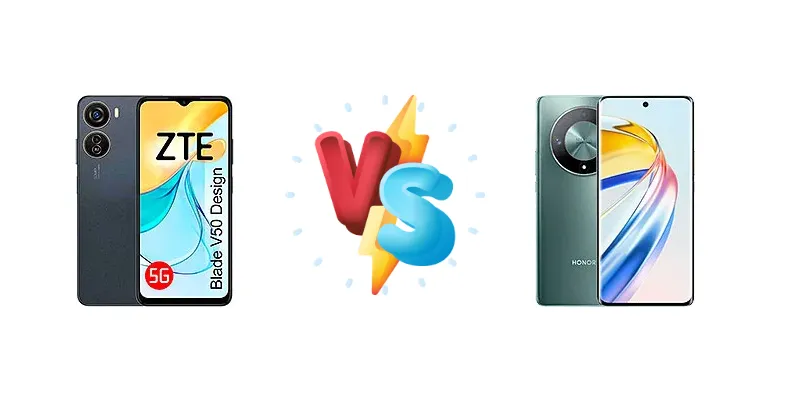
The ZTE Blade V50 Design and Honor X9b represent compelling options in the increasingly competitive budget and mid-range smartphone market. Both aim to deliver a solid experience without breaking the bank, but they take different approaches, primarily in their chipset choices and charging capabilities. This comparison dissects those differences to determine which device best suits your needs.
🏆 Quick Verdict
For the average user prioritizing sustained performance and faster charging, the Honor X9b emerges as the stronger contender. Its Snapdragon 6 Gen 1, built on a more efficient 4nm process, offers a noticeable advantage over the ZTE Blade V50 Design’s Unisoc T760, especially during demanding tasks. The 35W charging further solidifies its lead.
| Network |
|---|
| 2G bands | GSM 850 / 900 / 1800 / 1900 | GSM 850 / 900 / 1800 / 1900 |
| 3G bands | HSDPA 850 / 900 / 1900 / 2100 | HSDPA 850 / 900 / 1900 / 2100 |
| 4G bands | LTE | 1, 2, 3, 4, 5, 7, 8, 20, 28, 32, 38, 40, 41 |
| 5G bands | SA/NSA | 1, 3, 7, 8, 20, 28, 38, 40, 41, 77, 78 SA/NSA |
| Speed | HSPA, LTE, 5G | HSPA, LTE, 5G |
| Technology | GSM / HSPA / LTE / 5G | GSM / HSPA / LTE / 5G |
| Launch |
|---|
| Announced | 2023, July 20 | 2023, October 18 |
| Status | Available. Released 2023, August | Available. Released 2023, October |
| Body |
|---|
| Dimensions | 8.0 mm thickness | 163.6 x 75.5 x 8 mm (6.44 x 2.97 x 0.31 in) |
| SIM | Nano-SIM + Nano-SIM | Nano-SIM + Nano-SIM |
| Weight | - | 185 g (6.53 oz) |
| Display |
|---|
| Resolution | 1080 x 2408 pixels, 20:9 ratio (~400 ppi density) | 1220 x 2652 pixels, 19.5:9 ratio (~431 ppi density) |
| Size | 6.6 inches, 104.9 cm2 | 6.78 inches, 112.6 cm2 (~91.2% screen-to-body ratio) |
| Type | IPS LCD, 90Hz | AMOLED, 1B colors, 120Hz, 1200 nits (peak) |
| Platform |
|---|
| CPU | Octa-core (1x2.2 GHz Cortex-A76 & 3x Cortex-A76 & 4x Cortex-A55) | Octa-core (4x2.2 GHz Cortex-A78 & 4x1.8 GHz Cortex-A55) |
| Chipset | Unisoc T760 (6 nm) | Qualcomm SM6450 Snapdragon 6 Gen 1 (4 nm) |
| GPU | Mali-G57 | Adreno 710 |
| OS | Android 13 | Android 13, Magic OS 7.2 |
| Memory |
|---|
| Card slot | No | No |
| Internal | 128GB 4GB RAM | 256GB 8GB RAM, 256GB 12GB RAM, 512GB 8GB RAM, 512GB 12GB RAM |
| Main Camera |
|---|
| Dual | 50 MP, f/1.8, (wide), PDAF
Auxiliary lens | - |
| Features | LED flash, HDR, panorama | LED flash, panorama, HDR |
| Triple | - | 108 MP, f/1.8, (wide), 1/1.67", PDAF
5 MP, f/2.2, (ultrawide)
2 MP (macro) |
| Video | 1080p@30fps | 4K@30fps, 1080p@30fps |
| Selfie camera |
|---|
| Single | 8 MP, (wide) | 16 MP, f/2.5, (wide) |
| Video | 1080p@30fps | 1080p@30fps |
| Sound |
|---|
| 35mm jack | Yes | No |
| Loudspeaker | Yes | Yes |
| Comms |
|---|
| Bluetooth | Yes | 5.1, A2DP, LE |
| Infrared port | - | Yes |
| NFC | Yes | Yes (market/region dependent) |
| Positioning | GPS | GPS, GLONASS, GALILEO, BDS |
| Radio | Unspecified | No |
| USB | USB Type-C 2.0 | USB Type-C 2.0, OTG |
| WLAN | Yes | Wi-Fi 802.11 a/b/g/n/ac, dual-band, Wi-Fi Direct |
| Features |
|---|
| Sensors | Fingerprint (side-mounted), accelerometer, proximity | Fingerprint (under display, optical), accelerometer, gyro, proximity, compass |
| Battery |
|---|
| Charging | 22.5W wired | 35W wired
Reverse wired |
| Type | Li-Po 4500 mAh | Li-Po 5800 mAh |
| Misc |
|---|
| Colors | Sky Blue, Starry Gray, Gray Matt | Sunrise Orange, Midnight Black, Emerald Green |
| Models | - | ALI-NX1 |
| Price | About 200 EUR | About 970 EUR |
ZTE Blade V50 Design
- Potentially lower price point
- Unisoc T760 is a capable processor for basic tasks
- Likely a solid battery life for light usage
- Less powerful chipset compared to Snapdragon 6 Gen 1
- Slower 22.5W charging
- May exhibit more throttling under heavy load
Honor X9b
- More powerful Snapdragon 6 Gen 1 chipset
- Faster 35W wired charging with reverse charging
- Improved thermal efficiency due to 4nm process
- Likely a higher price tag
- May not offer significant camera improvements over the ZTE
- Battery life may be comparable to the ZTE depending on capacity
Display Comparison
Display specifications are not provided, so a direct comparison is impossible. However, given the price points, both devices likely utilize LCD panels. The Honor X9b, being positioned slightly higher, *may* feature a higher resolution or slightly improved color accuracy. Bezels are likely comparable, focusing on maximizing screen real estate within their respective budgets.
Camera Comparison
Camera details are absent, making a precise comparison difficult. However, it’s reasonable to assume both phones will feature multi-camera setups geared towards social media sharing. The Honor X9b, given its slightly higher positioning, *may* incorporate a larger main sensor or more advanced image processing algorithms. The ZTE Blade V50 Design will likely focus on providing adequate image quality for everyday use, while the Honor X9b could offer a more refined photographic experience. Without specific sensor sizes or aperture information, it's difficult to assess the low-light performance of either device.
Performance
The core difference lies in the chipsets. The Honor X9b’s Qualcomm Snapdragon 6 Gen 1 (4nm) boasts a more modern architecture with 4x Cortex-A78 cores clocked at 2.2 GHz, offering a significant uplift in CPU performance compared to the ZTE Blade V50 Design’s Unisoc T760 (6nm). While both are octa-core, the A78 cores in the Snapdragon are demonstrably more powerful than the A76 cores in the Unisoc. The 4nm fabrication process of the Snapdragon also translates to improved thermal efficiency, reducing the likelihood of throttling during extended gaming or heavy multitasking. The Unisoc T760, while capable, will likely exhibit more performance dips under sustained load. The Honor X9b's GPU will also benefit from the newer architecture, providing a better gaming experience.
Battery Life
Battery capacities are not specified. However, the Honor X9b’s 35W wired charging is a clear advantage over the ZTE Blade V50 Design’s 22.5W charging. This translates to significantly faster top-up times, reducing downtime. Even if the ZTE Blade V50 Design has a slightly larger battery capacity, the Honor X9b’s faster charging will likely result in a more convenient user experience. The Honor X9b also supports reverse wired charging, a feature absent on the ZTE Blade V50 Design, allowing it to act as a power bank for other devices.
Buying Guide
Buy the ZTE Blade V50 Design if you prioritize a lower initial cost and are primarily focused on basic smartphone tasks like calling, texting, and light social media use. Buy the Honor X9b if you value smoother multitasking, better gaming performance, and significantly faster charging speeds, even if it means a slightly higher investment.
Frequently Asked Questions
❓ Will the Unisoc T760 in the ZTE Blade V50 Design struggle with graphically intensive games like PUBG Mobile?
The Unisoc T760 is capable of running PUBG Mobile, but you'll likely need to lower the graphics settings to achieve a consistently smooth frame rate. The Snapdragon 6 Gen 1 in the Honor X9b will provide a noticeably better gaming experience with higher settings and fewer frame drops due to its more powerful GPU and efficient 4nm process.
❓ How much faster is the 35W charging on the Honor X9b compared to the 22.5W charging on the ZTE Blade V50 Design?
While exact charging times depend on battery capacity, 35W charging will significantly reduce the time it takes to fully charge the Honor X9b. Expect a 0-100% charge to be at least 30-45 minutes faster on the Honor X9b, offering a more convenient experience for users who frequently need to top up their battery.
❓ Does the Snapdragon 6 Gen 1 in the Honor X9b get hot during prolonged gaming sessions?
The Snapdragon 6 Gen 1 benefits from a 4nm fabrication process, which improves thermal efficiency. While some heat generation is inevitable during gaming, the Honor X9b is less likely to experience significant throttling compared to the ZTE Blade V50 Design, allowing for more sustained performance.