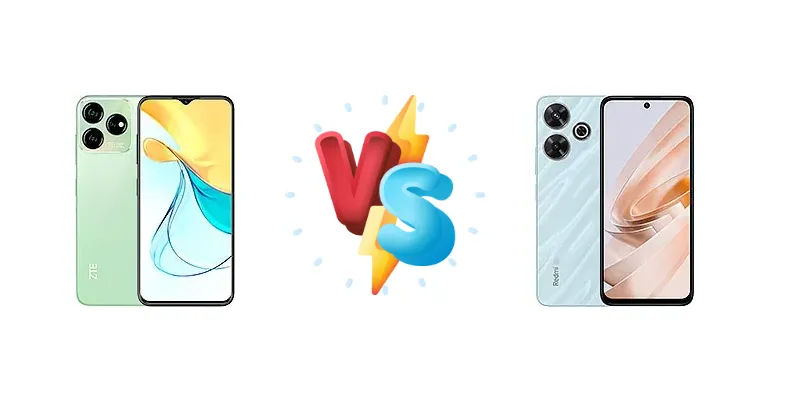
The sub-$200 smartphone market is fiercely competitive. The ZTE Blade V50 Design 4G and Xiaomi Redmi Note 13R both aim to deliver essential smartphone functionality at an accessible price. However, they take drastically different approaches to achieving this, primarily through their chipset choices. This comparison dissects those differences, revealing which phone offers the best value for your money.
🏆 Quick Verdict
For the average user prioritizing responsiveness and future-proofing, the Xiaomi Redmi Note 13R is the clear winner. Its Snapdragon 4+ Gen 2 chipset, built on a more efficient 4nm process, delivers significantly better performance than the ZTE Blade V50 Design 4G’s Unisoc T606. While the ZTE offers slightly slower charging, the performance gap justifies the small trade-off.
| Network |
|---|
| 2G bands | GSM 850 / 900 / 1800 / 1900 | GSM 850 / 900 / 1800 / 1900 |
| 3G bands | HSDPA 850 / 900 / 1900 / 2100 | HSDPA 850 / 900 / 2100 |
| 4G bands | LTE | 1, 3, 5, 8, 34, 38, 39, 40, 41 |
| 5G bands | - | 1, 5, 8, 28, 41, 78 SA/NSA |
| Speed | HSPA, LTE | HSPA, LTE, 5G |
| Technology | GSM / HSPA / LTE | GSM / CDMA / HSPA / EVDO / LTE / 5G |
| Launch |
|---|
| Announced | 2023, October | 2024, May 17 |
| Status | Available. Released 2023, October | Available. Released 2024, May 17 |
| Body |
|---|
| Build | Glass front, plastic frame, glass back | Glass front, plastic frame, glass back |
| Dimensions | 165 x 76.1 x 8.3 mm (6.50 x 3.00 x 0.33 in) | 168.6 x 76.3 x 8.2 mm (6.64 x 3.00 x 0.32 in) |
| SIM | Nano-SIM + Nano-SIM | Nano-SIM + Nano-SIM |
| Weight | 207 g (7.30 oz) | 205 g (7.23 oz) |
| Display |
|---|
| Resolution | 1080 x 2408 pixels, 20:9 ratio (~400 ppi density) | 1080 x 2460 pixels (~396 ppi density) |
| Size | 6.6 inches, 104.9 cm2 (~83.6% screen-to-body ratio) | 6.79 inches, 109.5 cm2 (~85.1% screen-to-body ratio) |
| Type | IPS LCD | IPS LCD, 120Hz, 550 nits |
| Platform |
|---|
| CPU | Octa-core (2x1.6 GHz Cortex-A75 & 6x1.6 GHz Cortex-A55) | Octa-core (2x2.3 GHz Cortex-A78 & 6x1.95 GHz Cortex-A55) |
| Chipset | Unisoc T606 (12 nm) | Qualcomm SM4450 Snapdragon 4+ Gen 2 (4 nm) |
| GPU | Mali-G57 MP1 | Adreno 613 |
| OS | Android 13 | Android 14, HyperOS |
| Memory |
|---|
| Card slot | microSDXC (dedicated slot) | No |
| Internal | 128GB 8GB RAM, 256GB 4GB RAM, 256GB 8GB RAM | 128GB 6GB RAM, 128GB 8GB RAM, 256GB 8GB RAM, 256GB 12GB RAM, 512GB 12GB RAM |
| Main Camera |
|---|
| Dual | - | 50 MP, f/1.8, (wide), 1/2.76", 0.64µm, PDAF
2 MP (macro) |
| Features | LED flash, HDR, panorama | LED flash, HDR |
| Triple | 50 MP, f/1.8, (wide), PDAF
2 MP (macro)
Auxiliary lens | - |
| Video | 1080p@30fps | 1080p@30fps |
| Selfie camera |
|---|
| Single | 8 MP, f/2.0, (wide) | 8 MP, (wide), 1/4.0", 1.12µm |
| Video | 1080p@30fps | 1080p@30fps |
| Sound |
|---|
| 35mm jack | Yes | Yes |
| Loudspeaker | Yes | Yes |
| Comms |
|---|
| Bluetooth | 5.2, A2DP, LE | 5.3, A2DP, LE |
| Infrared port | - | Yes |
| NFC | Yes (market/region dependent) | Yes |
| Positioning | GPS | GPS, GLONASS, GALILEO, BDS |
| Radio | Unspecified | No |
| USB | USB Type-C 2.0 | USB Type-C |
| WLAN | Wi-Fi 802.11 a/b/g/n/ac, dual-band | Wi-Fi 802.11 a/b/g/n/ac, dual-band |
| Features |
|---|
| Sensors | Fingerprint (side-mounted), accelerometer, proximity | Fingerprint (side-mounted), accelerometer, compass |
| Battery |
|---|
| Charging | 22.5W wired | 33W wired |
| Type | Li-Po 5000 mAh | 5030 mAh |
| Misc |
|---|
| Colors | Beach Green, Sunrise Violet, Diamont Black | Black, Blue, Silver |
| Models | - | 2406ERN9CC |
| Price | About 120 EUR | About 180 EUR |
ZTE Blade V50 Design 4G
- Potentially lower price point
- Functional for basic smartphone tasks
- Acceptable battery life (estimated)
- Significantly weaker performance compared to the Redmi Note 13R
- Slower charging speed
- Less future-proof
Xiaomi Redmi Note 13R
- Superior performance thanks to the Snapdragon 4+ Gen 2
- Faster 33W wired charging
- More efficient 4nm chipset
- Better image processing capabilities
- May be slightly more expensive than the ZTE Blade V50
- Likely similar display quality to the ZTE
Display Comparison
Neither device boasts a standout display. Both likely utilize LCD panels, a common cost-saving measure in this segment. However, detailed display specs (resolution, brightness, color gamut) are unavailable. The focus here is on internal components. The absence of high refresh rates is expected, prioritizing battery life over visual fluidity. Bezels are likely comparable, reflecting the budget nature of both devices.
Camera Comparison
Without detailed camera specifications, a direct comparison is difficult. However, it’s safe to assume both phones feature basic camera setups geared towards casual photography. The Redmi Note 13R likely benefits from Qualcomm’s image signal processor (ISP), which generally provides better image processing capabilities than those found in Unisoc chipsets. While both may include a primary camera and depth sensor, the Redmi Note 13R’s ISP will likely deliver more detailed and vibrant photos, especially in challenging lighting conditions. The absence of OIS on either device suggests reliance on software stabilization.
Performance
The core difference lies in the chipsets. The Xiaomi Redmi Note 13R’s Qualcomm Snapdragon 4+ Gen 2 (4nm) is a substantial upgrade over the ZTE Blade V50 Design 4G’s Unisoc T606 (12nm). The 4nm fabrication process of the Snapdragon offers significantly improved power efficiency, translating to less heat generation and sustained performance. The Snapdragon’s CPU configuration – 2x2.3 GHz Cortex-A78 & 6x1.95 GHz Cortex-A55 – also represents a performance leap over the Unisoc’s 2x1.6 GHz Cortex-A75 & 6x1.6 GHz Cortex-A55. This means faster app loading times, smoother multitasking, and a more enjoyable overall user experience on the Redmi Note 13R. The Redmi Note 13R will handle graphically intensive tasks and games with greater ease.
Battery Life
Battery capacity is not specified, but both phones likely feature batteries in the 5000mAh range, typical for this price point. The Redmi Note 13R’s 33W wired charging is a clear advantage over the ZTE Blade V50 Design 4G’s 22.5W charging. This translates to significantly faster charging times – potentially reducing a full charge from over 2 hours on the ZTE to around 1 hour 30 minutes on the Redmi. While the ZTE’s slower charging isn’t a deal-breaker, the Redmi Note 13R offers greater convenience.
Buying Guide
Buy the ZTE Blade V50 Design 4G if you need a basic, functional smartphone for essential tasks like calls, texts, and light social media use, and are on an extremely tight budget. Buy the Xiaomi Redmi Note 13R if you prefer a smoother, more responsive experience for everyday tasks, occasional gaming, and want a device that will feel more capable over time. The Redmi Note 13R is the better choice for users who value performance and longevity.
Frequently Asked Questions
❓ Will the Unisoc T606 in the ZTE Blade V50 struggle with multitasking?
Yes, the Unisoc T606 is a relatively basic chipset. While it can handle a few apps simultaneously, expect noticeable slowdowns and lag when switching between multiple demanding applications. The Redmi Note 13R’s Snapdragon 4+ Gen 2 offers a much smoother multitasking experience.
❓ How much faster is the charging on the Redmi Note 13R compared to the ZTE Blade V50?
The Redmi Note 13R’s 33W charging is considerably faster. While exact charge times depend on various factors, you can expect a full charge to take approximately 1 hour and 30 minutes on the Redmi, compared to potentially over 2 hours on the ZTE Blade V50 with its 22.5W charging.
❓ Is the Snapdragon 4+ Gen 2 in the Redmi Note 13R capable of playing popular mobile games?
The Snapdragon 4+ Gen 2 is capable of playing many popular mobile games, though you may need to lower graphics settings for more demanding titles. It offers a significantly better gaming experience than the Unisoc T606, which may struggle with even moderately demanding games.
❓ Does either phone support 5G connectivity?
No, both the ZTE Blade V50 Design 4G and the Xiaomi Redmi Note 13R are 4G-only devices, as indicated by their names. If 5G connectivity is a priority, you'll need to consider other smartphone options.