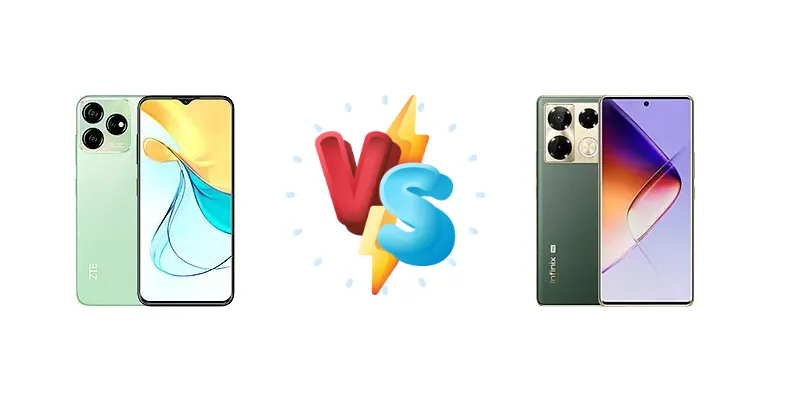
The ZTE Blade V50 Design 4G and the Infinix Note 40 Pro represent distinct approaches to the budget smartphone market. The ZTE focuses on a streamlined experience with a basic 4G connection, while the Infinix aims for a more feature-rich package, including faster charging and a more powerful chipset. This comparison dissects their key differences to help you determine which device best suits your needs.
🏆 Quick Verdict
For most users, the Infinix Note 40 Pro is the superior choice. Its Mediatek Dimensity 7020 chipset offers significantly better performance than the Unisoc T606 in the ZTE Blade V50 Design 4G, and the inclusion of 45W wired charging, plus wireless and reverse charging, provides a level of convenience the ZTE simply can't match.
| Network |
|---|
| 2G bands | GSM 850 / 900 / 1800 / 1900 | GSM 850 / 900 / 1800 / 1900 |
| 3G bands | HSDPA 850 / 900 / 1900 / 2100 | HSDPA 850 / 900 / 1700(AWS) / 1900 / 2100 |
| 4G bands | LTE | 1, 2, 3, 4, 5, 7, 8, 12, 17, 20, 28, 38, 40, 41, 42, 66 |
| 5G bands | - | 1, 3, 5, 7, 8, 12, 20, 28, 38, 40, 41, 66, 77, 78 SA/NSA |
| Speed | HSPA, LTE | HSPA, LTE, 5G |
| Technology | GSM / HSPA / LTE | GSM / HSPA / LTE / 5G |
| Launch |
|---|
| Announced | 2023, October | 2024, March 18 |
| Status | Available. Released 2023, October | Available. Released 2024, March 19 |
| Body |
|---|
| Build | Glass front, plastic frame, glass back | - |
| Dimensions | 165 x 76.1 x 8.3 mm (6.50 x 3.00 x 0.33 in) | 164.3 x 74.5 x 8.1 mm (6.47 x 2.93 x 0.32 in) |
| SIM | Nano-SIM + Nano-SIM | Nano-SIM + Nano-SIM |
| Weight | 207 g (7.30 oz) | 190 g or 196 g (6.70 oz) |
| Display |
|---|
| Protection | - | Corning Gorilla Glass |
| Resolution | 1080 x 2408 pixels, 20:9 ratio (~400 ppi density) | 1080 x 2436 pixels (~393 ppi density) |
| Size | 6.6 inches, 104.9 cm2 (~83.6% screen-to-body ratio) | 6.78 inches, 109.9 cm2 (~89.8% screen-to-body ratio) |
| Type | IPS LCD | AMOLED, 1B colors, 120Hz, 2160Hz PWM, 1300 nits (peak) |
| Platform |
|---|
| CPU | Octa-core (2x1.6 GHz Cortex-A75 & 6x1.6 GHz Cortex-A55) | Octa-core (2x2.2 GHz Cortex-A78 & 6x2.0 GHz Cortex-A55) |
| Chipset | Unisoc T606 (12 nm) | Mediatek Dimensity 7020 (6 nm) |
| GPU | Mali-G57 MP1 | IMG BXM-8-256 |
| OS | Android 13 | Android 14, XOS 14 |
| Memory |
|---|
| Card slot | microSDXC (dedicated slot) | Unspecified |
| Internal | 128GB 8GB RAM, 256GB 4GB RAM, 256GB 8GB RAM | 256GB 8GB RAM |
| Main Camera |
|---|
| Features | LED flash, HDR, panorama | Dual-LED flash, HDR, panorama |
| Triple | 50 MP, f/1.8, (wide), PDAF
2 MP (macro)
Auxiliary lens | 108 MP, f/1.8, (wide), PDAF, OIS
2 MP, f/2.4
2 MP, f/2.4 |
| Video | 1080p@30fps | 1440p@30fps, 1080p@30/60fps |
| Selfie camera |
|---|
| Features | - | Dual-LED flash |
| Single | 8 MP, f/2.0, (wide) | 32 MP, f/2.2, (wide), 1/3.1" |
| Video | 1080p@30fps | 1080p@30fps |
| Sound |
|---|
| 35mm jack | Yes | No |
| Loudspeaker | Yes | Yes, with stereo speakers |
| Comms |
|---|
| Bluetooth | 5.2, A2DP, LE | Yes |
| Infrared port | - | Yes |
| NFC | Yes (market/region dependent) | Yes (market/region dependent) |
| Positioning | GPS | GPS |
| Radio | Unspecified | FM radio |
| USB | USB Type-C 2.0 | USB Type-C 2.0, OTG |
| WLAN | Wi-Fi 802.11 a/b/g/n/ac, dual-band | Wi-Fi 802.11 a/b/g/n/ac, dual-band |
| Features |
|---|
| Sensors | Fingerprint (side-mounted), accelerometer, proximity | Fingerprint (under display, optical), accelerometer, gyro, proximity, compass |
| Battery |
|---|
| Charging | 22.5W wired | 45W wired, 50% in 26 min
20W wireless MagCharge
Reverse wired
Reverse wireless |
| Type | Li-Po 5000 mAh | 5000 mAh |
| Misc |
|---|
| Colors | Beach Green, Sunrise Violet, Diamont Black | Vintage Green, Titan Gold, Racing Edition |
| Models | - | X6851 |
| Price | About 120 EUR | About 280 EUR |
ZTE Blade V50 Design 4G
- Lower upfront cost
- Simple and straightforward user experience
- Reliable 4G connectivity
- Significantly slower performance
- Slow charging speeds
- Limited feature set
Infinix Note 40 Pro
- Much faster performance with Dimensity 7020
- 45W fast charging and wireless charging
- Reverse charging capabilities
- Higher price point
- Potentially larger physical size
- More complex software experience
Display Comparison
While specific display details (resolution, panel type) are missing for both devices, the core difference lies in the processing power driving them. A more powerful chipset, like the Dimensity 7020 in the Infinix, can better handle higher refresh rates and more complex image processing for a smoother visual experience. The ZTE's Unisoc T606 will likely result in a more basic display experience, adequate for everyday use but lacking the vibrancy and responsiveness of the Infinix.
Camera Comparison
Without detailed camera specifications, it's difficult to make a precise comparison. However, the chipset plays a crucial role in image processing. The Dimensity 7020’s ISP (Image Signal Processor) is far more capable than the Unisoc T606’s, enabling faster image capture, better noise reduction, and more sophisticated features. While both phones likely feature a multi-camera setup, the Infinix will likely deliver superior image quality, especially in low-light conditions. The ZTE's camera will likely be adequate for casual snapshots, but won't compete with the Infinix in terms of detail and dynamic range.
Performance
The performance gap between these two phones is substantial. The Infinix Note 40 Pro’s Mediatek Dimensity 7020, built on a 6nm process, boasts significantly higher clock speeds (2.2 GHz Cortex-A78) and a more efficient architecture compared to the ZTE Blade V50 Design 4G’s Unisoc T606 (1.6 GHz Cortex-A75). The 6nm node of the Dimensity 7020 translates to better power efficiency and reduced thermal throttling during sustained workloads, making it the clear winner for gaming and demanding applications. The Cortex-A78 cores in the Infinix offer a noticeable performance uplift over the Cortex-A75 cores in the ZTE.
Battery Life
The Infinix Note 40 Pro’s 45W wired charging is a game-changer, capable of reaching 50% charge in just 26 minutes. This is a significant advantage over the ZTE Blade V50 Design 4G’s slower 22.5W charging. Furthermore, the Infinix adds 20W wireless MagCharge and reverse wired/wireless charging, offering unparalleled convenience. While battery capacity isn't specified, the faster charging and added wireless options make the Infinix the more practical choice for users who need to quickly top up their device or share power with others.
Buying Guide
Buy the ZTE Blade V50 Design 4G if you prioritize simplicity and a lower upfront cost, and your usage is limited to basic tasks like calls, texts, and light social media. Buy the Infinix Note 40 Pro if you value performance for gaming or multitasking, faster charging speeds, and the added versatility of wireless and reverse wireless charging capabilities.
Frequently Asked Questions
❓ Will the Dimensity 7020 in the Infinix Note 40 Pro get noticeably warmer during extended gaming sessions?
The Dimensity 7020's 6nm process is designed for efficiency, and while some heat is inevitable during gaming, it's less prone to significant throttling compared to the Unisoc T606 in the ZTE Blade V50 Design 4G. The Infinix is likely to maintain higher frame rates for longer periods.
❓ Is the 20W MagCharge wireless charging on the Infinix Note 40 Pro compatible with all wireless chargers?
The 'MagCharge' designation indicates compatibility with magnetic wireless chargers, similar to MagSafe on iPhones. While it will likely work with standard Qi wireless chargers, you'll get the full 20W charging speed with a MagCharge-compatible charger for optimal alignment and efficiency.
❓ How does the Unisoc T606 handle multitasking compared to the Dimensity 7020?
The Unisoc T606 will struggle with heavy multitasking. The Dimensity 7020, with its more powerful cores and larger cache, can handle significantly more apps running in the background without noticeable slowdowns. Users who frequently switch between apps will find the Infinix a much smoother experience.
❓ Does the Infinix Note 40 Pro support VoLTE and VoWiFi for improved call quality?
While not explicitly stated, Infinix phones generally support VoLTE (Voice over LTE) and VoWiFi (Voice over Wi-Fi) depending on carrier compatibility. It's best to check with your mobile carrier to confirm support in your region.