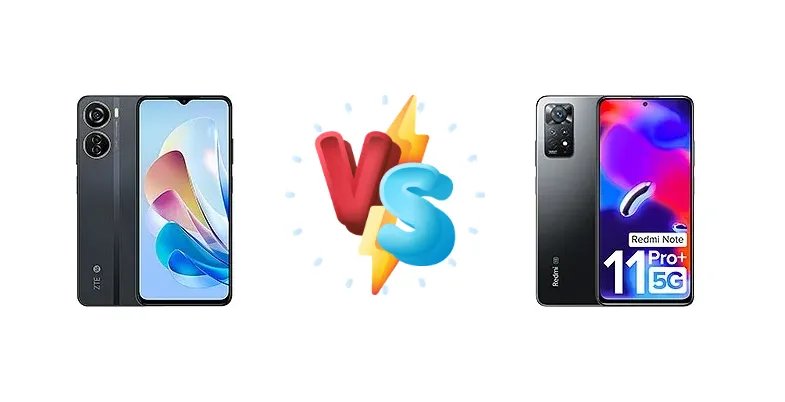
The ZTE Blade V41 Vita and Xiaomi Redmi Note 11 Pro+ 5G (India) represent compelling options in the increasingly competitive mid-range 5G smartphone market. While both aim to deliver a connected experience without breaking the bank, they take distinctly different approaches to chipset choice and charging technology, creating a clear divergence in user experience. This comparison dives deep into the specifics to determine which device offers the best value.
🏆 Quick Verdict
For the average user prioritizing rapid charging and a generally smoother experience, the Xiaomi Redmi Note 11 Pro+ 5G (India) is the better choice. Its 67W charging significantly outperforms the ZTE Blade V41 Vita’s 22.5W, and the Snapdragon 695 offers a more refined performance profile despite the similar 6nm fabrication process.
| Network |
|---|
| 2G bands | GSM 850 / 900 / 1800 / 1900 | GSM 850 / 900 / 1800 / 1900 - SIM 1 & SIM 2 |
| 3G bands | HSDPA 850 / 900 / 1900 / 2100 - V1 | HSDPA 850 / 900 / 1900 / 2100 |
| 4G bands | 1, 2, 3, 5, 7, 8, 20, 28, 38, 40, 41 - V1 | 1, 3, 5, 8, 40, 41 |
| 5G bands | 1, 3, 5, 7, 8, 20, 28, 38, 40, 41, 77, 78 SA/NSA - V1 | 1, 3, 5, 8, 28, 40, 78 SA/NSA |
| Speed | HSPA, LTE, 5G | HSPA, LTE-A (CA), 5G |
| Technology | GSM / HSPA / LTE / 5G | GSM / HSPA / LTE / 5G |
| | 2, 7, 28, 40, 66, 78 SA/NSA - V2 | - |
| Launch |
|---|
| Announced | 2022, December 07 | 2022, March 09 |
| Status | Available. Released 2022, December 23 | Available. Released 2022, March 15 |
| Body |
|---|
| Build | - | Glass front (Gorilla Glass 5), glass back |
| Dimensions | - | 164.2 x 76.1 x 8.1 mm (6.46 x 3.00 x 0.32 in) |
| SIM | Nano-SIM + Nano-SIM | Hybrid Dual SIM (Nano-SIM, dual stand-by) |
| Weight | - | 202 g (7.13 oz) |
| | - | IP53, dust and splash resistant |
| Display |
|---|
| Protection | - | Corning Gorilla Glass 5 |
| Resolution | 1080 x 2408 pixels, 20:9 ratio (~400 ppi density) | 1080 x 2400 pixels, 20:9 ratio (~395 ppi density) |
| Size | 6.6 inches, 104.9 cm2 | 6.67 inches, 107.4 cm2 (~86.0% screen-to-body ratio) |
| Type | IPS LCD, 90Hz | Super AMOLED, 120Hz, 700 nits, 1200 nits (peak) |
| Platform |
|---|
| CPU | Octa-core (2x2.4 GHz Cortex-A76 & 6x2.0 GHz Cortex-A55) | Octa-core (2x2.2 GHz Kryo 660 Gold & 6x1.7 GHz Kryo 660 Silver) |
| Chipset | Mediatek Dimensity 810 (6 nm) | Qualcomm SM6375 Snapdragon 695 5G (6 nm) |
| GPU | Mali-G57 MC2 | Adreno 619 |
| OS | Android 12, MyOS 12 | Android 11, MIUI 13 |
| Memory |
|---|
| Card slot | microSDXC (dedicated slot) | microSDXC (uses shared SIM slot) |
| Internal | 128GB 6GB RAM | 64GB 6GB RAM, 128GB 6GB RAM, 128GB 8GB RAM, 256GB 8GB RAM |
| | UFS 2.2 | UFS 2.2 |
| Main Camera |
|---|
| Features | LED flash, HDR, panorama | LED flash, HDR, panorama |
| Single | 8 MP, (wide) | - |
| Triple | 50 MP, f/1.8, (wide), PDAF
2 MP (macro)
Auxiliary lens | 108 MP, f/1.9, 26mm (wide), 1/1.52", 0.7µm, PDAF
8 MP, f/2.2, 118˚ (ultrawide)
2 MP, f/2.4, (macro) |
| Video | 1080p@30fps | 1080p@30fps |
| Selfie camera |
|---|
| Single | 8 MP, (wide) | 16 MP, f/2.5, (wide), 1/3.06" 1.0µm |
| Video | 1080p@30fps | 1080p@30fps |
| Sound |
|---|
| 3.5mm jack | Yes | Yes |
| 35mm jack | Yes | - |
| Loudspeaker | Yes | Yes, with stereo speakers |
| | - | 24-bit/192kHz audio |
| Comms |
|---|
| Bluetooth | 5.0, A2DP, LE | 5.1, A2DP, LE |
| Infrared port | - | Yes |
| NFC | Yes | No |
| Positioning | GPS | GPS, GLONASS, BDS, GALILEO |
| Radio | Unspecified | Unspecified |
| USB | USB Type-C 2.0, OTG | USB Type-C 2.0, OTG |
| WLAN | Wi-Fi 802.11 a/b/g/n/ac/6, dual-band | Wi-Fi 802.11 a/b/g/n/ac, dual-band, Wi-Fi Direct |
| Features |
|---|
| Sensors | Fingerprint (side-mounted), accelerometer, proximity | Fingerprint (side-mounted), accelerometer, gyro, proximity, compass |
| Battery |
|---|
| Charging | 22.5W wired | 67W wired, PD3.0, QC3, 50% in 15 min, 100% in 42 min (advertised) |
| Type | Li-Po 4500 mAh | Li-Po 5000 mAh, non-removable |
| Misc |
|---|
| Colors | Starry Black | Mirage Blue, Phantom White, Stealth Black |
| Models | 8140N | 2201116SI |
| Price | About 300 EUR | About 250 EUR |
ZTE Blade V41 Vita
- Potentially lower price point
- Decent performance for basic tasks
- 5G connectivity
- Slow 22.5W charging
- Likely less refined software experience
- Potentially weaker camera system
Xiaomi Redmi Note 11 Pro+ 5G (India)
- Significantly faster 67W charging
- More optimized Snapdragon 695 chipset
- Likely better camera performance
- Potentially higher price
- May not offer substantial gaming performance gains
- Software bloat (typical of Xiaomi)
Display Comparison
Neither device's display specifications are provided, so a direct comparison is limited. However, given the market positioning, we can infer that both likely utilize LCD panels. The Redmi Note 11 Pro+ 5G, being a slightly higher-tier device, may benefit from a higher peak brightness and potentially better color calibration. The absence of LTPO technology on either suggests standard refresh rate implementations, likely 60Hz or 90Hz.
Camera Comparison
Without detailed camera specs, a precise comparison is difficult. However, the Redmi Note 11 Pro+ 5G (India) is likely to feature a more sophisticated camera system, potentially including a larger main sensor and optical image stabilization (OIS). The ZTE Blade V41 Vita will likely rely on software processing to compensate for a potentially less capable sensor. The presence of a 2MP macro camera on either device is largely a marketing tactic and offers limited practical benefit.
Performance
The core difference lies in the chipsets: the ZTE Blade V41 Vita features the Mediatek Dimensity 810, while the Xiaomi Redmi Note 11 Pro+ 5G (India) uses the Qualcomm Snapdragon 695 5G. Both are 6nm chips, but the Snapdragon 695’s Kryo 660 Gold cores, clocked at 2.2 GHz, offer a slight edge over the Dimensity 810’s 2.4 GHz Cortex-A76 cores. While clock speed isn't everything, Qualcomm’s architectural optimizations and software integration generally translate to a smoother experience, particularly in sustained workloads. The Dimensity 810’s Cortex-A55 efficiency cores are clocked slightly higher at 2.0 GHz versus the Snapdragon’s 1.7 GHz, but this difference is unlikely to be noticeable in most real-world scenarios. RAM speed is not specified, but both likely utilize LPDDR4X to keep costs down.
Battery Life
The Xiaomi Redmi Note 11 Pro+ 5G (India) boasts a significant advantage with its 67W wired charging, capable of reaching 50% charge in just 15 minutes and 100% in 42 minutes (advertised). The ZTE Blade V41 Vita’s 22.5W charging is considerably slower. While battery capacity isn’t specified, the faster charging of the Redmi Note 11 Pro+ 5G mitigates the impact of a potentially smaller battery, offering more convenient top-ups throughout the day.
Buying Guide
Buy the ZTE Blade V41 Vita if you need a functional 5G phone with a decent processor for everyday tasks and aren't overly concerned with fast charging or peak performance. Buy the Xiaomi Redmi Note 11 Pro+ 5G (India) if you prioritize quick top-ups, a more responsive user interface, and a slightly more capable chipset for light gaming and multitasking.
Frequently Asked Questions
❓ Will the Snapdragon 695 in the Redmi Note 11 Pro+ 5G handle demanding games like PUBG Mobile?
The Snapdragon 695 is capable of running PUBG Mobile, but likely at medium settings to maintain a stable frame rate. It's not a gaming-focused chipset, so don't expect flagship-level performance. The Dimensity 810 in the ZTE Blade V41 Vita will offer similar gaming performance.
❓ How long will it realistically take to fully charge the ZTE Blade V41 Vita with its 22.5W charger?
Given the 22.5W charging speed, a full charge from 0% on the ZTE Blade V41 Vita will likely take well over 1.5 to 2 hours, depending on battery capacity. This is significantly slower than the Redmi Note 11 Pro+ 5G's advertised 42-minute charge time.
❓ Does the Xiaomi Redmi Note 11 Pro+ 5G (India) support carrier aggregation for improved 5G speeds?
The Snapdragon 695 supports carrier aggregation, which allows the phone to combine multiple 5G channels for faster data speeds. However, actual speeds will depend on your carrier's network and support for carrier aggregation in your area.