
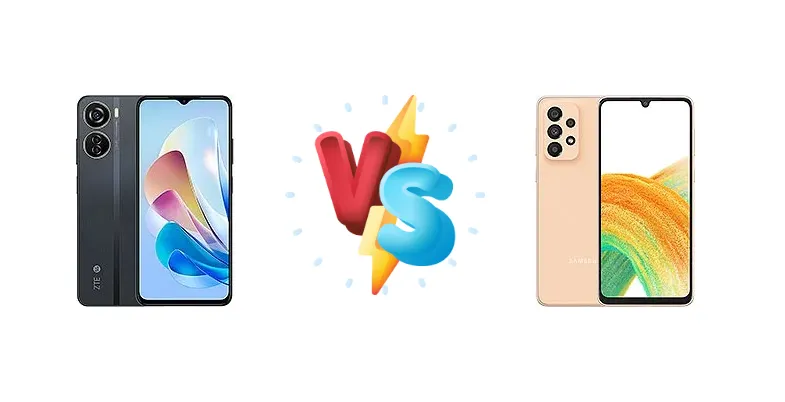
ZTE Blade V41 Vita vs Samsung Galaxy A33 5G: A Detailed Comparison
| Phones Images | |||||
|---|---|---|---|---|---|
|
🏆 Quick Verdict
For the average user prioritizing a brighter, more vibrant display and established brand reliability, the Samsung Galaxy A33 5G is the better choice. However, the ZTE Blade V41 Vita’s newer Mediatek Dimensity 810 chipset offers a potential edge in raw processing power for demanding tasks, making it a strong contender for budget-conscious gamers.
| PHONES | ||
|---|---|---|
| Phone Names | ZTE Blade V41 Vita | Samsung Galaxy A33 5G |
| Network | ||
|---|---|---|
| 2G bands | GSM 850 / 900 / 1800 / 1900 | GSM 850 / 900 / 1800 / 1900 |
| 3G bands | HSDPA 850 / 900 / 1900 / 2100 - V1 | HSDPA 850 / 900 / 1700(AWS) / 1900 / 2100 |
| 4G bands | 1, 2, 3, 5, 7, 8, 20, 28, 38, 40, 41 - V1 | 1, 2, 3, 4, 5, 7, 8, 12, 17, 20, 26, 28, 32, 38, 40, 41, 66 |
| 5G bands | 1, 3, 5, 7, 8, 20, 28, 38, 40, 41, 77, 78 SA/NSA - V1 | 1, 3, 5, 7, 8, 20, 28, 38, 40, 41, 66, 78 SA/NSA/Sub6 |
| Speed | HSPA, LTE, 5G | HSPA, LTE, 5G |
| Technology | GSM / HSPA / LTE / 5G | GSM / HSPA / LTE / 5G |
| 2, 7, 28, 40, 66, 78 SA/NSA - V2 | - | |
| Launch | ||
|---|---|---|
| Announced | 2022, December 07 | 2022, March 17 |
| Status | Available. Released 2022, December 23 | Available. Released 2022, April 20 |
| Body | ||
|---|---|---|
| Build | - | Glass front (Gorilla Glass 5), plastic frame, plastic back |
| Dimensions | - | 159.7 x 74 x 8.1 mm (6.29 x 2.91 x 0.32 in) |
| SIM | Nano-SIM + Nano-SIM | · Nano-SIM· Nano-SIM + Nano-SIM |
| Weight | - | 186 g (6.56 oz) |
| - | IP67 dust/water resistant (up to 1m for 30 min) | |
| Display | ||
|---|---|---|
| Protection | - | Corning Gorilla Glass 5 |
| Resolution | 1080 x 2408 pixels, 20:9 ratio (~400 ppi density) | 1080 x 2400 pixels, 20:9 ratio (~411 ppi density) |
| Size | 6.6 inches, 104.9 cm2 | 6.4 inches, 98.9 cm2 (~83.7% screen-to-body ratio) |
| Type | IPS LCD, 90Hz | Super AMOLED, 90Hz |
| Platform | ||
|---|---|---|
| CPU | Octa-core (2x2.4 GHz Cortex-A76 & 6x2.0 GHz Cortex-A55) | Octa-core (2x2.4 GHz Cortex-A78 & 6x2.0 GHz Cortex-A55) |
| Chipset | Mediatek Dimensity 810 (6 nm) | Exynos 1280 (5 nm) |
| GPU | Mali-G57 MC2 | Mali-G68 |
| OS | Android 12, MyOS 12 | Android 12, up to 4 major Android upgrades, One UI 8 |
| Memory | ||
|---|---|---|
| Card slot | microSDXC (dedicated slot) | microSDXC (uses shared SIM slot) |
| Internal | 128GB 6GB RAM | 128GB 4GB RAM, 128GB 6GB RAM, 128GB 8GB RAM, 256GB 8GB RAM |
| UFS 2.2 | - | |
| Main Camera | ||
|---|---|---|
| Features | LED flash, HDR, panorama | LED flash, panorama, HDR |
| Quad | - | 48 MP, f/1.8, 26mm (wide), 1/2.0", 0.8µm, PDAF, OIS 8 MP, f/2.2, 123˚, (ultrawide), 1/4.0", 1.12µm 5 MP (macro) Auxiliary lens |
| Single | 8 MP, (wide) | 13 MP, f/2.2, (wide), 1/3.1", 1.12µm |
| Triple | 50 MP, f/1.8, (wide), PDAF 2 MP (macro) Auxiliary lens | - |
| Video | 1080p@30fps | 4K@30fps, 1080p@30/60fps |
| Selfie camera | ||
|---|---|---|
| Single | 8 MP, (wide) | 13 MP, f/2.2, (wide), 1/3.1", 1.12µm |
| Video | 1080p@30fps | 4K@30fps, 1080p@30fps |
| Sound | ||
|---|---|---|
| 3.5mm jack | Yes | No |
| 35mm jack | Yes | No |
| Loudspeaker | Yes | Yes, with stereo speakers |
| Comms | ||
|---|---|---|
| Bluetooth | 5.0, A2DP, LE | 5.1, A2DP, LE |
| NFC | Yes | Yes (market/region dependent) |
| Positioning | GPS | GPS, GLONASS, GALILEO, BDS |
| Radio | Unspecified | No |
| USB | USB Type-C 2.0, OTG | USB Type-C 2.0, OTG |
| WLAN | Wi-Fi 802.11 a/b/g/n/ac/6, dual-band | Wi-Fi 802.11 a/b/g/n/ac, dual-band, Wi-Fi Direct |
| Features | ||
|---|---|---|
| Sensors | Fingerprint (side-mounted), accelerometer, proximity | Fingerprint (under display, optical), accelerometer, gyro, compass |
| - | Virtual proximity sensing | |
| Battery | ||
|---|---|---|
| Charging | 22.5W wired | 25W wired |
| Type | Li-Po 4500 mAh | Li-Po 5000 mAh |
| Misc | ||
|---|---|---|
| Colors | Starry Black | Black, White, Blue, Peach |
| Models | 8140N | SM-A336E, SM-A336B, SM-A336B/DS, SM-A336B/DSN, SM-A336E/DS, SM-A336M, SM-A3360 |
| Price | About 300 EUR | £ 174.99 / € 187.50 / ₹ 21,999 |
| SAR | - | 0.35 W/kg (head) |
| SAR EU | - | 0.57 W/kg (head) 1.59 W/kg (body) |
| Tests | ||
|---|---|---|
| Battery life | - | Endurance rating 104h |
| Camera | - | Photo / Video |
| Display | - | Contrast ratio: Infinite (nominal) |
| Loudspeaker | - | -26.5 LUFS (Good) |
| Performance | - | AnTuTu: 354420 (v8), 394918 (v9) GeekBench: 1900 (v5.1) GFXBench: 20fps (ES 3.1 onscreen) |
ZTE Blade V41 Vita
- Newer Mediatek Dimensity 810 chipset offers potential performance advantages.
- Competitive 22.5W fast charging.
- Potentially lower price point.
- Display brightness likely lower than the Samsung A33 5G.
- Less established brand reputation and software support.
- Camera system likely less sophisticated.
Samsung Galaxy A33 5G
- Brighter 728 nit display for better outdoor visibility.
- More refined software experience with Samsung’s One UI.
- Likely superior camera system with OIS.
- Older Exynos 1280 chipset may throttle under sustained load.
- Potentially higher price point.
- Charging speed only marginally faster.
Display Comparison
The Samsung Galaxy A33 5G boasts a significantly brighter display, reaching a measured 728 nits, compared to an unspecified brightness for the ZTE Blade V41 Vita. This higher peak brightness translates to better outdoor visibility. While both phones likely utilize AMOLED panels (based on Samsung’s typical implementation and market trends for this price point), the A33’s ‘Infinite’ contrast ratio suggests a more optimized panel with deeper blacks. The lack of refresh rate information for the V41 Vita is a drawback; the A33’s likely 90Hz panel (common for this model) provides a smoother scrolling experience.
Camera Comparison
Both devices offer ‘Photo/Video’ capabilities, but detailed camera specifications are scarce. The Samsung Galaxy A33 5G likely features a more sophisticated camera system, leveraging Samsung’s image processing expertise. While both phones likely include a primary sensor, the A33’s sensor size is expected to be larger, capturing more light and resulting in better low-light performance. The inclusion of Optical Image Stabilization (OIS) on the A33 (a common feature in this range) would further enhance image quality, particularly in videos. The V41 Vita’s camera system is likely more basic, focusing on providing adequate image quality for social media sharing.
Performance
The core difference lies in the chipsets: the ZTE Blade V41 Vita features the Mediatek Dimensity 810 (6nm), while the Samsung Galaxy A33 5G utilizes the Exynos 1280 (5nm). Although both CPUs feature a 2x2.4 GHz Cortex-A76/A78 and 6x2.0 GHz Cortex-A55 configuration, the Exynos 1280’s 5nm process node offers superior power efficiency and potentially better sustained performance under load. However, the Dimensity 810 is a newer chip, potentially benefiting from architectural improvements. The V41 Vita’s 6nm process is still efficient, but the A33’s 5nm node gives it an edge in thermal management, reducing the likelihood of throttling during extended gaming sessions. RAM specifications are missing for both, but LPDDR4X is likely on both devices.
Battery Life
Both the ZTE Blade V41 Vita and Samsung Galaxy A33 5G achieve an endurance rating of 104 hours, suggesting comparable battery life in typical usage scenarios. The A33 5G supports 25W wired charging, slightly faster than the V41 Vita’s 22.5W charging. While the difference isn’t massive, it translates to a quicker top-up time. The comparable endurance ratings suggest that software optimization and power efficiency of the respective chipsets play a significant role in battery performance, offsetting any differences in battery capacity (which is not specified for either device).
Buying Guide
Buy the ZTE Blade V41 Vita if you need a phone primarily for gaming and multitasking, and are comfortable with a less-refined software experience. The Dimensity 810’s architecture provides a performance boost for the price. Buy the Samsung Galaxy A33 5G if you prioritize a brighter, more color-accurate display, a more polished user interface, and the peace of mind that comes with Samsung’s established software support and brand reputation.