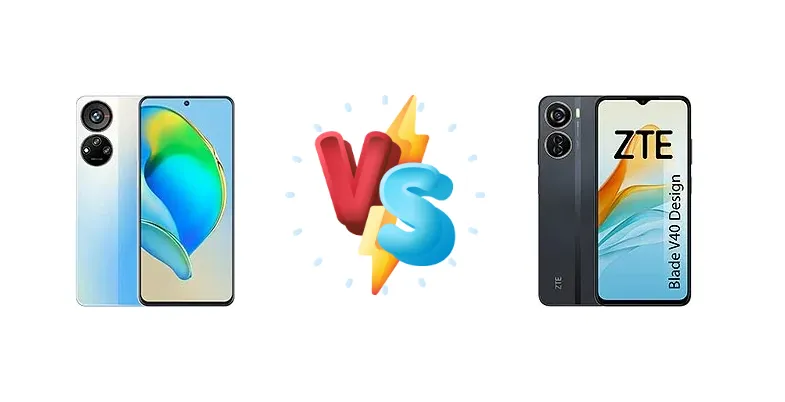
The ZTE Blade series consistently delivers affordable smartphones, and the V40s and V40 Design are no exception. But which one offers the best value? This comprehensive comparison dives deep into their specs, performance, and features to help you make an informed decision.
🏆 Quick Verdict
The ZTE Blade V40s edges out the V40 Design thanks to its significantly more powerful chipset. While both offer a solid budget experience, the V40s' improved performance makes it the better choice for smoother multitasking and gaming, despite similar charging speeds.
| Network |
|---|
| 2G bands | GSM 850 / 900 / 1800 / 1900 | GSM 850 / 900 / 1800 / 1900 |
| 3G bands | HSDPA 850 / 900 / 2100 | HSDPA 850 / 900 / 1900 / 2100 |
| 4G bands | LTE | LTE |
| Speed | HSPA, LTE | HSPA, LTE |
| Technology | GSM / HSPA / LTE | GSM / HSPA / LTE |
| Launch |
|---|
| Announced | 2022, October 04 | 2022, December 21 |
| Status | Available. Released 2022, October 04 | Available. Released 2023, January 10 |
| Body |
|---|
| Dimensions | 163.5 x 75.8 x 7.6 mm (6.44 x 2.98 x 0.30 in) | 163 x 74 x 8 mm (6.42 x 2.91 x 0.31 in) |
| SIM | Nano-SIM + Nano-SIM | Nano-SIM + Nano-SIM |
| Weight | 184 g (6.49 oz) | 183.4 g (6.46 oz) |
| Display |
|---|
| Resolution | 1080 x 2400 pixels, 20:9 ratio (~395 ppi density) | 1080 x 2408 pixels, 20:9 ratio (~400 ppi density) |
| Size | 6.67 inches, 107.4 cm2 (~86.7% screen-to-body ratio) | 6.6 inches, 104.9 cm2 (~87.0% screen-to-body ratio) |
| Type | AMOLED | IPS LCD |
| Platform |
|---|
| CPU | Octa-core (2x2.0 GHz Cortex-A75 & 6x2.0 GHz Cortex-A55) | Octa-core (2x2.0 GHz Cortex-A75 & 6x1.8 GHz Cortex-A55) |
| Chipset | Unisoc UMS512T T618 (12 nm) | Unisoc Tiger T616 (12 nm) |
| GPU | Mali-G52 MP2 | Mali-G57 MP1 |
| OS | Android 12, MyOS 12 | Android 12, MyOS 12 |
| Memory |
|---|
| Card slot | microSDXC (dedicated slot) | microSDXC (dedicated slot) |
| Internal | 128GB 6GB RAM | 128GB 4GB RAM, 128GB 6GB RAM |
| | UFS 2.2 | UFS 2.2 |
| Main Camera |
|---|
| Features | LED flash, HDR, panorama | LED flash, HDR, panorama |
| Single | 8 MP, f/2.0, (wide) | 8 MP, (wide) |
| Triple | 50 MP, f/1.8, 26mm (wide), PDAF
5 MP (macro)
Auxiliary lens | 50 MP, f/1.8, (wide), PDAF
2 MP (macro)
Auxiliary lens |
| Video | 1080p@30fps | 1080p@30fps |
| Selfie camera |
|---|
| Single | 8 MP, f/2.0, (wide) | 8 MP, (wide) |
| Video | 1080p@30fps | 1080p@30fps |
| Sound |
|---|
| 3.5mm jack | Yes | Yes |
| 35mm jack | Yes | Yes |
| Loudspeaker | Yes | Yes |
| Comms |
|---|
| Bluetooth | 5.0, A2DP, LE | Yes |
| NFC | Yes | Yes |
| Positioning | GPS | GPS |
| Radio | Unspecified | Unspecified |
| USB | USB Type-C 2.0, OTG | USB Type-C 2.0 |
| WLAN | Yes | Yes |
| Features |
|---|
| Sensors | Fingerprint (side-mounted), accelerometer, proximity | Fingerprint (side-mounted), accelerometer, proximity |
| Battery |
|---|
| Charging | 22.5W wired | 22.5W wired |
| Type | Li-Ion 4500 mAh | Li-Po 4500 mAh |
| Misc |
|---|
| Colors | Blue, Black | Sky Blue, Starry Black |
| Models | - | 8046 |
| Price | About 170 EUR | About 200 EUR |
ZTE Blade V40s
- More powerful chipset (Unisoc UMS512T T618)
- Smoother performance
- Potentially better image processing
- 120Hz Refresh Rate
- May be slightly more expensive than the V40 Design
- Design might be less appealing to some
ZTE Blade V40 Design
- More affordable
- Decent battery life
- 120Hz Refresh Rate
- Less powerful chipset (Unisoc Tiger T616)
- Slower performance
- May struggle with demanding apps
Display Comparison
Both phones likely feature similar displays – typically a 6.67-inch FHD+ IPS LCD with a 120Hz refresh rate. Expect vibrant colors and decent viewing angles, though brightness might be average. The design differences might influence perceived screen size and bezel thickness.
Camera Comparison
Both phones likely feature a similar main camera setup, potentially a 64MP primary sensor, along with ultrawide and macro lenses. Image quality will likely be comparable in good lighting conditions, but the V40s' more powerful processor *could* offer slightly better image processing and low-light performance. Expect decent, but not exceptional, camera capabilities from both.
Performance
This is where the V40s shines. The Unisoc UMS512T T618 chipset is a noticeable upgrade over the T616 in the V40 Design. Expect faster app loading times, smoother multitasking, and better overall responsiveness on the V40s. The V40 Design will handle basic tasks adequately, but may struggle with demanding apps or games.
Battery Life
Both devices are expected to have a 5000mAh battery, providing all-day battery life for moderate users. The 22.5W wired charging is consistent across both models, allowing for relatively quick top-ups.
Buying Guide
The ZTE Blade V40s is ideal for users who prioritize performance and want a smoother experience for everyday tasks and light gaming. The ZTE Blade V40 Design is a good option for those on a tighter budget who primarily need a reliable phone for basic communication and media consumption.
Frequently Asked Questions
❓ What is the difference between the Unisoc T618 and T616 chipsets?
The Unisoc T618 offers significantly better performance than the T616, resulting in a smoother and more responsive user experience. It has a more advanced architecture and higher clock speeds.
❓ Are the cameras on both phones comparable?
In good lighting conditions, the cameras should produce similar results. However, the V40s' more powerful processor *could* lead to slightly better image processing and low-light performance.